Recombinant Porphyromonas gingivalis Major fimbrium subunit FimA type-1 (fimA)

Recombinant Porphyromonas gingivalis Major fimbrium subunit FimA type-1 (fimA) — Structural subunit of the major fimbriae. Purity >85%.

SKU: BCRECP-002743 Category:

Product Specifications

Product SkuBCRECP-002743
Product DescriptionRecombinant Porphyromonas gingivalis Major fimbrium subunit FimA type-1 (fimA) Protein is expressed from E.coli with N-terminal 10xHis-tagged and C-terminal Myc-tagged. It contains 47-383aa. [Accession | B2RH54].
Uniprot No.B2RH54
Gene NamesfimA
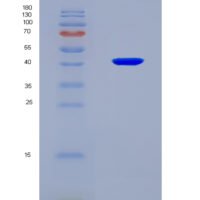
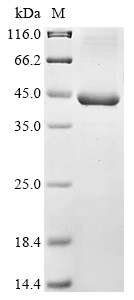
PurityGreater than 85% as determined by SDS-PAGE.
Expression SystemE.coli
Expression Region47-383aa
SpeciesPorphyromonas gingivalis (strain ATCC 33277 / DSM 20709 / CIP 103683 / JCM 12257 / NCTC 11834 / 2561)
Tag InfoN-terminal 10xHis-tagged and C-terminal Myc-tagged
Molecular weight43.9kDa
ActivityPlease contact us to obtain bioactivity data.
BufferIf the delivery form is liquid, the default storage buffer is Tris/PBS-based buffer, 5%-50% glycerol. If the delivery form is lyophilized powder, the buffer before lyophilization is Tris/PBS-based buffer, 6% Trehalose.
StorageStore at -20°C/-80°C upon receipt, aliquoting is necessary for mutiple use. Avoid repeated freeze-thaw cycles.
Research AreasOthers

Function

Structural subunit of the major fimbriae. These long, filamentous pili are attached to the cell surface; they mediate biofilm formation, adhesion onto host cells and onto other bacteria that are part of the oral microbiome. They play an important role in the invasion of periodontal tissues.

Biological Context

Subcellular Location: Fimbrium; Cell outer membrane

Product Specifications

Recombinant Porphyromonas gingivalis Major fimbrium subunit FimA type-1 (fimA) is a recombinant protein from Porphyromonas gingivalis (strain ATCC 33277 / DSM 20709 / CIP 103683 / JCM 12257 / NCTC 11834 / 2561), expressed in E.coli, covering amino acids 47-383aa, with N-terminal 10xHis-tagged and C-terminal Myc-tagged tag, molecular weight 43.9kDa, purity Greater than 85% as determined by SDS-PAGE.. Suitable for ELISA and Western Blot applications.
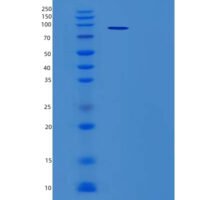
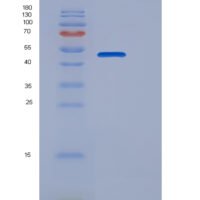
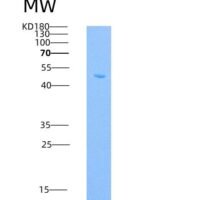
SDS-PAGE: Single band at expected molecular weight confirming purity.

ELISA: Suitable as coating antigen or detection standard.

Western Blot: Compatible with standard Western Blot protocols.

Protein Interaction: Validated for SPR (Surface Plasmon Resonance) and BLI (Bio-Layer Interferometry) studies.

Shipping: Shipped at ambient temperature. Lyophilized protein is stable during transit.

Storage: Store lyophilized protein at -20°C to -80°C. Reconstituted protein should be aliquoted and stored at -80°C. Avoid repeated freeze-thaw cycles.

Shelf Life: 12 months from date of receipt when stored as recommended.

Shipping Time: Orders placed before 2 PM EST ship same day. International orders typically deliver within 5-10 business days.

Protein Biology

Function

Structural subunit of the major fimbriae. These long, filamentous pili are attached to the cell surface; they mediate biofilm formation, adhesion onto host cells and onto other bacteria that are part of the oral microbiome (PubMed:12593606, PubMed:15165251, PubMed:17526848, PubMed:17675496, PubMed:20530728, PubMed:27062925, PubMed:9786913). They play an important role in the invasion of periodontal tissues (PubMed:12593606). Fimbriae and their constituents are major virulence factors. FimA proteins from different strains have highly divergent sequences, and this has been used for classification (PubMed:23809984). The sequence-based classification correlates with pathogenicity (PubMed:17675496)

Subcellular Location

Fimbrium; Cell outer membrane

Subunit

Fimbriae are composed of a major, structural subunit (FimA) and the minor components FimC, FimD and FimE (PubMed:17526848, PubMed:17675496). Head-to-tail oligomerization of FimA molecules mediates assembly of the fimbrium stalk, while the minor components probably form the fimbrium tip. Linear, head-to-tail oligomerization of FimA is mediated by a conformation change, facilitating the insertion of a C-terminal beta-strand into a groove in the N-terminal domain of the following subunit (By similarity). The anchoring subunit FimB limits fimbrium length and is important for solid fimbrium attachment to the outer membrane. In its absence, the major fimbriae become very long and are easily detached from the membrane (PubMed:27062925)

Gene: fimA  |  Organism: Porphyromonas gingivalis (strain ATCC 33277 / DSM 20709 / CIP 103683 / JCM 12257 / NCTC 11834 / 2561)  |  Synonyms: Fimbrillin; Major fimbrial subunit protein type I
Key Publications

Frequently Asked Questions

How do I order or inquire about this product?

Fill out the Online Inquiry form with your required quantity and specifications. You can also email sales@biocrestsci.com. Our team typically responds within 4 business hours with a quote and availability confirmation.

What is the shipping and delivery time?

Orders placed before 2 PM EST ship the same day. Domestic (US) delivery typically takes 2-3 business days. International orders deliver within 5-10 business days. All products are shipped at ambient temperature with appropriate packaging to ensure stability.

How should I store this recombinant protein?

Lyophilized proteins should be stored at -20°C to -80°C upon receipt. After reconstitution, aliquot and store at -80°C. Avoid repeated freeze-thaw cycles. Shelf life is 12 months from date of receipt when stored as recommended.

What quality controls are performed on your products?

Each product undergoes SDS-PAGE purity analysis (typically >85-95%), endotoxin testing, and bioactivity validation. Products are validated for ELISA, Western Blot, and SPR/BLI applications as specified on this product page. A Certificate of Analysis (CoA) is available upon request.

Shopping Cart
Scroll to Top