
NON-GMP RESEARCH SERVICE
Yeast Protein Expression Service
BioCrestSci provides non-GMP yeast protein expression for research proteins that can benefit from microbial scalability, secretion and selected eukaryotic processing. The workflow covers construct planning, Pichia transformation and clone screening, small-scale expression, basic purification and defined quality-control reporting.
A DECISION-READY WORKFLOW
Why Choose BioCrestSci
Clone and secretion focused planning
Promoter choice, integration strategy, secretion signal, strain compatibility and downstream recovery are reviewed for the target.
Evidence driven clone selection
Transformation, positive-clone screening and small-scale expression are treated as separate decisions so productive clones can be selected before additional work.
Purification and basic QC included
The $4,680 package includes basic protein purification and the listed basic QC scope. SEC polishing, specialized endotoxin control and functional assays are optional.
FROM CONSTRUCT TO CHARACTERIZATION
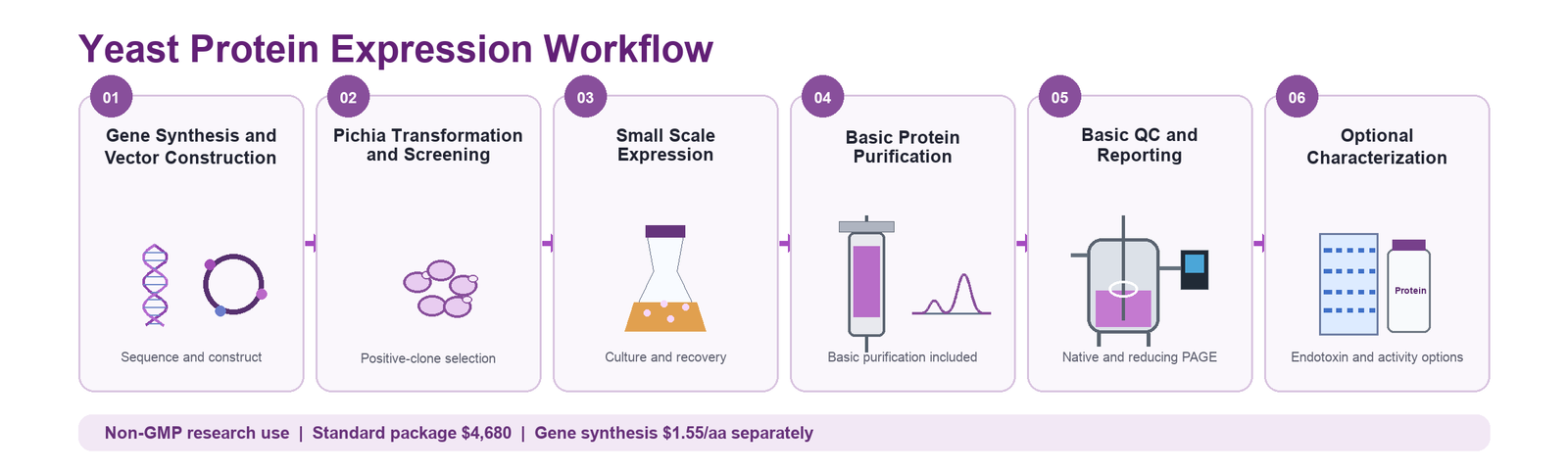
Six-Stage Yeast Protein Expression Workflow
SCOPE, DELIVERABLES AND PRICING
Stage 01–06 Technical Details
The standard package covers Stages 02–05. Stage 01 gene synthesis and Stage 06 options are separate. Final scope is confirmed after technical assessment.
Gene Synthesis and Vector Construction
Description
Prepare a yeast-compatible expression construct with an agreed promoter, secretion signal or intracellular format and affinity tag.
Key Considerations
- Coding-region accuracy
- promoter and integration strategy
- secretion signal
- tag placement
- reading frame
- strain compatibility.
Deliverables
Expression-ready construct and sequence or vector documentation.
Price
$1.55/aa, charged separately
Pichia Transformation and Clone Screening
Description
Introduce the expression construct into Pichia, recover transformants and screen positive candidates for downstream expression work.
Key Considerations
- Transformation recovery
- integration or construct verification where appropriate
- clone identity
- secretion
- productivity
- selection design.
Deliverables
Positive Pichia clone candidates and screening information.
Price
$4,000
Small Scale Expression
Description
Culture selected clones under an agreed induction or feed plan and assess recombinant protein recovery.
Key Considerations
- Medium and induction strategy
- biomass
- pH and oxygen needs
- harvest timing
- extracellular versus intracellular recovery
- glycosylation sensitivity.
Deliverables
Small-scale expression result and selected clone or culture condition.
Price
$380
Basic Protein Purification
Description
Recover the target from culture supernatant or cell fraction and apply a target-compatible basic affinity-purification route.
Key Considerations
- Clarification or lysis
- tag accessibility
- host-cell components
- proteolysis
- buffer stability
- purification recovery.
Deliverables
Basic purified protein fraction and documented recovery conditions.
Price
Included in the $4,680 package; no separate basic purification fee
Basic Quality Control and Reporting
Description
Evaluate the purified material by native PAGE, reducing SDS-PAGE and standard project reporting.
Key Considerations
- Apparent molecular mass
- oligomeric behavior
- host-dependent heterogeneity
- concentration
- stability
- intended-use criteria.
Deliverables
Native PAGE, reducing SDS-PAGE and standard COA or study report.
Price
$300 subtotal: Native PAGE $75; reducing SDS-PAGE $75; report $150
Optional Characterization and Process Add Ons
Description
Add polishing, endotoxin-control or activity work according to the target and downstream experiment.
Key Considerations
- Protein recovery after polishing
- host-specific glycan patterns
- assay controls
- analytical sensitivity
- numerical acceptance criteria.
Deliverables
Optional Endotoxin Removal, quotation upon request, target <0.1 EU/µg; Bioactivity Measurement, quoted by assay scope; SEC polishing, buffer exchange or tag cleavage when appropriate.
Price
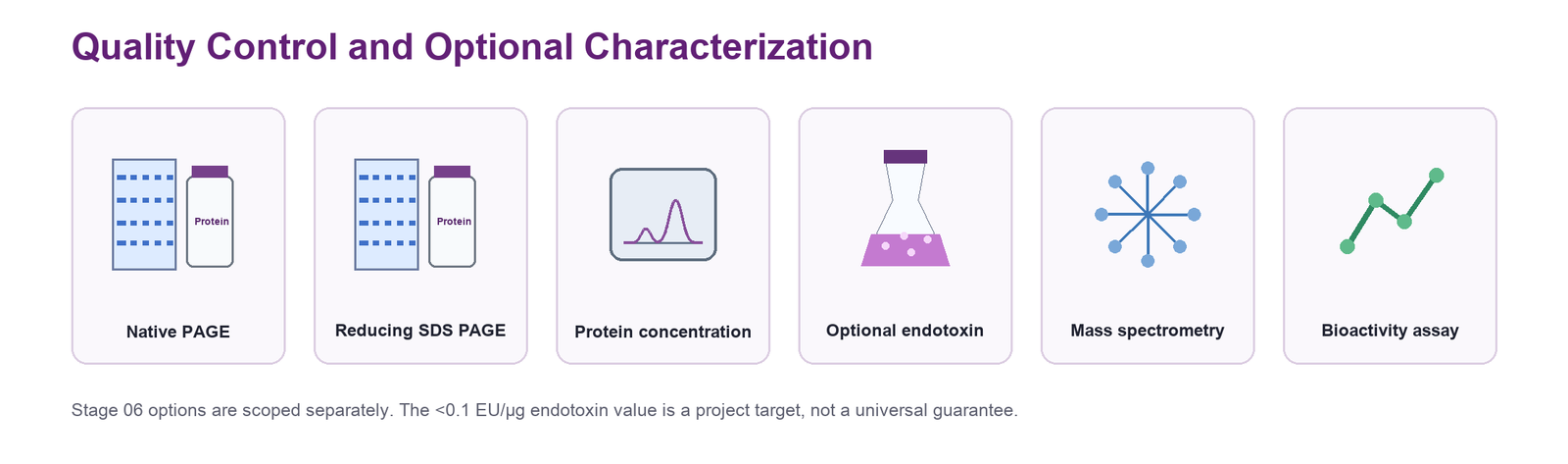
Quoted separately; <0.1 EU/µg is a target and is not guaranteed
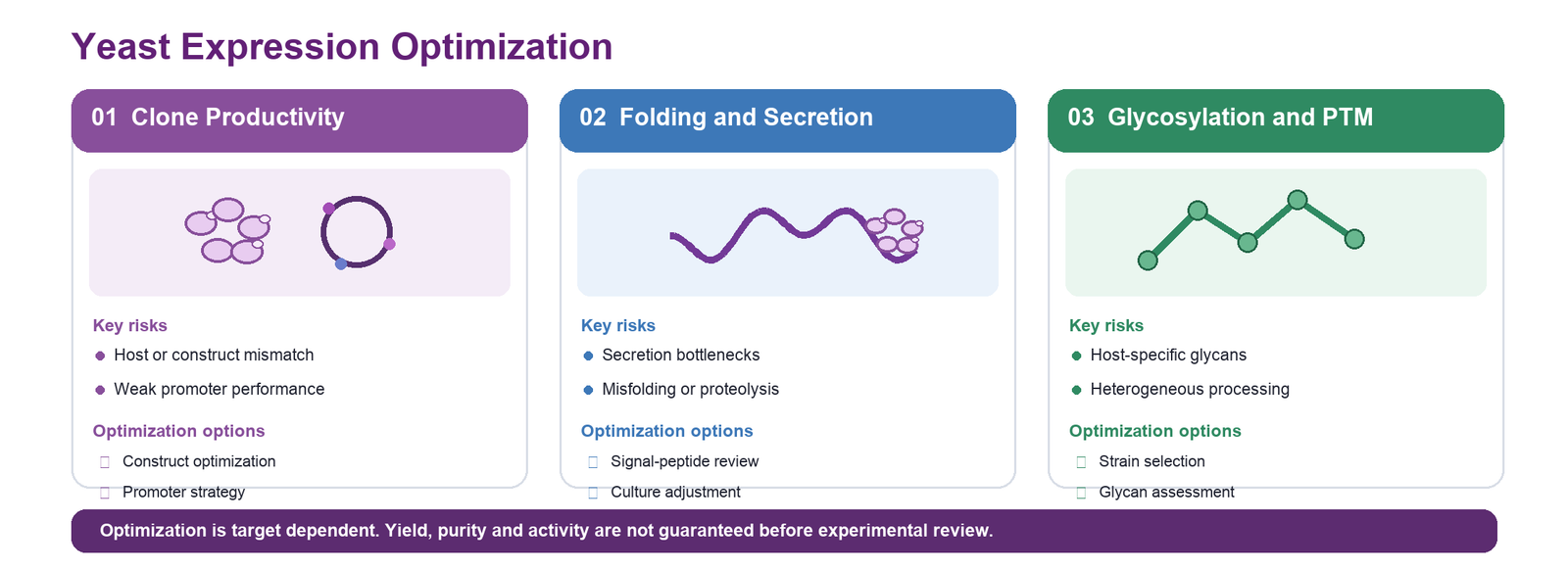
TARGET-SPECIFIC RISK REVIEW
Yeast Expression Optimization
RESEARCH APPLICATIONS
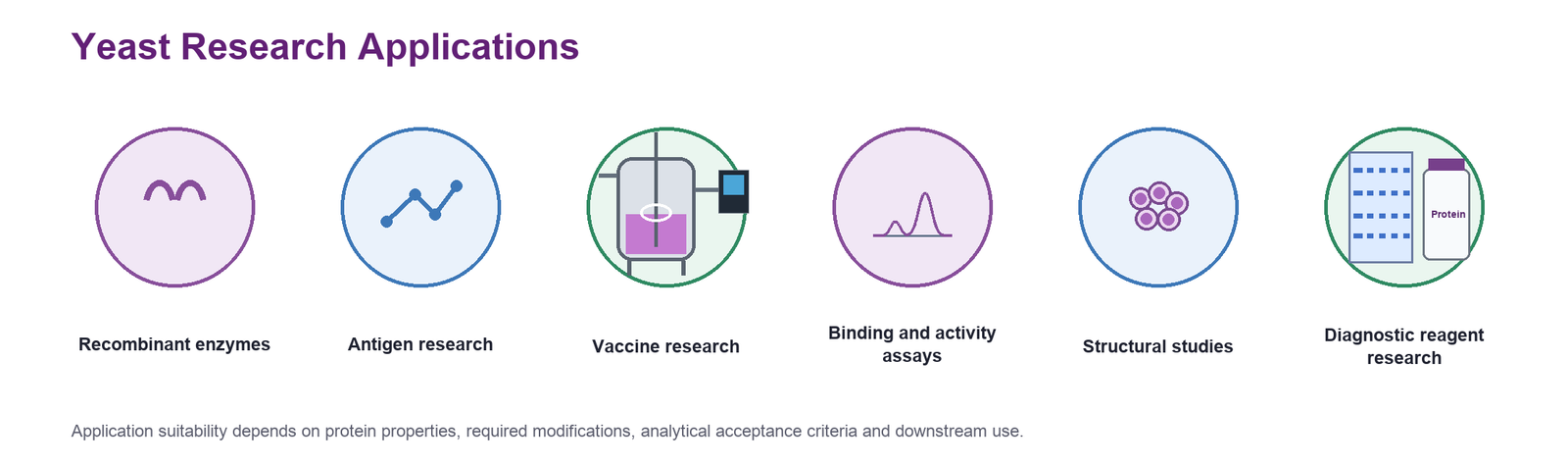
Designed for Diverse Recombinant Protein Programs
- Recombinant enzymes
- Antigen research
- Vaccine research
- Binding and activity assays
- Structural studies
- Diagnostic reagent research
DEFINED BASIC QC
Quality Control and Project Reporting
Basic QC includes native PAGE, reducing SDS-PAGE and a standard COA or study report. Additional analytical work is selected according to the molecule and intended use.
PROJECT PLANNING
Frequently Asked Questions
Which proteins are suitable for yeast expression?
Selected recombinant enzymes, secreted proteins, antigens and protein domains can be reasonable candidates. Targets that require a specific mammalian glycosylation pattern may need a different expression system.
What is included in the standard yeast package?
The $4,680 package includes Pichia transformation and clone screening, small-scale expression, basic protein purification, native PAGE, reducing SDS-PAGE and a standard COA or study report. Gene synthesis and Stage 06 options are separate.
Can I provide my own yeast expression plasmid or strain?
A customer-supplied construct or strain can be considered when sequence, vector, marker, promoter, integration strategy, strain identity and available expression history are provided. Verification and adaptation work are agreed before production.
What happens if clone productivity or secretion is low?
The workflow can be reviewed for construct design, promoter choice, clone selection, secretion signal, culture conditions and harvest timing. Additional optimization is separately scoped, and yield remains target dependent.
Can you provide low endotoxin or bioactive yeast protein?
Optional endotoxin removal and bioactivity measurement can be evaluated. Yeast is not a bacterial endotoxin source, but the final specification still depends on the complete process and analytical method. The <0.1 EU/µg value is a target, not a guarantee.
START WITH A TECHNICAL REVIEW
Discuss Your Yeast Protein Expression Project
Share the target sequence, preferred construct, intended application and requested analytical scope. BioCrestSci will assess feasibility and define a project-specific plan.