
NON-GMP RESEARCH SERVICE
Baculovirus Insect Cell Protein Expression Service
BioCrestSci provides non-GMP baculovirus and insect cell protein expression for research targets that may benefit from eukaryotic folding and insect-cell processing. The workflow covers construct planning, Sf9 transfection and expression verification, small-scale production, basic purification and defined quality-control reporting.
A DECISION-READY WORKFLOW
Why Choose BioCrestSci
Baculovirus and host cell planning
Construct design, recombinant baculovirus preparation, Sf9 compatibility, infection strategy and target localization are considered before production.
Stage based expression evidence
Transfection, expression verification and small-scale production are separated into reviewable stages so infection and harvest decisions reflect observed performance.
Basic purification included
The $3,600 package includes basic protein purification and basic QC. Polishing, virus-related characterization, endotoxin control and bioactivity work are optional.
FROM CONSTRUCT TO CHARACTERIZATION
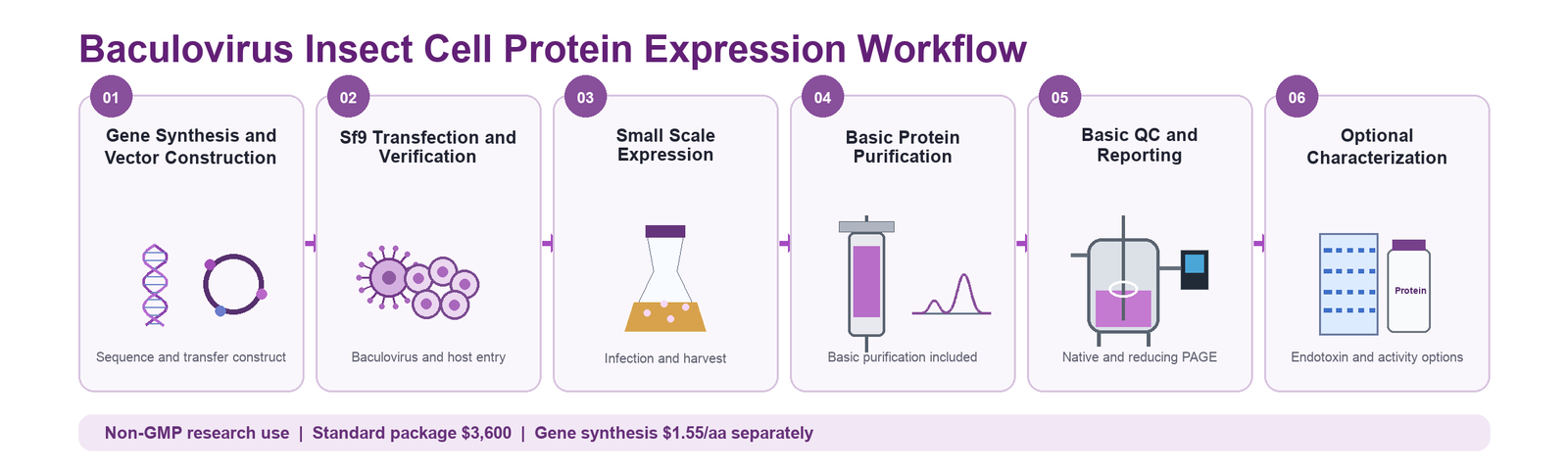
Six-Stage Baculovirus Insect Cell Protein Expression Workflow
SCOPE, DELIVERABLES AND PRICING
Stage 01–06 Technical Details
The standard package covers Stages 02–05. Stage 01 gene synthesis and Stage 06 options are separate. Final scope is confirmed after technical assessment.
Gene Synthesis and Vector Construction
Description
Prepare a baculovirus-compatible expression construct with an agreed coding region, processing signal and affinity tag.
Key Considerations
- Sequence correctness
- vector compatibility
- domain boundaries
- signal peptide
- tag arrangement
- reading frame
- intended protein form.
Deliverables
Expression-ready construct and sequence or vector documentation.
Price
$1.55/aa, charged separately
Sf9 Transfection and Expression Verification
Description
Generate the recombinant baculovirus workflow, transfect Sf9 cells and assess target expression under defined verification conditions.
Key Considerations
- Transfection performance
- recombinant virus handling
- host-cell response
- expression confirmation
- viral passage
- inoculum quality.
Deliverables
Expression-verification result and agreed recombinant baculovirus or culture material.
Price
$2,930
Small Scale Expression
Description
Produce the target in infected insect-cell culture and select an appropriate harvest condition.
Key Considerations
- Infection timing
- multiplicity where applicable
- cell density and viability
- culture duration
- secretion versus intracellular recovery
- protein stability.
Deliverables
Small-scale expression result and selected infection or harvest condition.
Price
$370
Basic Protein Purification
Description
Recover the target from cells or culture medium and apply a target-compatible basic affinity-purification route.
Key Considerations
- Clarification
- lysis where required
- tag accessibility
- aggregates
- host-cell or virus-related materials
- buffer compatibility
- recovery.
Deliverables
Basic purified protein fraction and documented recovery conditions.
Price
Included in the $3,600 package; no separate basic purification fee
Basic Quality Control and Reporting
Description
Assess the purified material by native PAGE, reducing SDS-PAGE and standard project reporting.
Key Considerations
- Apparent molecular mass
- oligomeric state
- concentration
- product stability
- host or virus-related considerations
- intended-use criteria.
Deliverables
Native PAGE, reducing SDS-PAGE and standard COA or study report.
Price
$300 subtotal: Native PAGE $75; reducing SDS-PAGE $75; report $150
Optional Characterization and Process Add Ons
Description
Add protein polishing, endotoxin-control, bioactivity or target-specific impurity work after technical review.
Key Considerations
- Protein recovery after added processing
- assay controls
- virus-related analytical scope
- method suitability
- numerical acceptance criteria.
Deliverables
Optional Endotoxin Removal, quotation upon request, target <0.1 EU/µg; Bioactivity Measurement, quoted by assay scope; SEC polishing, buffer exchange or tag cleavage when appropriate.
Price
Quoted separately; <0.1 EU/µg is a target and is not guaranteed
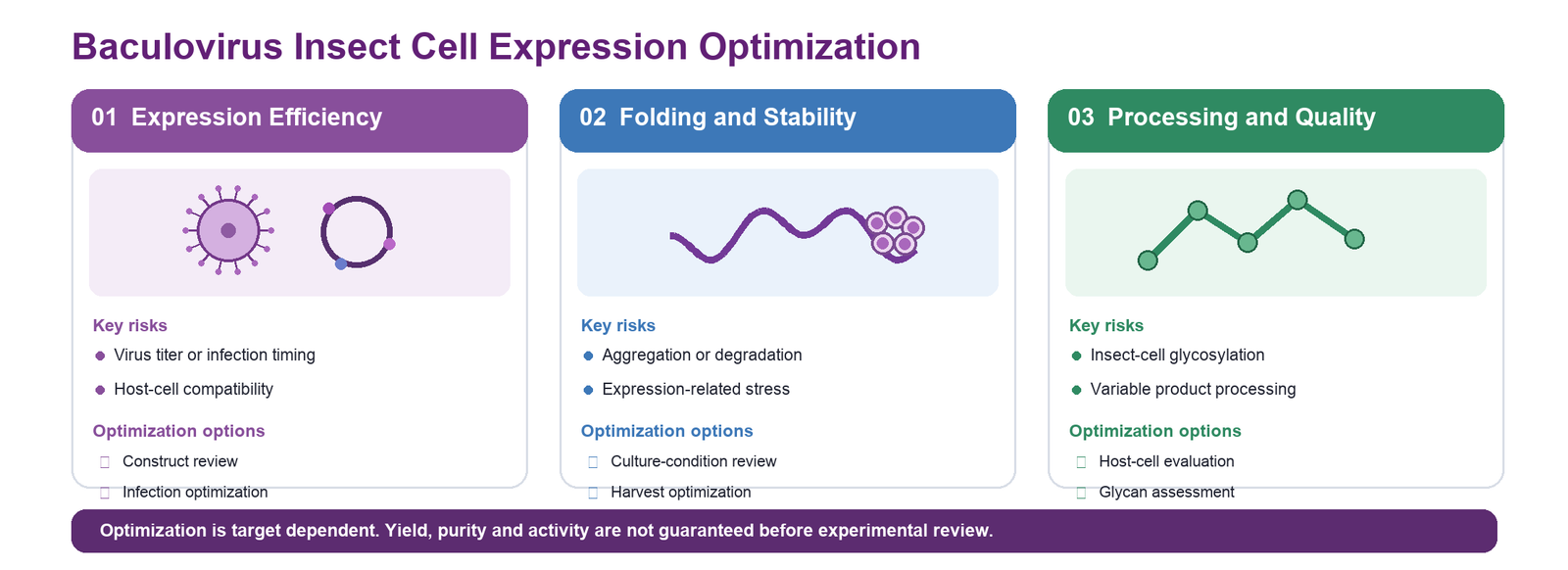
TARGET-SPECIFIC RISK REVIEW
Baculovirus Insect Cell Expression Optimization
RESEARCH APPLICATIONS
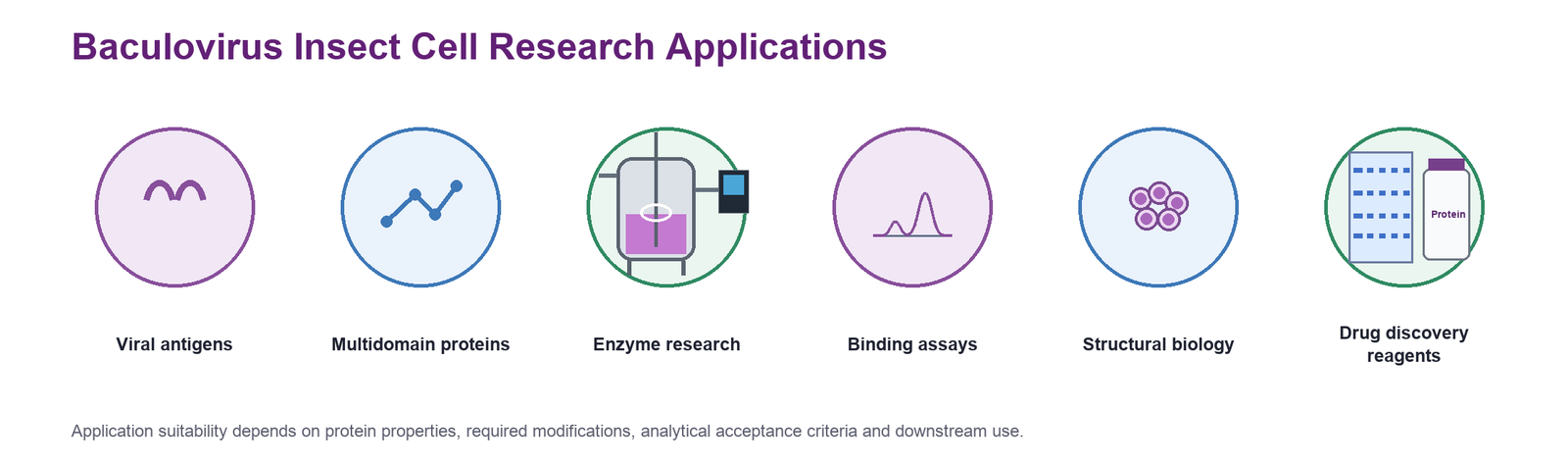
Designed for Diverse Recombinant Protein Programs
- Viral antigens
- Multidomain proteins
- Enzyme research
- Binding assays
- Structural biology
- Drug discovery reagents
DEFINED BASIC QC
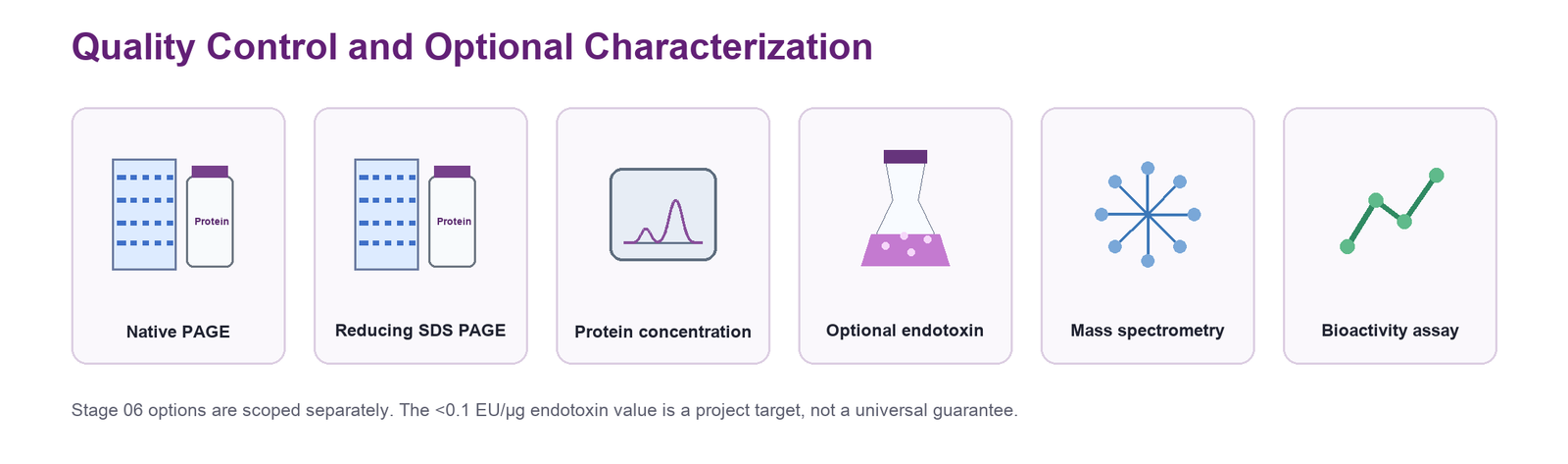
Quality Control and Project Reporting
Basic QC includes native PAGE, reducing SDS-PAGE and a standard COA or study report. Additional analytical work is selected according to the molecule and intended use.
PROJECT PLANNING
Frequently Asked Questions
Which proteins are suitable for baculovirus insect cell expression?
Selected viral antigens, multidomain proteins, enzymes and other complex recombinant targets can be candidates. Required folding, glycosylation, oligomeric state and biological activity determine whether the system is appropriate.
What is included in the standard baculovirus package?
The $3,600 package includes Sf9 transfection and expression verification, small-scale expression, basic protein purification, native PAGE, reducing SDS-PAGE and a standard COA or study report. Gene synthesis and Stage 06 options are separate.
Can I provide my own baculovirus transfer construct?
A customer-supplied construct can be assessed when the vector map, insert sequence, tag arrangement, transfer system, resistance or selection information and available expression history are provided. Verification or adaptation work is agreed before production.
What happens if infection performance or expression is low?
The project can be reviewed for construct behavior, recombinant virus preparation, viral passage, cell condition, infection timing, multiplicity and harvest window. Optimization is separately scoped, and yield remains target dependent.
Can you provide low endotoxin or bioactive insect cell protein?
Optional endotoxin removal and bioactivity measurement can be assessed. The <0.1 EU/µg value is a project target rather than a universal guarantee, and assay design, controls and any virus-related analytical requirements are quoted separately.
START WITH A TECHNICAL REVIEW
Discuss Your Baculovirus Insect Cell Protein Expression Project
Share the target sequence, preferred construct, intended application and requested analytical scope. BioCrestSci will assess feasibility and define a project-specific plan.