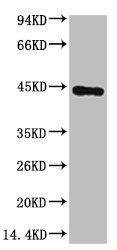
Function
Actin is a highly conserved protein that polymerizes to produce filaments that form cross-linked networks in the cytoplasm of cells. Actin exists in both monomeric (G-actin) and polymeric (F-actin) forms, both forms playing key functions, such as cell motility and contraction. In addition to their role in the cytoplasmic cytoskeleton, G- and F-actin also localize in the nucleus, and regulate gene transcription and motility and repair of damaged DNA.
Biological Context
Subcellular Location: Cytoplasm, cytoskeleton; Nucleus
Disease Association: Dystonia-deafness syndrome 1 (DDS1) : An autosomal dominant form of dystonia with juvenile onset, associated with congenital or childhood-onset sensorineural deafness. Dystonia is defined by the presence of sustained involuntary muscle contraction, often leading to abnormal postures. Some DDS1 patients have dysmorphic features, skeletal anomalies, and/or mild developmental delay with impaired intellectual development. [The disease is caused by variants affecting the gene represented in this entry] | Baraitser-Winter syndrome 1 (BRWS1) : A rare developmental disorder characterized by the combination of congenital ptosis, high-arched eyebrows, hypertelorism, ocular colobomata, and a brain malformation consisting of anterior-predominant lissencephaly. Other typical features include postnatal short stature and microcephaly, intellectual disability, seizures, and hearing loss. [The disease is caused by variants affecting the gene represented in this entry] | Thrombocytopenia 8, with dysmorphic features and developmental delay (THC8) : A form of thrombocytopenia, a hematologic disorder defined by a decrease in the number of platelets in circulating blood, resulting in the potential for increased bleeding and decreased ability for clotting. THC8 is an autosomal dominant form characterized by early-childhood onset of thrombocytopenia with platelet anisotropy. Affected individuals also have dysmorphic facial features and variable developmental delay with speech delay and mildly impaired intellectual development. [The disease is caused by variants affecting the gene represented in this entry] | Becker nevus syndrome (BNS) : A syndrome characterized by the association of Becker nevi with musculoskeletal abnormalities, unilateral breast hypoplasia, intellectual disability, developmental delay, and cardiomyopathy. Becker nevus is a cutaneous hamartoma that appears in childhood as a unilateral tan patch and increases in thickness, pigmentation, and hair growth during adolescence. Histologically, epidermal acanthosis is accompanied by irregularly dispersed ectopic smooth muscle bundles and increased terminal hair follicles. Most cases are sporadic. [The disease is caused by variants affecting the gene represented in this entry] | Congenital smooth muscle hamartoma, with or without hemihypertrophy (CSMH) : A benign skin lesion that usually presents as an indurated, slightly pigmented or flesh-colored plaque with perifollicular papules or coarse hair. Histopathologically, there is excessive proliferation of ectopic smooth muscle within the dermis. Hair follicles are normal in number and hyperkeratosis, acanthosis and hyperpigmentation of the basal cell layer can sometimes be seen. Rarely, CSMH is associated with hemihypertrophy. [The disease is caused by variants affecting the gene represented in this entry]
Product Specifications
Mouse anti-Human/Rat/Mouse/Monkey/Dog/Chicken/Hamster/Rabbit ACTB Monoclonal Antibody is a recombinant protein. Suitable for ELISA and Western Blot applications. Explore more Antibody products →