Function
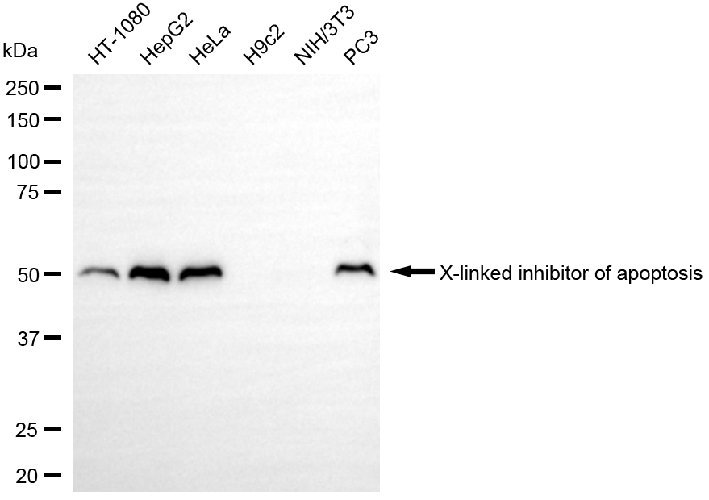
Multi-functional protein which regulates not only caspases and apoptosis, but also modulates inflammatory signaling and immunity, copper homeostasis, mitogenic kinase signaling, cell proliferation, as well as cell invasion and metastasis (PubMed:11257230, PubMed:11257231, PubMed:11447297, PubMed:12121969, PubMed:12620238, PubMed:17560374, PubMed:17967870, PubMed:19473982, PubMed:20154138, PubMed:22103349, PubMed:9230442). Acts as a direct caspase inhibitor (PubMed:11257230, PubMed:11257231, PubMed:12620238). Directly bind to the active site pocket of CASP3 and CASP7 and obstructs substrate entry (PubMed:11257230, PubMed:11257231, PubMed:16352606, PubMed:16916640). Inactivates CASP9 by keeping it in a monomeric, inactive state (PubMed:12620238). Acts as an E3 ubiquitin-protein ligase regulating NF-kappa-B signaling and the target proteins for its E3 ubiquitin-protein ligase activity include: RIPK1, RIPK2, MAP3K2/MEKK2, DIABLO/SMAC, AIFM1, CCS, PTEN and BIRC5/survivin (PubMed:17560374, PubMed:17967870, PubMed:19473982, PubMed:20154138, PubMed:22103349, PubMed:22607974, PubMed:29452636, PubMed:30026309). Acts as an important regulator of innate immunity by mediating 'Lys-63'-linked polyubiquitination of RIPK2 downstream of NOD1 and NOD2, thereby transforming RIPK2 into a scaffolding protein for downstream effectors, ultimately leading to activation of the NF-kappa-B and MAP kinases signaling (PubMed:19667203, PubMed:22607974, PubMed:29452636, PubMed:30026309). 'Lys-63'-linked polyubiquitination of RIPK2 also promotes recruitment of the LUBAC complex to RIPK2 (PubMed:22607974, PubMed:29452636). Regulates the BMP signaling pathway and the SMAD and MAP3K7/TAK1 dependent pathways leading to NF-kappa-B and JNK activation (PubMed:17560374). Ubiquitination of CCS leads to enhancement of its chaperone activity toward its physiologic target, SOD1, rather than proteasomal degradation (PubMed:20154138). Ubiquitination of MAP3K2/MEKK2 and AIFM1 does not lead to proteasomal degradation (PubMed:17967870, PubMed:22103349). Plays a role in copper homeostasis by ubiquitinating COMMD1 and promoting its proteasomal degradation (PubMed:14685266). Can also function as E3 ubiquitin-protein ligase of the NEDD8 conjugation pathway, targeting effector caspases for neddylation and inactivation (PubMed:21145488). Ubiquitinates and therefore mediates the proteasomal degradation of BCL2 in response to apoptosis (PubMed:29020630). Protects cells from spontaneous formation of the ripoptosome, a large multi-protein complex that has the capability to kill cancer cells in a caspase-dependent and caspase-independent manner (PubMed:22095281). Suppresses ripoptosome formation by ubiquitinating RIPK1 and CASP8 (PubMed:22095281). Acts as a positive regulator of Wnt signaling and ubiquitinates TLE1, TLE2, TLE3, TLE4 and AES (PubMed:22304967). Ubiquitination of TLE3 results in inhibition of its interaction with TCF7L2/TCF4 thereby allowing efficient recruitment and binding of the transcriptional coactivator beta-catenin to TCF7L2/TCF4 that is required to initiate a Wnt-specific transcriptional program (PubMed:22304967)
Disease Association
Lymphoproliferative syndrome, X-linked, 2 (XLP2) : A rare immunodeficiency characterized by extreme susceptibility to infection with Epstein-Barr virus (EBV). Symptoms include severe or fatal mononucleosis, acquired hypogammaglobulinemia, pancytopenia and malignant lymphoma. [The disease is caused by variants affecting the gene represented in this entry]
Subunit
Monomer, and homodimer. Part of a complex composed of SEPTIN4 isoform ARTS, XIAP and BCL2, within the complex interacts with SEPTIN4 isoform ARTS and BCL2, SEPTIN4 isoform ARTS acts as a scaffold protein and stabilizes the complex (PubMed:29020630). Interacts (via BIR3 domain) with DIABLO/SMAC; the interaction inhibits apoptotic suppressor activity (PubMed:11140637, PubMed:11257230, PubMed:21695558). Interacts with HTRA2/PRSS25; the interaction inhibits apoptotic suppressor activity (PubMed:11604410). Interacts with TAB1/MAP3K7IP1 and AIFM1. Interaction with DIABLO/SMAC hinders binding of TAB1/MAP3K7IP1 and AIFM1. Interacts with TCF25 and COMMD1. Interacts (via BIR3 domain) with SEPTIN4 isoform ARTS (PubMed:15029247, PubMed:21695558). Interacts (via BIR3 domain) with SEPTIN4 (By similarity). Interacts with RIP1, RIP2, RIP3, RIP4, CCS and USP19. Interacts (via BIR 2 domain and BIR 3 domain) with HAX1 (via C-terminus) and this interaction blocks ubiquitination of XIAP/BIRC4. Interacts with the monomeric form of BIRC5/survivin. Interacts with TLE3 and TCF7L2/TCF4. Interacts (via BIR 3 and RING domains) with PDCL3 (PubMed:19012568)