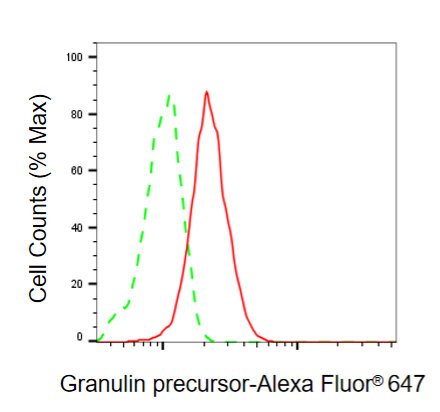
Mouse anti-Human sapiens (Human) GRN Monoclonal Antibody

Mouse anti-Human sapiens (Human) GRN Monoclonal Antibody — recombinant protein.

SKU: BCREC-000551MA Category:

Product Specifications

Uniprot No.P28799
Target NamesGRN
Species ReactivityMouse
ImmunogenRecombinant Human GRN protein
Immunogen SpeciesHomo sapiens (Human)
ConjugateNon-conjugated
IsotypeMouse IgG1
ClonalityMonoclonal
ApplicationsELISA, WB, FC, ICC
BufferPBS, 50% glycerol, 0.05% Proclin 300, 0.05%BSA
StorageUpon receipt, store at -20°C or -80°C. Avoid repeated freeze.

Function

Stabilizes CTSD through interaction with CTSD leading to maintain its aspartic-type peptidase activity.

Biological Context

Subcellular Location: Secreted; Lysosome
Tissue Specificity: In myelogenous leukemic cell lines of promonocytic, promyelocytic, and proerythroid lineage, in fibroblasts, and very strongly in epithelial cell lines. Present in inflammatory cells and bone marrow. Highest levels in kidney
Disease Association: Frontotemporal dementia 2 (FTD2) : A form of dementia characterized by pathologic finding of frontotemporal lobar degeneration, presenile dementia with behavioral changes, deterioration of cognitive capacities and loss of memory. Gestural apraxia, parkinsonism, visual loss, and visual hallucinations are present in 25 to 40% of patients. [The disease is caused by variants affecting the gene represented in this entry] | Ceroid lipofuscinosis, neuronal, 11 (CLN11) : A form of neuronal ceroid lipofuscinosis characterized by rapidly progressive visual loss due to retinal dystrophy, seizures, cerebellar ataxia, and cerebellar atrophy. Cognitive decline may also occur. Neuronal ceroid lipofuscinoses are progressive neurodegenerative, lysosomal storage diseases characterized by intracellular accumulation of autofluorescent liposomal material. [The disease is caused by variants affecting the gene represented in this entry]

Product Specifications

Mouse anti-Human sapiens (Human) GRN Monoclonal Antibody is a recombinant protein. Suitable for ELISA and Western Blot applications.

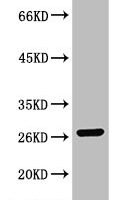
SDS-PAGE: Single band at expected molecular weight confirming purity.

ELISA: Suitable as coating antigen or detection standard.

Western Blot: Compatible with standard Western Blot protocols.

Protein Interaction: Validated for SPR (Surface Plasmon Resonance) and BLI (Bio-Layer Interferometry) studies.

Shipping: Shipped at ambient temperature. Lyophilized protein is stable during transit.

Storage: Store lyophilized protein at -20°C to -80°C. Reconstituted protein should be aliquoted and stored at -80°C. Avoid repeated freeze-thaw cycles.

Shelf Life: 12 months from date of receipt when stored as recommended.

Shipping Time: Orders placed before 2 PM EST ship same day. International orders typically deliver within 5-10 business days.

Protein Biology

Function

Stabilizes CTSD through interaction with CTSD leading to maintain its aspartic-type peptidase activity

Subcellular Location

Secreted; Lysosome

Disease Association

Frontotemporal dementia 2 (FTD2) : A form of dementia characterized by pathologic finding of frontotemporal lobar degeneration, presenile dementia with behavioral changes, deterioration of cognitive capacities and loss of memory. Gestural apraxia, parkinsonism, visual loss, and visual hallucinations are present in 25 to 40% of patients. [The disease is caused by variants affecting the gene represented in this entry] | Ceroid lipofuscinosis, neuronal, 11 (CLN11) : A form of neuronal ceroid lipofuscinosis characterized by rapidly progressive visual loss due to retinal dystrophy, seizures, cerebellar ataxia, and cerebellar atrophy. Cognitive decline may also occur. Neuronal ceroid lipofuscinoses are progressive neurodegenerative, lysosomal storage diseases characterized by intracellular accumulation of autofluorescent liposomal material. [The disease is caused by variants affecting the gene represented in this entry]

Tissue Specificity

In myelogenous leukemic cell lines of promonocytic, promyelocytic, and proerythroid lineage, in fibroblasts, and very strongly in epithelial cell lines. Present in inflammatory cells and bone marrow. Highest levels in kidney

Subunit

Progranulin is secreted as a homodimer (PubMed:23364791). Interacts with SLPI; interaction protects progranulin from proteolysis (PubMed:12526812). Interacts (via region corresponding to granulin-7 peptide) with CTSD; stabilizes CTSD and increases its proteolytic activity (PubMed:28453791). Interacts (via region corresponding to granulin-7 peptide) with SORT1; this interaction mediates endocytosis and lysosome delivery of progranulin; interaction occurs at the neuronal cell surface in a stressed nervous system (PubMed:21092856). Interacts with PSAP; facilitates lysosomal delivery of progranulin from the extracellular space and the biosynthetic pathway (PubMed:26370502). Forms a complex with PSAP and M6PR; PSAP bridges the binding between progranulin and M6PR (PubMed:26370502). Forms a complex with PSAP and SORT1; progranulin bridges the interaction between PSAP and SORT1; facilitates lysosomal targeting of PSAP via SORT1; interaction enhances PSAP uptake in primary cortical neurons (PubMed:28541286). Interacts (via regions corresponding to granulin-2 and granulin-7 peptides) with GBA1; this interaction prevents aggregation of GBA1-SCARB2 complex via interaction with HSPA1A upon stress (PubMed:27789271). Interacts (via region corresponding to granulin-7 peptide) with HSPA1A; mediates recruitment of HSPA1A to GBA1 and prevents GBA1 aggregation in response to stress (PubMed:27789271)

Gene: GRN  |  Organism: Homo sapiens  |  Synonyms: Acrogranin; Epithelin precursor; Glycoprotein of 88 Kda; Granulin precursor; PC cell-derived growth factor; Proepithelin
Key Publications

Frequently Asked Questions

How do I order or inquire about this product?

Fill out the Online Inquiry form with your required quantity and specifications. You can also email sales@biocrestsci.com. Our team typically responds within 4 business hours with a quote and availability confirmation.

What is the shipping and delivery time?

Orders placed before 2 PM EST ship the same day. Domestic (US) delivery typically takes 2-3 business days. International orders deliver within 5-10 business days. All products are shipped at ambient temperature with appropriate packaging to ensure stability.

How should I store this recombinant protein?

Lyophilized proteins should be stored at -20°C to -80°C upon receipt. After reconstitution, aliquot and store at -80°C. Avoid repeated freeze-thaw cycles. Shelf life is 12 months from date of receipt when stored as recommended.

What quality controls are performed on your products?

Each product undergoes SDS-PAGE purity analysis (typically >85-95%), endotoxin testing, and bioactivity validation. Products are validated for ELISA, Western Blot, and SPR/BLI applications as specified on this product page. A Certificate of Analysis (CoA) is available upon request.

Shopping Cart
Scroll to Top