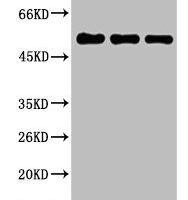
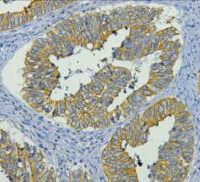
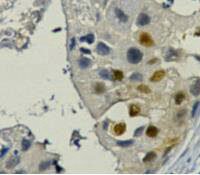
Mouse anti-Human/Mouse/Rat sapiens (Human) JUN Monoclonal Antibody

Mouse anti-Human/Mouse/Rat sapiens (Human) JUN Monoclonal Antibody — recombinant protein.

SKU: BCREC-000929MA Category:

Product Specifications

Uniprot No.P05412
Target NamesJUN
Species ReactivityMouse
ImmunogenRecombinant Human JUN protein
Immunogen SpeciesHomo sapiens (Human)
ConjugateNon-conjugated
IsotypeMouse IgG1
ClonalityMonoclonal
ApplicationsELISA, WB, FC, ICC
BufferPBS, 50% glycerol, 0.05% Proclin 300, 0.05%BSA
StorageUpon receipt, store at -20°C or -80°C. Avoid repeated freeze.

Function

(Microbial infection) Upon Epstein-Barr virus (EBV) infection, binds to viral BZLF1 Z promoter and activates viral BZLF1 expression.

Biological Context

Subcellular Location: Nucleus
Tissue Specificity: Expressed in the developing and adult prostate and prostate cancer cells

Product Specifications

Mouse anti-Human/Mouse/Rat sapiens (Human) JUN Monoclonal Antibody is a recombinant protein. Suitable for ELISA and Western Blot applications.

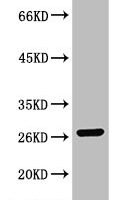
SDS-PAGE: Single band at expected molecular weight confirming purity.

ELISA: Suitable as coating antigen or detection standard.

Western Blot: Compatible with standard Western Blot protocols.

Protein Interaction: Validated for SPR (Surface Plasmon Resonance) and BLI (Bio-Layer Interferometry) studies.

Shipping: Shipped at ambient temperature. Lyophilized protein is stable during transit.

Storage: Store lyophilized protein at -20°C to -80°C. Reconstituted protein should be aliquoted and stored at -80°C. Avoid repeated freeze-thaw cycles.

Shelf Life: 12 months from date of receipt when stored as recommended.

Shipping Time: Orders placed before 2 PM EST ship same day. International orders typically deliver within 5-10 business days.

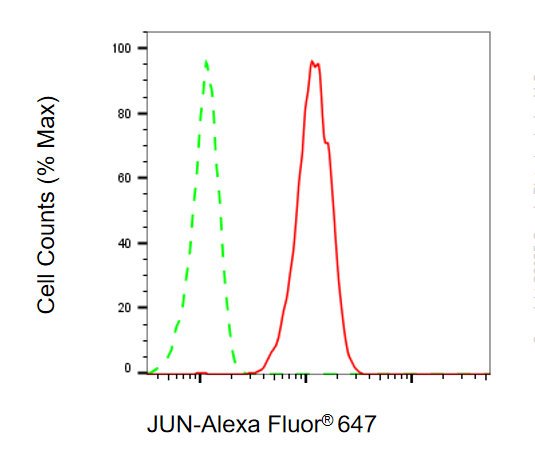
Protein Biology

Function

(Microbial infection) Upon Epstein-Barr virus (EBV) infection, binds to viral BZLF1 Z promoter and activates viral BZLF1 expression

Subcellular Location

Nucleus

Tissue Specificity

Expressed in the developing and adult prostate and prostate cancer cells

Subunit

Heterodimer with either BATF3 or ATF7 (PubMed:10376527, PubMed:12087103, PubMed:15467742). Heterodimer with FOS (By similarity). Heterodimer with FOSB isoform 1 and 2 (By similarity). Component of an AP-1 transcription factor complex composed of JUN-FOS heterodimers (By similarity). As part of the AP-1 transcription factor complex, forms heterodimers with FOSB, thereby binding to the AP-1 consensus sequence and stimulating transcription (By similarity). Interacts with FOS and FOSB isoform 1 and 2 (By similarity). The ATF7/JUN heterodimer is essential for ATF7 transactivation activity (PubMed:10376527). Interacts with TSC22D3 (via N-terminus); the interaction inhibits the binding of active AP1 to its target DNA (By similarity). Interacts with HIVEP3 and MYBBP1A (By similarity). Interacts with SP1, SPIB and TCF20 (PubMed:10196196, PubMed:16478997, PubMed:8663478). Interacts with COPS5; the interaction leads indirectly to its phosphorylation (PubMed:8837781). Component of the SMAD3/SMAD4/JUN/FOS/complex which forms at the AP1 promoter site (PubMed:10995748). The SMAD3/SMAD4 heterodimer acts synergistically with the JUN/FOS heterodimer to activate transcription in response to TGF-beta (PubMed:9732876). Interacts (via its basic DNA binding and leucine zipper domains) with SMAD3 (via an N-terminal domain); the interaction is required for TGF-beta-mediated transactivation of the SMAD3/SMAD4/JUN/FOS/complex (PubMed:10995748). Interacts with methylated RNF187 (PubMed:20852630, PubMed:23624934). Binds to HIPK3. Interacts (when phosphorylated) with FBXW7 (PubMed:14739463). Found in a complex with PRR7 and FBXW7 (PubMed:27458189). Interacts with PRR7 and FBXW7; the interaction inhibits ubiquitination-mediated JUN degradation promoting its phosphorylation and transcriptional activity (PubMed:27458189). Interacts with RBM39 (By similarity). Interacts with PAGE4 (PubMed:24263171, PubMed:24559171, PubMed:26242913). Interacts with ARK2N and CSNK2B; the interaction with ARK2N is mediated by CSNK2B (PubMed:31341047)

Gene: JUN  |  Organism: Homo sapiens  |  Synonyms: Activator protein 1; Proto-oncogene c-Jun; Transcription factor AP-1 subunit Jun; V-jun avian sarcoma virus 17 oncogene homolog; p39
Key Publications

Frequently Asked Questions

How do I order or inquire about this product?

Fill out the Online Inquiry form with your required quantity and specifications. You can also email sales@biocrestsci.com. Our team typically responds within 4 business hours with a quote and availability confirmation.

What is the shipping and delivery time?

Orders placed before 2 PM EST ship the same day. Domestic (US) delivery typically takes 2-3 business days. International orders deliver within 5-10 business days. All products are shipped at ambient temperature with appropriate packaging to ensure stability.
How should I store this recombinant protein?

Lyophilized proteins should be stored at -20°C to -80°C upon receipt. After reconstitution, aliquot and store at -80°C. Avoid repeated freeze-thaw cycles. Shelf life is 12 months from date of receipt when stored as recommended.

What quality controls are performed on your products?

Each product undergoes SDS-PAGE purity analysis (typically >85-95%), endotoxin testing, and bioactivity validation. Products are validated for ELISA, Western Blot, and SPR/BLI applications as specified on this product page. A Certificate of Analysis (CoA) is available upon request.

Shopping Cart
Scroll to Top