
Insect Baculovirus Expression Service
From gene to purified protein using the baculovirus–insect cell expression system (BEVS). Designed for complex eukaryotic targets — kinases, multiprotein complexes, GPCRs, and secreted proteins — where bacterial systems fall short and mammalian timelines are prohibitive.
Why Insect Baculovirus — and When It's the Right Choice
Eukaryotic PTMs
Supports phosphorylation, glycosylation, myristoylation — critical for protein folding and activity.
High Yields
Polyhedrin/p10 promoters deliver tens to hundreds of mg/L under optimized conditions.
6–10 Week Timeline
Significantly faster than stable mammalian cell line development.
Scalable & Serum-Free
Adapts readily to suspension culture and bioreactor formats (L to 250L).
Multi-Complex Expression
Co-express multiple genes for VLPs, multi-subunit enzymes, complexes.
Safety Profile
Baculoviruses do not replicate in vertebrate cells — safer for manufacturing.
Best suited for
- Kinases and phosphoproteins requiring active-site integrity
- Membrane proteins, GPCRs, and ion channels (≤4 TMD)
- Large proteins (>100 kDa) prone to truncation in E. coli
- Secreted proteins and glycoproteins
- Virus-like particle (VLP) production
- Structural biology targets (cryo-EM, X-ray crystallography)
- Multi-subunit complexes requiring co-expression
Consider alternatives when
- Authentic mammalian glycosylation patterns are essential (HEK293 or CHO)
- Rapid turnaround of small, simple, non-glycosylated proteins (E. coli)
- Regulatory submission requires GMP-grade mammalian-derived glycoforms
- Target protein has confirmed toxicity to Sf9/Hi5 host cells at high MOI
Our Service Advantages
Codon Optimization & Protein Analysis
We provide codon-optimization and post-expression protein analysis as part of the standard workflow, improving the probability of soluble, active protein at the first attempt.
Extensive Insect Cell Track Record
Our team has accumulated substantial project experience in insect-cell expression, including challenging targets such as full-length membrane proteins with up to four transmembrane spans.
Multiple Fusion Tags & Host Options
We support His, GST, Strep-II, FLAG, and MBP tags, and offer Sf9, Sf21, Hi5, and S2 host cell options to match the solubility and secretion profile of your target.
Multi-Scale Fermentation Formats
From 500 mL pilot flasks to 2.5 L, 10 L, and 30 L scale-up, with large-scale bioreactor options at 80 L, 130 L, and 250 L for programs requiring gram-level quantities.
In-House Milligram-to-Gram Protein
We can deliver high-purity recombinant protein at milligram to gram quantities within competitive lead times, reducing the need for multi-vendor handoffs.
Low Endotoxin — LAL Verified (<0.1 EU/µg)
Endotoxin levels are verified by LAL assay to below 0.1 EU/µg, meeting requirements for cell-based functional assays, immunological studies, and in vivo preclinical work.
Custom Recombinant Protein Production — Step by Step
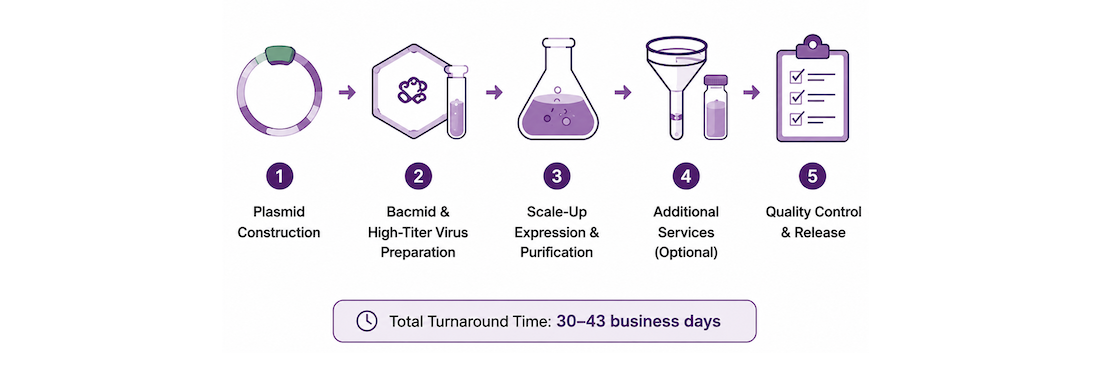
Plasmid Construction
- Target gene codon-optimized for insect cell expression
- GOI cloned into a baculovirus transfer vector (e.g., pFastBac)
- Sequence verified by Sanger sequencing
Bacmid & High-Titer Virus Preparation
- Transfer vector transformed into DH10Bac cells
- GOI transposed into baculovirus shuttle vector (bacmid)
- Sf9 cells transfected to generate P1 virus; amplified to high-titer P3
- Viral titer determined by plaque assay or qPCR
Scale-Up Expression & Purification
- Cells infected at optimized MOI in spinner flasks or bioreactor
- Harvest at optimal time post-infection based on pilot data
- Affinity capture (His-tag IMAC, GST, Strep-Tactin, FLAG)
- Polishing by IEX and/or SEC as required
Additional Services (Optional)
- 0.22 µm filter-sterilization for cell-based applications
- Endotoxin removal to <1 EU/mg or <0.1 EU/µg
- Lyophilization with excipient formulation for stability
Quality Control & Release
- Purity by SDS-PAGE and SEC-HPLC (≥90% standard)
- Concentration by A280 or BCA
- Endotoxin by LAL assay
- Functional activity assay (ELISA, enzyme activity, thermal shift)
- Certificate of Analysis (CoA) issued
Protein Expression — Insect Host Cell Systems
| Cell Line | Origin | Primary Applications |
|---|---|---|
| Sf9 Most common | Spodoptera frugiperda pupal ovarian tissue | The most widely used host for BEVS. Suitable for transfection, virus propagation, high-titer production, plaque assays, and intracellular/secreted protein expression. |
| Sf21 Structural targets | Parent line of Sf9; S. frugiperda pupal ovarian cells | Comparable to Sf9; can outperform in certain structural protein contexts (e.g., crystallin proteins) for more homogeneous preparations. |
| Hi5 Secreted proteins | Trichoplusia ni (cabbage looper) ovarian cells | Preferred for secreted proteins and VLPs due to more active secretory pathway and higher extracellular yields. |
| S2 Viral proteins | Drosophila melanogaster embryonic cells | Well-suited for viral structural proteins; can be used as stable expression system (inducible/constitutive). |
Standard Deliverables
Purified recombinant protein
Target quantity agreed at project initiation; shipped in specified buffer at −80°C or lyophilized
Certificate of Analysis (CoA)
Purity, concentration, endotoxin level, and relevant activity data
SDS-PAGE image
Coomassie or silver-stained gel showing major bands and purity estimate
SEC-HPLC chromatogram
Monomer / aggregate profile under native-like conditions
Protein concentration report
A280 or BCA measurement with extinction coefficient used
Technical project report
For complex projects: expression screening data, yield at each purification step, QC summary
Ready to Discuss Your Protein Target?
Share your sequence, expression goals, and timeline. Our scientific team will assess feasibility and recommend the right host, tag, and scale before you commit.