,

Recombinant Human Interferon gamma receptor 1 (IFNGR1), partial

Recombinant Human Interferon gamma receptor 1 (IFNGR1), partial — Receptor subunit for interferon gamma/INFG that plays crucial roles in antimicrobial, antiviral, and antitumor responses by activating effector immune cells and enhancing antigen presentation. Purity >90%.

SKU: BCRECP-000907 Categories: ,

Product Specifications

Product SkuBCRECP-000907
Product DescriptionRecombinant Human Interferon gamma receptor 1 (IFNGR1) Protein is expressed from Mammalian cell with C-terminal hFc1-tagged. It contains 18-245aa. [Accession | P15260].
Uniprot No.P15260
Gene NamesIFNGR1
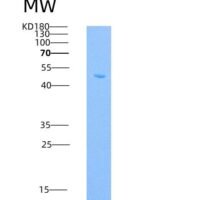
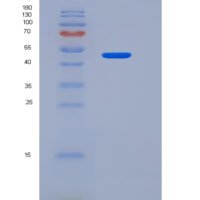
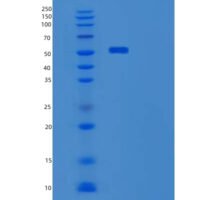
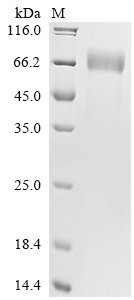
PurityGreater than 90% as determined by SDS-PAGE.
Expression SystemMammalian cell
Expression Region18-245aa
SpeciesHomo sapiens (Human)
Tag InfoC-terminal hFc1-tagged
Molecular weight54.7kDa
ActivityPlease contact us to obtain bioactivity data.
BufferIf the delivery form is liquid, the default storage buffer is Tris/PBS-based buffer, 5%-50% glycerol. If the delivery form is lyophilized powder, the buffer before lyophilization is Tris/PBS-based buffer, 6% Trehalose.
StorageStore at -20°C/-80°C upon receipt, aliquoting is necessary for mutiple use. Avoid repeated freeze-thaw cycles.
Research AreasImmunology

Function

Receptor subunit for interferon gamma/INFG that plays crucial roles in antimicrobial, antiviral, and antitumor responses by activating effector immune cells and enhancing antigen presentation. Associates with transmembrane accessory factor IFNGR2 to form a functional receptor. Upon ligand binding, the intracellular domain of IFNGR1 opens out to allow association of downstream signaling components JAK1 and JAK2.

Biological Context

Subcellular Location: Cell membrane (Single-pass type I membrane protein)
Disease Association: Immunodeficiency 27A (IMD27A) : A form of Mendelian susceptibility to mycobacterial disease, a rare condition caused by impairment of interferon-gamma mediated immunity. It is characterized by predisposition to illness caused by moderately virulent mycobacterial species, such as Bacillus Calmette-Guerin (BCG) vaccine, environmental non-tuberculous mycobacteria, and by the more virulent Mycobacterium tuberculosis. Other microorganisms rarely cause severe clinical disease in individuals with susceptibility to mycobacterial infections, with the exception of Salmonella which infects less than 50% of these individuals. Clinical outcome severity depends on the degree of impairment of interferon-gamma mediated immunity. Some patients die of overwhelming mycobacterial disease with lepromatous-like lesions in early childhood, whereas others develop, later in life, disseminated but curable infections with tuberculoid granulomas. [The disease is caused by variants affecting the gene represented in this entry] | Immunodeficiency 27B (IMD27B) : A form of Mendelian susceptibility to mycobacterial disease, a rare condition caused by impairment of interferon-gamma mediated immunity. It is characterized by predisposition to illness caused by moderately virulent mycobacterial species, such as Bacillus Calmette-Guerin (BCG) vaccine, environmental non-tuberculous mycobacteria, and by the more virulent Mycobacterium tuberculosis. Other microorganisms rarely cause severe clinical disease in individuals with susceptibility to mycobacterial infections, with the exception of Salmonella which infects less than 50% of these individuals. Clinical outcome severity depends on the degree of impairment of interferon-gamma mediated immunity. Some patients die of overwhelming mycobacterial disease with lepromatous-like lesions in early childhood, whereas others develop, later in life, disseminated but curable infections with tuberculoid granulomas. IMD27B commonly presents with recurrent, moderately severe infections with environmental mycobacteria or BCG. Salmonellosis is present in about 5% of patients. [The disease is caused by variants affecting the gene represented in this entry]

Product Specifications

Recombinant Human Interferon gamma receptor 1 (IFNGR1), partial is a recombinant protein from Homo sapiens (Human), expressed in Mammalian cell, covering amino acids 18-245aa, with C-terminal hFc1-tagged tag, molecular weight 54.7kDa, purity Greater than 90% as determined by SDS-PAGE.. Suitable for ELISA and Western Blot applications.

SDS-PAGE: Single band at expected molecular weight confirming purity.

ELISA: Suitable as coating antigen or detection standard.

Western Blot: Compatible with standard Western Blot protocols.

Protein Interaction: Validated for SPR (Surface Plasmon Resonance) and BLI (Bio-Layer Interferometry) studies.

Shipping: Shipped at ambient temperature. Lyophilized protein is stable during transit.

Storage: Store lyophilized protein at -20°C to -80°C. Reconstituted protein should be aliquoted and stored at -80°C. Avoid repeated freeze-thaw cycles.

Shelf Life: 12 months from date of receipt when stored as recommended.

Shipping Time: Orders placed before 2 PM EST ship same day. International orders typically deliver within 5-10 business days.

Protein Biology

Function

Receptor subunit for interferon gamma/INFG that plays crucial roles in antimicrobial, antiviral, and antitumor responses by activating effector immune cells and enhancing antigen presentation (PubMed:20015550). Associates with transmembrane accessory factor IFNGR2 to form a functional receptor (PubMed:10986460, PubMed:2971451, PubMed:7615558, PubMed:7617032, PubMed:7673114). Upon ligand binding, the intracellular domain of IFNGR1 opens out to allow association of downstream signaling components JAK1 and JAK2. In turn, activated JAK1 phosphorylates IFNGR1 to form a docking site for STAT1. Subsequent phosphorylation of STAT1 leads to dimerization, translocation to the nucleus, and stimulation of target gene transcription (PubMed:28883123). STAT3 can also be activated in a similar manner although activation seems weaker. IFNGR1 intracellular domain phosphorylation also provides a docking site for SOCS1 that regulates the JAK-STAT pathway by competing with STAT1 binding to IFNGR1 (By similarity)

Subcellular Location

Cell membrane (Single-pass type I membrane protein)

Disease Association

Immunodeficiency 27A (IMD27A) : A form of Mendelian susceptibility to mycobacterial disease, a rare condition caused by impairment of interferon-gamma mediated immunity. It is characterized by predisposition to illness caused by moderately virulent mycobacterial species, such as Bacillus Calmette-Guerin (BCG) vaccine, environmental non-tuberculous mycobacteria, and by the more virulent Mycobacterium tuberculosis. Other microorganisms rarely cause severe clinical disease in individuals with susceptibility to mycobacterial infections, with the exception of Salmonella which infects less than 50% of these individuals. Clinical outcome severity depends on the degree of impairment of interferon-gamma mediated immunity. Some patients die of overwhelming mycobacterial disease with lepromatous-like lesions in early childhood, whereas others develop, later in life, disseminated but curable infections with tuberculoid granulomas. [The disease is caused by variants affecting the gene represented in this entry] | Immunodeficiency 27B (IMD27B) : A form of Mendelian susceptibility to mycobacterial disease, a rare condition caused by impairment of interferon-gamma mediated immunity. It is characterized by predisposition to illness caused by moderately virulent mycobacterial species, such as Bacillus Calmette-Guerin (BCG) vaccine, environmental non-tuberculous mycobacteria, and by the more virulent Mycobacterium tuberculosis. Other microorganisms rarely cause severe clinical disease in individuals with susceptibility to mycobacterial infections, with the exception of Salmonella which infects less than 50% of these individuals. Clinical outcome severity depends on the degree of impairment of interferon-gamma mediated immunity. Some patients die of overwhelming mycobacterial disease with lepromatous-like lesions in early childhood, whereas others develop, later in life, disseminated but curable infections with tuberculoid granulomas. IMD27B commonly presents with recurrent, moderately severe infections with environmental mycobacteria or BCG. Salmonellosis is present in about 5% of patients. [The disease is caused by variants affecting the gene represented in this entry]

Subunit

Monomer (PubMed:9367779). Heterodimer with IFNGR2, to form the IFNG receptor complex (PubMed:7615558). Interacts with JAK1 (PubMed:7615558). Interacts (when phosphorylated) with STAT1 (PubMed:8156998). Interacts with SOCS1 (By similarity)

Gene: IFNGR1  |  Organism: Homo sapiens  |  Synonyms: CDw119; Interferon gamma receptor alpha-chain
Key Publications

Frequently Asked Questions

How do I order or inquire about this product?

Fill out the Online Inquiry form with your required quantity and specifications. You can also email sales@biocrestsci.com. Our team typically responds within 4 business hours with a quote and availability confirmation.

What is the shipping and delivery time?

Orders placed before 2 PM EST ship the same day. Domestic (US) delivery typically takes 2-3 business days. International orders deliver within 5-10 business days. All products are shipped at ambient temperature with appropriate packaging to ensure stability.

How should I store this recombinant protein?

Lyophilized proteins should be stored at -20°C to -80°C upon receipt. After reconstitution, aliquot and store at -80°C. Avoid repeated freeze-thaw cycles. Shelf life is 12 months from date of receipt when stored as recommended.

What quality controls are performed on your products?

Each product undergoes SDS-PAGE purity analysis (typically >85-95%), endotoxin testing, and bioactivity validation. Products are validated for ELISA, Western Blot, and SPR/BLI applications as specified on this product page. A Certificate of Analysis (CoA) is available upon request.

Shopping Cart
Scroll to Top