Recombinant Human Protein lin-28 homolog A (LIN28A), partial

Recombinant Human Protein lin-28 homolog A (LIN28A), partial — RNA-binding protein that inhibits processing of pre-let-7 miRNAs and regulates translation of mRNAs that control developmental timing, pluripotency and metabolism. Purity >90%.

SKU: BCRECP-001074 Category:

Product Specifications

Product SkuBCRECP-001074
Product DescriptionRecombinant Human Protein lin-28 homolog A (LIN28A) Protein is expressed from Yeast with N-terminal 6xHis-tagged. It contains 39-112aa. [Accession | Q9H9Z2].
Uniprot No.Q9H9Z2
Gene NamesLIN28A
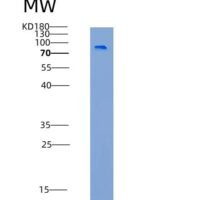
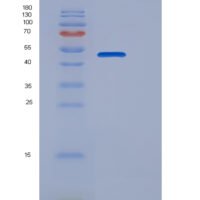
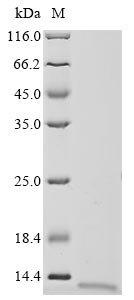
PurityGreater than 90% as determined by SDS-PAGE.
Expression SystemYeast
Expression Region39-112aa
SpeciesHomo sapiens (Human)
Tag InfoN-terminal 6xHis-tagged
Molecular weight10.2kDa
ActivityPlease contact us to obtain bioactivity data.
BufferIf the delivery form is liquid, the default storage buffer is Tris/PBS-based buffer, 5%-50% glycerol. If the delivery form is lyophilized powder, the buffer before lyophilization is Tris/PBS-based buffer, 6% Trehalose.
StorageStore at -20°C/-80°C upon receipt, aliquoting is necessary for mutiple use. Avoid repeated freeze-thaw cycles.
Research Areasothers

Function

RNA-binding protein that inhibits processing of pre-let-7 miRNAs and regulates translation of mRNAs that control developmental timing, pluripotency and metabolism. Seems to recognize a common structural G-quartet (G4) feature in its miRNA and mRNA targets (Probable). 'Translational enhancer' that drives specific mRNAs to polysomes and increases the efficiency of protein synthesis.

Biological Context

Subcellular Location: Cytoplasm; Rough endoplasmic reticulum; Cytoplasm, P-body; Cytoplasm, Stress granule; Nucleus, nucleolus
Tissue Specificity: Expressed in embryonic stem cells, placenta and testis. Tends to be up-regulated in HER2-overexpressing breast tumors

Product Specifications

Recombinant Human Protein lin-28 homolog A (LIN28A), partial is a recombinant protein from Homo sapiens (Human), expressed in Yeast, covering amino acids 39-112aa, with N-terminal 6xHis-tagged tag, molecular weight 10.2kDa, purity Greater than 90% as determined by SDS-PAGE.. Suitable for ELISA and Western Blot applications.
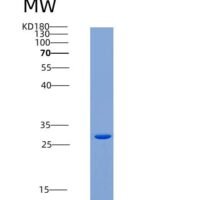
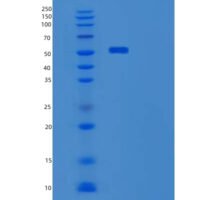
SDS-PAGE: Single band at expected molecular weight confirming purity.

ELISA: Suitable as coating antigen or detection standard.

Western Blot: Compatible with standard Western Blot protocols.

Protein Interaction: Validated for SPR (Surface Plasmon Resonance) and BLI (Bio-Layer Interferometry) studies.

Shipping: Shipped at ambient temperature. Lyophilized protein is stable during transit.

Storage: Store lyophilized protein at -20°C to -80°C. Reconstituted protein should be aliquoted and stored at -80°C. Avoid repeated freeze-thaw cycles.

Shelf Life: 12 months from date of receipt when stored as recommended.

Shipping Time: Orders placed before 2 PM EST ship same day. International orders typically deliver within 5-10 business days.

Protein Biology

Function

RNA-binding protein that inhibits processing of pre-let-7 miRNAs and regulates translation of mRNAs that control developmental timing, pluripotency and metabolism (PubMed:21247876). Seems to recognize a common structural G-quartet (G4) feature in its miRNA and mRNA targets (Probable). 'Translational enhancer' that drives specific mRNAs to polysomes and increases the efficiency of protein synthesis. Its association with the translational machinery and target mRNAs results in an increased number of initiation events per molecule of mRNA and, indirectly, in mRNA stabilization. Binds IGF2 mRNA, MYOD1 mRNA, ARBP/36B4 ribosomal protein mRNA and its own mRNA. Essential for skeletal muscle differentiation program through the translational up-regulation of IGF2 expression. Suppressor of microRNA (miRNA) biogenesis, including that of let-7, miR107, miR-143 and miR-200c. Specifically binds the miRNA precursors (pre-miRNAs), recognizing an 5'-GGAG-3' motif found in pre-miRNA terminal loop, and recruits TUT4 and TUT7 uridylyltransferases (PubMed:18951094, PubMed:19703396, PubMed:22118463, PubMed:22898984). This results in the terminal uridylation of target pre-miRNAs (PubMed:18951094, PubMed:19703396, PubMed:22118463, PubMed:22898984). Uridylated pre-miRNAs fail to be processed by Dicer and undergo degradation. The repression of let-7 expression is required for normal development and contributes to maintain the pluripotent state by preventing let-7-mediated differentiation of embryonic stem cells (PubMed:18951094, PubMed:19703396, PubMed:22118463, PubMed:22898984). Localized to the periendoplasmic reticulum area, binds to a large number of spliced mRNAs and inhibits the translation of mRNAs destined for the ER, reducing the synthesis of transmembrane proteins, ER or Golgi lumen proteins, and secretory proteins. Binds to and enhances the translation of mRNAs for several metabolic enzymes, such as PFKP, PDHA1 or SDHA, increasing glycolysis and oxidative phosphorylation. Which, with the let-7 repression may enhance tissue repair in adult tissue (By similarity)

Subcellular Location

Cytoplasm; Rough endoplasmic reticulum; Cytoplasm, P-body; Cytoplasm, Stress granule; Nucleus, nucleolus

Tissue Specificity

Expressed in embryonic stem cells, placenta and testis. Tends to be up-regulated in HER2-overexpressing breast tumors

Subunit

Monomer (By similarity). During skeletal muscle differentiation, associated with translation initiation complexes in the polysomal compartment (PubMed:21247876). Directly interacts with EIF3S2 (By similarity). Interacts with NCL in an RNA-dependent manner (By similarity). Interacts (via C-terminus) with DHX9 (via N- and C-terminus); this interaction occurs in a RNA-independent manner (PubMed:21247876). Interacts with TUT4 in the presence of pre-let-7 RNA (PubMed:19703396, PubMed:22118463)

Gene: LIN28A  |  Organism: Homo sapiens  |  Synonyms: Zinc finger CCHC domain-containing protein 1
Key Publications

Frequently Asked Questions

How do I order or inquire about this product?

Fill out the Online Inquiry form with your required quantity and specifications. You can also email sales@biocrestsci.com. Our team typically responds within 4 business hours with a quote and availability confirmation.

What is the shipping and delivery time?

Orders placed before 2 PM EST ship the same day. Domestic (US) delivery typically takes 2-3 business days. International orders deliver within 5-10 business days. All products are shipped at ambient temperature with appropriate packaging to ensure stability.

How should I store this recombinant protein?

Lyophilized proteins should be stored at -20°C to -80°C upon receipt. After reconstitution, aliquot and store at -80°C. Avoid repeated freeze-thaw cycles. Shelf life is 12 months from date of receipt when stored as recommended.

What quality controls are performed on your products?

Each product undergoes SDS-PAGE purity analysis (typically >85-95%), endotoxin testing, and bioactivity validation. Products are validated for ELISA, Western Blot, and SPR/BLI applications as specified on this product page. A Certificate of Analysis (CoA) is available upon request.

Shopping Cart
Scroll to Top