,

Recombinant Human Programmed cell death protein 10 (PDCD10)

Recombinant Human Programmed cell death protein 10 (PDCD10) — Promotes cell proliferation. Purity >90%.

SKU: BCRECP-001357 Categories: ,

Product Specifications

Product SkuBCRECP-001357
Product DescriptionRecombinant Human Programmed cell death protein 10 (PDCD10) Protein is expressed from E.coli with N-terminal 6xHis-SUMO-tagged. It contains 1-212aa. [Accession | Q9BUL8].
Uniprot No.Q9BUL8
Gene NamesPDCD10
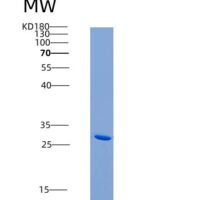
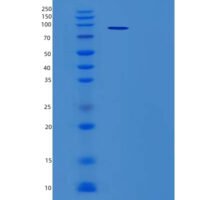
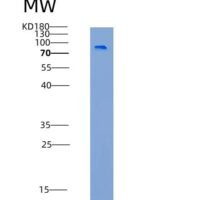
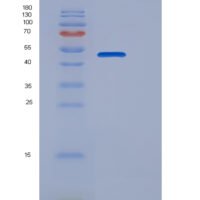
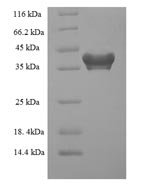
PurityGreater than 90% as determined by SDS-PAGE.
Expression SystemE.coli
Expression Region1-212aa
SpeciesHomo sapiens (Human)
Tag InfoN-terminal 6xHis-SUMO-tagged
Molecular weight40.7kDa
ActivityPlease contact us to obtain bioactivity data.
BufferIf the delivery form is liquid, the default storage buffer is Tris/PBS-based buffer, 5%-50% glycerol. If the delivery form is lyophilized powder, the buffer before lyophilization is Tris/PBS-based buffer, 6% Trehalose.
StorageStore at -20°C/-80°C upon receipt, aliquoting is necessary for mutiple use. Avoid repeated freeze-thaw cycles.
Research AreasSignal Transduction

Function

Promotes cell proliferation. Modulates apoptotic pathways. Increases mitogen-activated protein kinase activity and STK26 activity.

Biological Context

Subcellular Location: Cytoplasm; Golgi apparatus membrane (Peripheral membrane protein); Cell membrane (Peripheral membrane protein)
Tissue Specificity: Ubiquitous
Disease Association: Cerebral cavernous malformations 3 (CCM3) : A form of cerebral cavernous malformations, a congenital vascular anomaly of the central nervous system that can result in hemorrhagic stroke, seizures, recurrent headaches, and focal neurologic deficits. The lesions are characterized by grossly enlarged blood vessels consisting of a single layer of endothelium and without any intervening neural tissue, ranging in diameter from a few millimeters to several centimeters. CCM3 inheritance is autosomal dominant. [The disease is caused by variants affecting the gene represented in this entry]

Product Specifications

Recombinant Human Programmed cell death protein 10 (PDCD10) is a recombinant protein from Homo sapiens (Human), expressed in E.coli, covering amino acids 1-212aa, with N-terminal 6xHis-SUMO-tagged tag, molecular weight 40.7kDa, purity Greater than 90% as determined by SDS-PAGE.. Suitable for ELISA and Western Blot applications.

SDS-PAGE: Single band at expected molecular weight confirming purity.

ELISA: Suitable as coating antigen or detection standard.

Western Blot: Compatible with standard Western Blot protocols.

Protein Interaction: Validated for SPR (Surface Plasmon Resonance) and BLI (Bio-Layer Interferometry) studies.

Shipping: Shipped at ambient temperature. Lyophilized protein is stable during transit.

Storage: Store lyophilized protein at -20°C to -80°C. Reconstituted protein should be aliquoted and stored at -80°C. Avoid repeated freeze-thaw cycles.

Shelf Life: 12 months from date of receipt when stored as recommended.

Shipping Time: Orders placed before 2 PM EST ship same day. International orders typically deliver within 5-10 business days.

Protein Biology

Function

Promotes cell proliferation. Modulates apoptotic pathways. Increases mitogen-activated protein kinase activity and STK26 activity (PubMed:27807006). Important for cell migration, and for normal structure and assembly of the Golgi complex (PubMed:27807006). Part of the striatin-interacting phosphatase and kinase (STRIPAK) complexes. STRIPAK complexes have critical roles in protein (de)phosphorylation and are regulators of multiple signaling pathways including Hippo, MAPK, nuclear receptor and cytoskeleton remodeling. Different types of STRIPAK complexes are involved in a variety of biological processes such as cell growth, differentiation, apoptosis, metabolism and immune regulation (PubMed:18782753). Important for KDR/VEGFR2 signaling. Increases the stability of KDR/VEGFR2 and prevents its breakdown. Required for normal cardiovascular development. Required for normal angiogenesis, vasculogenesis and hematopoiesis during embryonic development (By similarity)

Subcellular Location

Cytoplasm; Golgi apparatus membrane (Peripheral membrane protein); Cell membrane (Peripheral membrane protein)

Disease Association

Cerebral cavernous malformations 3 (CCM3) : A form of cerebral cavernous malformations, a congenital vascular anomaly of the central nervous system that can result in hemorrhagic stroke, seizures, recurrent headaches, and focal neurologic deficits. The lesions are characterized by grossly enlarged blood vessels consisting of a single layer of endothelium and without any intervening neural tissue, ranging in diameter from a few millimeters to several centimeters. CCM3 inheritance is autosomal dominant. [The disease is caused by variants affecting the gene represented in this entry]

Tissue Specificity

Ubiquitous

Subunit

Homodimer (PubMed:20489202). Interacts (via C-terminus) with CCM2 (PubMed:17360971, PubMed:20489202). Interacts (via C-terminus) with PXN (PubMed:20489202). Interacts (via N-terminus) with STK25 (PubMed:17360971, PubMed:20332113). Interacts (via N-terminus) with STK26 (PubMed:17360971, PubMed:20332113, PubMed:27807006). Interacts (via N-terminus) with STK24 (PubMed:20332113, PubMed:27807006). Interacts with GOLGA2 (PubMed:20332113). Identified in a complex with KRIT1 and CCM2. Interacts with KDR/VEGFR2. Interaction with KDR/VEGFR2 is enhanced by stimulation with VEGFA (Ref.5). Interacts with RIPOR1 (via C-terminus); this interaction is required for the association of RIPOR1 with either STK24 and STK26 kinases and occurs in a Rho-independent manner (PubMed:27807006). Part of the core of STRIPAK complexes composed of PP2A catalytic and scaffolding subunits, the striatins (PP2A regulatory subunits), the striatin-associated proteins MOB4, STRIP1 and STRIP2, PDCD10 and members of the STE20 kinases, such as STK24 and STK26 (PubMed:18782753). Found in complex with PGCKA1 and members of the STE20 kinases, such as STK24, STK25 and STK26 (PubMed:38517886)

Gene: PDCD10  |  Organism: Homo sapiens  |  Synonyms: Cerebral cavernous malformations 3 protein; TF-1 cell apoptosis-related protein 15
Key Publications

Frequently Asked Questions

How do I order or inquire about this product?

Fill out the Online Inquiry form with your required quantity and specifications. You can also email sales@biocrestsci.com. Our team typically responds within 4 business hours with a quote and availability confirmation.

What is the shipping and delivery time?

Orders placed before 2 PM EST ship the same day. Domestic (US) delivery typically takes 2-3 business days. International orders deliver within 5-10 business days. All products are shipped at ambient temperature with appropriate packaging to ensure stability.

How should I store this recombinant protein?

Lyophilized proteins should be stored at -20°C to -80°C upon receipt. After reconstitution, aliquot and store at -80°C. Avoid repeated freeze-thaw cycles. Shelf life is 12 months from date of receipt when stored as recommended.

What quality controls are performed on your products?

Each product undergoes SDS-PAGE purity analysis (typically >85-95%), endotoxin testing, and bioactivity validation. Products are validated for ELISA, Western Blot, and SPR/BLI applications as specified on this product page. A Certificate of Analysis (CoA) is available upon request.

Shopping Cart
Scroll to Top