Recombinant Human DNA polymerase theta (POLQ), partial

Recombinant Human DNA polymerase theta (POLQ), partial — Low-fidelity DNA polymerase with a putative helicase activity that promotes microhomology-mediated end-joining (MMEJ), an alternative non-homologous end-joining (NHEJ) machinery required to repair … Purity >85%.

SKU: BCRECP-001416 Category:

Product Specifications

Product SkuBCRECP-001416
Product DescriptionRecombinant Human DNA polymerase theta (POLQ) Protein is expressed from E.coli with C-terminal 6xHis-tagged. It contains 1820-2590aa. [Accession | O75417].
Uniprot No.O75417
Gene NamesPOLQ
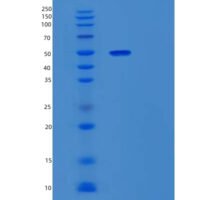
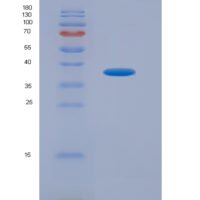
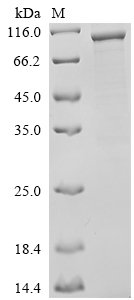
PurityGreater than 85% as determined by SDS-PAGE.
Expression SystemE.coli
Expression Region1820-2590aa
SpeciesHomo sapiens (Human)
Tag InfoC-terminal 6xHis-tagged
Molecular weight87.5kDa
ActivityPlease contact us to obtain bioactivity data.
BufferIf the delivery form is liquid, the default storage buffer is Tris/PBS-based buffer, 5%-50% glycerol. If the delivery form is lyophilized powder, the buffer before lyophilization is Tris/PBS-based buffer, 6% Trehalose.
StorageStore at -20°C/-80°C upon receipt, aliquoting is necessary for mutiple use. Avoid repeated freeze-thaw cycles.
Research AreasOthers

Function

Low-fidelity DNA polymerase with a putative helicase activity that promotes microhomology-mediated end-joining (MMEJ), an alternative non-homologous end-joining (NHEJ) machinery required to repair double-strand breaks in DNA during mitosis. MMEJ is an error-prone repair pathway that produces deletions of sequences from the strand being repaired and promotes genomic rearrangements, such as telomere fusions, some of them leading to cellular transformation. MMEJ is required during mitosis to repair persistent double-strand breaks that originate in S-phase.

Biological Context

Subcellular Location: Nucleus; Chromosome
Tissue Specificity: Highly expressed in testis
Disease Association: Breast cancer (BC) : A common malignancy originating from breast epithelial tissue. Breast neoplasms can be distinguished by their histologic pattern. Invasive ductal carcinoma is by far the most common type. Breast cancer is etiologically and genetically heterogeneous. Important genetic factors have been indicated by familial occurrence and bilateral involvement. Mutations at more than one locus can be involved in different families or even in the same case. [The gene represented in this entry may be involved in disease pathogenesis]

Product Specifications

Recombinant Human DNA polymerase theta (POLQ), partial is a recombinant protein from Homo sapiens (Human), expressed in E.coli, covering amino acids 1820-2590aa, with C-terminal 6xHis-tagged tag, molecular weight 87.5kDa, purity Greater than 85% as determined by SDS-PAGE.. Suitable for ELISA and Western Blot applications.

SDS-PAGE: Single band at expected molecular weight confirming purity.

ELISA: Suitable as coating antigen or detection standard.

Western Blot: Compatible with standard Western Blot protocols.

Protein Interaction: Validated for SPR (Surface Plasmon Resonance) and BLI (Bio-Layer Interferometry) studies.

Shipping: Shipped at ambient temperature. Lyophilized protein is stable during transit.

Storage: Store lyophilized protein at -20°C to -80°C. Reconstituted protein should be aliquoted and stored at -80°C. Avoid repeated freeze-thaw cycles.

Shelf Life: 12 months from date of receipt when stored as recommended.

Shipping Time: Orders placed before 2 PM EST ship same day. International orders typically deliver within 5-10 business days.

Protein Biology

Function

Low-fidelity DNA polymerase with a putative helicase activity that promotes microhomology-mediated end-joining (MMEJ), an alternative non-homologous end-joining (NHEJ) machinery required to repair double-strand breaks in DNA during mitosis (PubMed:14576298, PubMed:18503084, PubMed:24648516, PubMed:25642963, PubMed:25643323, PubMed:25775267, PubMed:26636256, PubMed:27311885, PubMed:27591252, PubMed:30655289, PubMed:31562312, PubMed:32873648, PubMed:34140467, PubMed:34179826, PubMed:36455556, PubMed:37440612, PubMed:37674080). MMEJ is an error-prone repair pathway that produces deletions of sequences from the strand being repaired and promotes genomic rearrangements, such as telomere fusions, some of them leading to cellular transformation (PubMed:25642963, PubMed:25643323, PubMed:25775267, PubMed:27311885, PubMed:27591252, PubMed:31562312, PubMed:32873648). MMEJ is required during mitosis to repair persistent double-strand breaks that originate in S-phase (PubMed:37440612, PubMed:37674080). Although error-prone, MMEJ protects against chromosomal instability and tumorigenesis (By similarity). The polymerase acts by binding directly the 2 ends of resected double-strand breaks, allowing microhomologous sequences in the overhangs to form base pairs (PubMed:25643323, PubMed:25775267, PubMed:27311885, PubMed:27591252). It then extends each strand from the base-paired region using the opposing overhang as a template (PubMed:25643323, PubMed:25775267, PubMed:27311885, PubMed:27591252). Requires partially resected DNA containing 2 to 6 base pairs of microhomology to perform MMEJ (PubMed:25643323, PubMed:25775267, PubMed:27311885, PubMed:27591252). The polymerase lacks proofreading activity and is highly promiscuous: unlike most polymerases, promotes extension of ssDNA and partial ssDNA (pssDNA) substrates (PubMed:18503084, PubMed:21050863, PubMed:22135286). When the ends of a break do not contain terminal microhomology must identify embedded complementary sequences through a scanning step (PubMed:32234782). Promotes dissociation of the replication protein A complex (RPA/RP-A), composed of RPA1, RPA2 and RPA3, from resected double-strand breaks to allow their annealing and subsequent joining by MMEJ (PubMed:36455556). Removal of RPA/RP-A complex proteins prevents RAD51 accumulation at resected ends, thereby inhibiting homology-recombination repair (HR) pathway (PubMed:25642963, PubMed:28695890). Also shows RNA-directed DNA polymerase activity to mediate DNA repair in vitro; however this activity needs additional evidence in vivo (PubMed:34117057). May also have lyase activity (PubMed:19188258). Involved in somatic hypermutation of immunoglobulin genes, a process that requires the activity of DNA polymerases to ultimately introduce mutations at both A/T and C/G base pairs (By similarity). POLQ-mediated end joining activity is involved in random integration of exogenous DNA hampers (PubMed:28695890). DNA helicase activity has been examined and has (PubMed:29444826) and has not (PubMed:14576298, PubMed:36455556) been demonstrated (PubMed:14576298, PubMed:29444826, PubMed:36455556)

Subcellular Location

Nucleus; Chromosome

Disease Association

Breast cancer (BC) : A common malignancy originating from breast epithelial tissue. Breast neoplasms can be distinguished by their histologic pattern. Invasive ductal carcinoma is by far the most common type. Breast cancer is etiologically and genetically heterogeneous. Important genetic factors have been indicated by familial occurrence and bilateral involvement. Mutations at more than one locus can be involved in different families or even in the same case. [The gene represented in this entry may be involved in disease pathogenesis]

Tissue Specificity

Highly expressed in testis

Subunit

Homomultimer; forms homodimers and homotetramers (PubMed:25643323, PubMed:26636256, PubMed:31562312). Interacts with RAD51 (PubMed:25642963). Interacts with ORC2 and ORC4 (PubMed:24989122). Interacts with RHNO1; interaction takes place during mitosis and promotes POLQ recruitment to DNA damage sites (PubMed:37440612). Interacts (when phosphorylated) with TOPBP1 (via BRCT domains 7 and 8); promoting POLQ recruitment to DNA damage sites (PubMed:37674080)

Gene: POLQ  |  Organism: Homo sapiens  |  Synonyms: DNA polymerase eta
Key Publications

Frequently Asked Questions

How do I order or inquire about this product?

Fill out the Online Inquiry form with your required quantity and specifications. You can also email sales@biocrestsci.com. Our team typically responds within 4 business hours with a quote and availability confirmation.

What is the shipping and delivery time?

Orders placed before 2 PM EST ship the same day. Domestic (US) delivery typically takes 2-3 business days. International orders deliver within 5-10 business days. All products are shipped at ambient temperature with appropriate packaging to ensure stability.

How should I store this recombinant protein?

Lyophilized proteins should be stored at -20°C to -80°C upon receipt. After reconstitution, aliquot and store at -80°C. Avoid repeated freeze-thaw cycles. Shelf life is 12 months from date of receipt when stored as recommended.

What quality controls are performed on your products?

Each product undergoes SDS-PAGE purity analysis (typically >85-95%), endotoxin testing, and bioactivity validation. Products are validated for ELISA, Western Blot, and SPR/BLI applications as specified on this product page. A Certificate of Analysis (CoA) is available upon request.

Shopping Cart
Scroll to Top