Function
(Microbial infection) In case of hepatitis C virus/HCV infection, the complex formed by SLC3A2 and SLC7A5/LAT1 plays a role in HCV propagation by facilitating viral entry into host cell and increasing L-leucine uptake-mediated mTORC1 signaling activation, thereby contributing to HCV-mediated pathogenesis.
Biological Context
Subcellular Location: Apical cell membrane (Multi-pass membrane protein); Cell membrane (Multi-pass membrane protein); Lysosome membrane (Multi-pass membrane protein)
Tissue Specificity: Detected in placenta, in the syncytiotrophoblast layer (at protein level). Expressed abundantly in adult lung, liver, brain, skeletal muscle, placenta, bone marrow, testis, resting lymphocytes and monocytes, and in fetal liver. Weaker expression in thymus, cornea, retina, peripheral leukocytes, spleen, kidney, colon and lymph node. During gestation, expression in the placenta was significantly stronger at full-term than at the mid-trimester stage. Also expressed in all human tumor cell lines tested and in the astrocytic process of primary astrocytic gliomas. Expressed in retinal endothelial cells and in the intestinal epithelial cell line Caco-2
Product Specifications
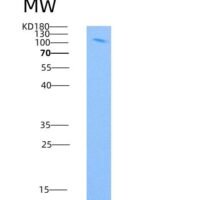
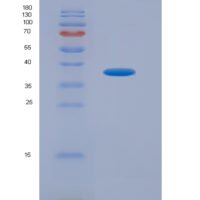
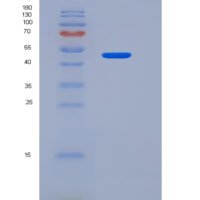
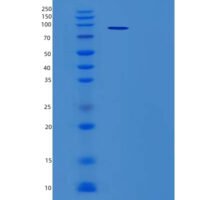
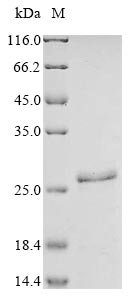
Recombinant Human Large neutral amino acids transporter small subunit 1 (SLC7A5), partial is a recombinant protein from Homo sapiens (Human), expressed in E.coli, covering amino acids 16-50aa, with N-terminal 10xHis-SUMO-tagged and C-terminal Myc-tagged tag, molecular weight 19.7kDa, purity Greater than 90% as determined by SDS-PAGE.. Suitable for ELISA and Western Blot applications.