Function
Neuron-specific restriction factor that prevents herpes simplex virus 1 (HHV-1) infection in the brain by blocking viral entry. Also able to restrict herpes simplex virus 2 (HHV-2) infection, although to a lesser extent. Acts by preventing the association between the viral glycoprotein D (gD) and its cell surface receptor NECTIN1, thereby inhibiting fusion of the virus and the cell membrane.
Biological Context
Subcellular Location: Cell membrane (Single-pass type I membrane protein)
Tissue Specificity: Expressed predominantly in brain, and at lower levels in heart, placenta and skeletal muscle. Down-regulated in brain tumors as compared to control brain tissues
Disease Association: [Encephalopathy, acute, infection-induced, herpes-specific (IIAE). A rare complication of human herpesvirus 1 (HHV-1) infection, occurring in only a small minority of HHV-1 infected individuals. It is characterized by hemorrhagic necrosis of parts of the temporal and frontal lobes. Onset is over several days and involves fever, headache, seizures, stupor, and often coma, frequently with a fatal outcome. Disease susceptibility is associated with variants affecting the gene represented in this entry ]
Product Specifications
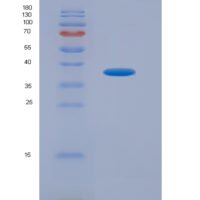
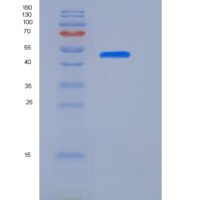
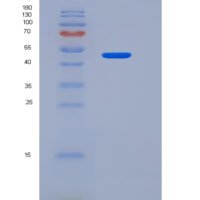
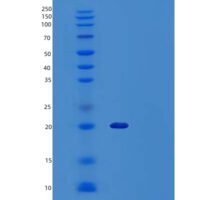
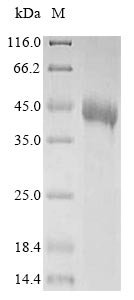
Recombinant Human Tomoregulin-1 (TMEFF1), partial is a recombinant protein from Homo sapiens (Human), expressed in E.coli, covering amino acids 40-330aa, with N-terminal 10xHis-tagged and C-terminal Myc-tagged tag, molecular weight 38.5kDa, purity Greater than 85% as determined by SDS-PAGE.. Suitable for ELISA and Western Blot applications.