
Why Yeast for Recombinant Protein Production?
Yeast expression systems occupy a useful position in the expression system landscape. Unlike E. coli, yeast can perform post-translational modifications including N- and O-linked glycosylation, signal peptide processing, and disulfide bond formation — modifications that are often critical for the stability and biological activity of eukaryotic proteins.
At the same time, yeast retains many practical advantages of microbial systems: rapid growth, well-established genetics, cost-effective fermentation, and the ability to scale to high cell densities without the viral contamination risks associated with mammalian cell culture.
When to Consider Yeast Expression
Your protein is a eukaryotic target that formed inclusion bodies or was inactive in E. coli. It requires disulfide bonds or glycosylation for correct folding. You need higher yields than insect or mammalian systems typically provide at lower cost. You want secreted expression to simplify purification. Or you are working with enzymes, growth factors, cytokines, or glycoproteins at research or early development scale.
Two Yeast Systems, Chosen for Your Target
We work with both major yeast expression hosts. Which one fits your project depends on your protein's characteristics, required yield, and downstream application.
Komagataella phaffii
The workhorse of yeast-based recombinant protein production. The tightly regulated AOX1 promoter enables high-level inducible expression, and the system's ability to grow to very high cell densities often translates to strong volumetric yields. Secretion into the culture medium is a major advantage for downstream processing.
- High cell density growth
- AOX1 / GAP promoters
- Secretory expression
- Disulfide bond formation
- N- & O-glycosylation
- Lower hyperglycosylation vs. S. cer.
- Gram-scale potential
Baker's yeast
The most genetically well-characterized eukaryote. Useful for proteins where you need rapid strain construction, GAL1-inducible or constitutive expression, or when the protein is known to fold well in this host. S. cerevisiae can hyperglycosylate some targets more than P. pastoris — a factor we review during target assessment.
- GAL1 / constitutive promoters
- Secretory & intracellular
- Post-translational modifications
- Rapid genetic manipulation
- Well-established protocols
Target Classes: Proteins Well-Suited for Yeast Expression
Yeast is not the right system for every target. These are the categories where it tends to perform reliably — and where we have accumulated the most experience.
Proteins with multiple disulfide bonds that consistently misfold or form inclusion bodies in bacterial systems. The yeast secretory pathway provides an oxidizing environment conducive to correct disulfide formation.
Targets where glycosylation contributes to folding stability or biological activity. Note that yeast produces high-mannose N-glycans; if human-type complex glycans are essential, mammalian expression should be considered.
Cellulases, lipases, proteases, and other industrial enzymes that benefit from eukaryotic processing. High-yield secretory expression in P. pastoris is particularly well-established.
Recombinant growth factors, receptor ectodomains, and signaling proteins for cell culture, bioassay development, or structural studies where biological activity must be preserved.
Proteins previously attempted in E. coli without success — low yield, insolubility, or lack of activity — where a eukaryotic host is the logical next step before committing to more expensive mammalian systems.
Research-grade protein antigens for immunization, ELISA development, or assay calibration. Yeast offers a practical balance of throughput, yield, and eukaryotic quality.
Platform Strengths
Copper ion-assisted selection identifies high-copy transformants directly — saving 5–10 working days.
Up to 100 mg/L under shake flask for well-expressed targets; gram-scale via fed-batch bioreactor.
25–35 working days end‑to‑end; expedited options available.
No charge if expression fails to meet agreed specifications.
pPic9k, pPic3.5k, pPiczαA + N/C‑terminal tags in parallel.
SDS-PAGE, Western blot, endotoxin, full datasheet with every shipment.
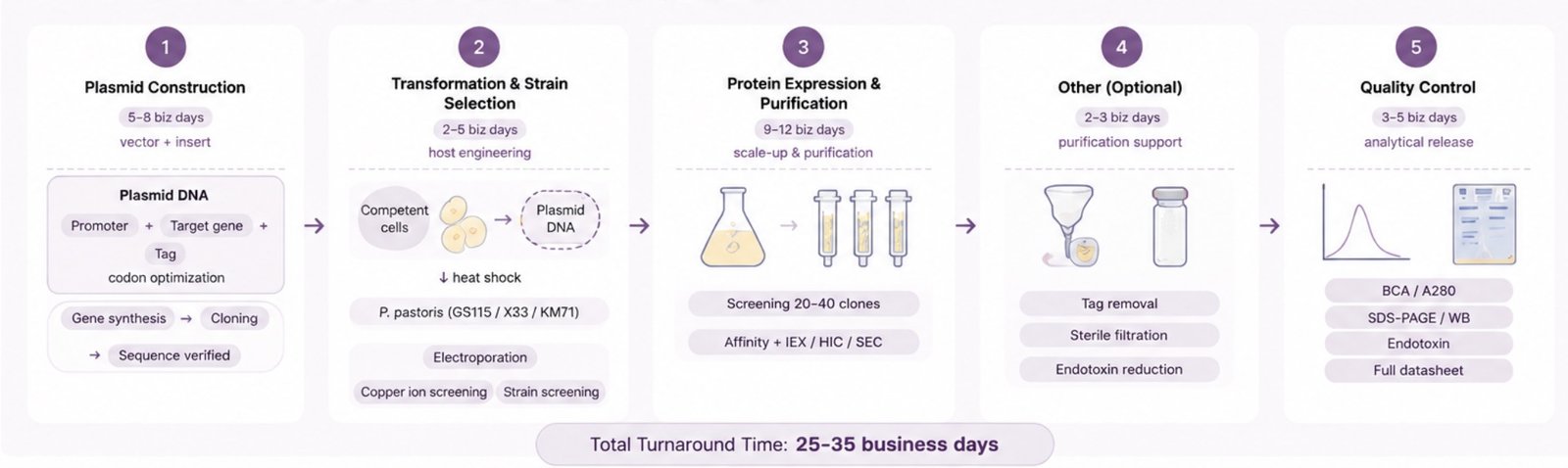
Standard Service Process
| Step | Service Item | Detailed Description | Working Days |
|---|---|---|---|
| 1 | Expression Vector Construction | Codon optimization, full gene synthesis, cloning into pPic9k/pPic3.5k/pPiczαA, verification by sequencing. Multi‑vector optimization in parallel. | 8–10 |
| 2 | Yeast Transformation & Strain Identification | Electroporation into P. pastoris (GS115, X33, KM71). Copper ion‑assisted screening — saves 5–10 days. | 5–18 |
| 3 | Screening, Scale‑Up & Purification | 20–40 clones screened. Affinity + polishing (IEX, HIC, SEC). | 9–12 standard |
| 4 | Additional Custom Services | Tag removal, sterile filtration, endotoxin reduction. | 2–3 |
| 5 | Quality Control & Release | BCA/A280, SDS-PAGE, Western blot, endotoxin, full datasheet. | 3–5 |
Total timeline: 25–35 working days from gene synthesis to purified protein delivery.
Known Limitations of Yeast Expression
We believe informed decisions produce better outcomes. Here is what you should know before choosing yeast for your project.
🧬 Glycosylation Is Not Human-Identical
Pichia pastoris performs N-linked glycosylation, but the resulting glycans are predominantly high-mannose structures. For most research applications — binding studies, enzyme assays, antigen production — this is acceptable. For therapeutic protein development requiring human-like glycosylation, mammalian expression is the appropriate choice.
⚠️ Expression Success Is Not Guaranteed
Yeast expression does not succeed for every target. Difficult proteins — large multi-domain complexes, aggregation-prone sequences, certain membrane proteins — may require iterative optimization. We design projects with realistic scope. We do not claim a universal success rate.
Why Choose BioCrest Sci
No charge if expression fails to meet agreed specs.
Proprietary copper ion‑assisted strain selection.
Shake flask yields for well‑expressed secreted targets.
Efficient end‑to‑end pipeline.
Common Questions — Researchers Usually Ask
Possibly — depends on cause. If eukaryotic chaperones or disulfides are required, yeast may resolve it. We review your sequence and prior data before recommending.
Well‑expressed secreted proteins in P. pastoris can reach up to 100 mg/L in shake flasks. We provide a realistic estimate range and agree on a minimum yield.
Yes. If you have a validated yeast plasmid, we can use it — skipping gene synthesis reduces timeline and cost.
Yes, enzymatic tag removal (~3 days) or tag‑free vectors from the start.
We define minimum yield, purity, and functional specs in writing. If those specs are not met, you are not charged for the expression phase.
Ready to discuss your target?
Share your protein sequence, previous expression history, and intended application.
We'll return a technical assessment and project proposal within 3–5 business days.