
Transmembrane Protein Expression Service
Seven complementary production platforms — from purified nanodiscs to native-membrane particles — built around what your downstream application actually needs.
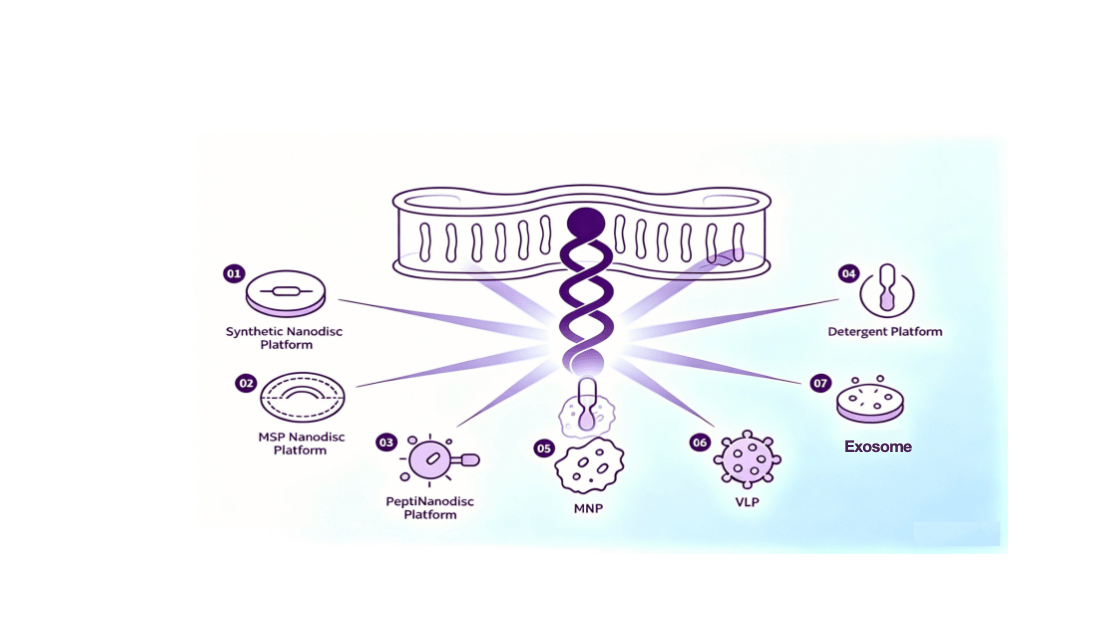
Why seven platforms?
Full-length multi-pass transmembrane proteins — GPCRs, claudins, ion channels, transporters — are notoriously difficult to produce outside their native membrane environment. Detergent extraction disrupts conformational epitopes that matter most for antibody drug discovery.
✅ Our approach: No one-size-fits-all.
7 platforms, all built on the HEK293 mammalian expression system, covering the full spectrum from purified soluble protein to intact native membrane environment.
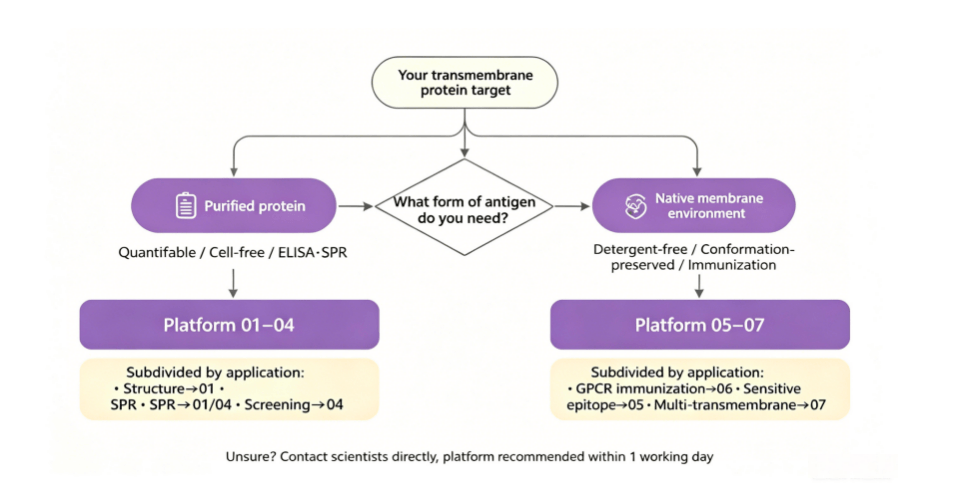
Find your platform in 1 min
Step 1 — What format do you need?
🧪 Purified protein (quantifiable / cell-free / SPR / structural) → Platforms 01–04
🧬 Native membrane environment (detergent-free / intact conformation) → Platforms 05–07
Step 2 — Primary application
Immunization → 05–07 preferred | ELISA/screening → 01–04
Structural biology → 01–03 | Binding kinetics → 01/04
Purified Membrane Protein Platforms
Platforms 01–04: ideal for binding assays, structural biology & biochemical characterization
Native Membrane Platforms
Platforms 05–07: optimal for GPCR immunization & conformationally sensitive epitopes
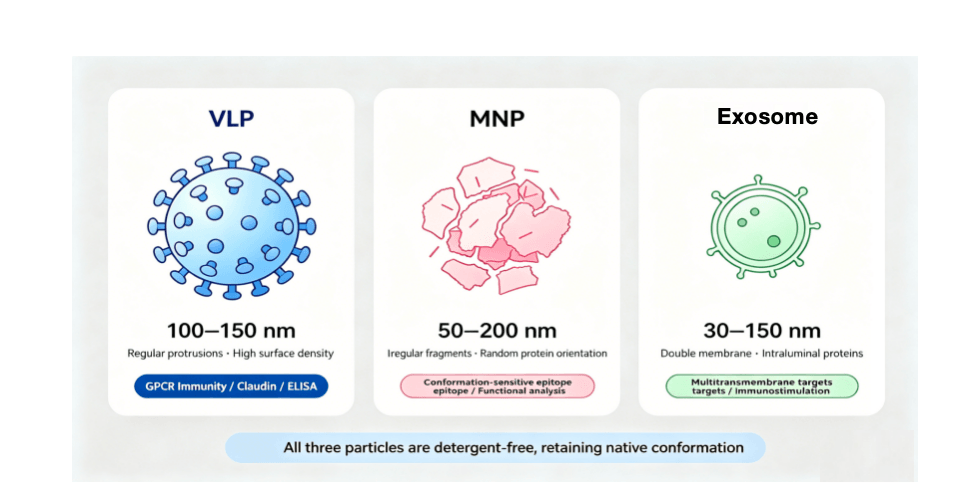
Derived from cell membranes, carries target in native lipid environment, no detergent extraction. Ideal for conformationally sensitive epitopes.
Co-expression with HIV-1 gag drives VLP budding; displays target on enveloped particle surface. Gold-standard for GPCR/claudin immunization.
Naturally secreted exosomes from HEK293 overexpressing your target. Native membrane context, excellent for multi-pass targets.
🎯 Key Applications
- ✓ Therapeutic antibody immunogens (all 7 platforms)
- ✓ Ligand-receptor binding studies (SPR/BLI)
- ✓ In vitro functional assays (GPCR signaling / transport)
- ✓ Structural characterization (cryo-EM)
📌 Supported Target Classes
- ✓ GPCR (Class A/B/C/Frizzled)
- ✓ Claudins (CLDN6, CLDN18.1, CLDN18.2)
- ✓ Ion channels · SLC transporters
- ✓ Viral envelope glycoproteins · Tumor-associated membrane antigens
📦 Standard Deliverables
- ✓ Purified protein / membrane particle prep
- ✓ SDS-PAGE & Western blot
- ✓ Functional binding validation (ELISA)
- ✓ Particle characterization (NTA/TEM/DLS where applicable)
- ✓ Certificate of Analysis (CoA)
Why BioCrest Sci
Deep expertise in multi-pass transmembrane proteins, tailored workflows, and a commitment to delivering native-like conformations for your most challenging targets.
🔬 7-in-1 Flexibility
From nanodiscs to native membrane particles, we offer the most comprehensive platform lineup — no need to force your target into one format.
🧬 HEK293 Mastery
Mammalian expression with native post-translational modifications, correct glycosylation, and near-physiological folding.
⚡ Conformational Integrity
Detergent-free options (MNP, VLP, exosome) preserve fragile epitopes — critical for antibody drug discovery.
📦 End-to-End QC
Full package: SDS-PAGE, functional ELISA, particle characterization (NTA/TEM/DLS), and CoA for every project.
Frequently Asked Questions
Quick answers about platform selection, timelines, and technical capabilities.
Typical timelines range from 6 to 9 weeks from gene synthesis to first QC data. This depends on target complexity, expression level, and selected platform. Our project managers provide a detailed timeline during project kick-off.
For GPCR immunization, we strongly recommend native membrane platforms: VLP (Platform 06) or MNP (Platform 05). Both preserve conformational epitopes without detergents, leading to higher-quality antibody responses. Exosome platform (07) is also effective for multi-pass targets.
Synthetic Nanodisc (01) and Detergent Platform (04) allow absolute quantification. For MSP Nanodisc (02), PeptiNanodisc (03) and native membrane formats (05–07), yields are semi-quantitative but fully characterized for functional assays and immunization campaigns. We always include QC data.
Yes. Our core expertise covers multi-pass transmembrane proteins including Claudin family (CLDN6, 18.1, 18.2), GPCRs, ion channels, and solute carriers (SLCs). We routinely express full-length, properly folded multi-spanning targets using our optimized HEK293 platforms.
Every project includes a full QC package: SDS-PAGE and/or Western blot, functional binding validation (ELISA or equivalent), particle characterization (NTA, TEM, DLS when applicable), and a Certificate of Analysis (CoA) detailing production conditions and analytical results.
Ready to Discuss Your Target?
Share your target, application, and timeline. Our scientists will recommend the most appropriate platform, assess feasibility, and provide a detailed project proposal.
Typical timeline: Gene synthesis → first QC data in 6–9 weeks (varies by target complexity)