Recombinant Clostridium botulinum D phage Botulinum neurotoxin type D (botD), partial

Recombinant Clostridium botulinum D phage Botulinum neurotoxin type D (botD), partial — Responsible for host epithelial cell transcytosis, host nerve cell targeting and translocation of light chain (LC) into eukaryotic host cell cytosol. Purity >85%.

SKU: BCRECP-002224 Category:

Product Specifications

Product SkuBCRECP-002224
Product DescriptionRecombinant Clostridium botulinum D phage Botulinum neurotoxin type D (botD) Protein is expressed from E.coli with N-terminal 6xHis-B2M-tagged. It contains 1-442aa. [Accession | P19321].
Uniprot No.P19321
Gene NamesbotD
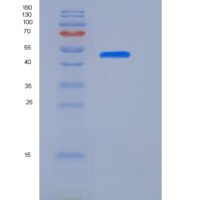
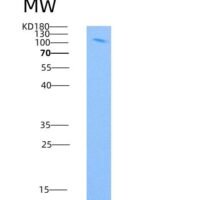
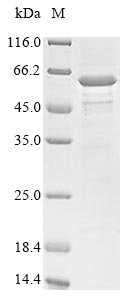
PurityGreater than 85% as determined by SDS-PAGE.
Expression SystemE.coli
Expression Region1-442aa
SpeciesClostridium botulinum
Tag InfoN-terminal 6xHis-B2M-tagged
Molecular weight64.5kDa
ActivityPlease contact us to obtain bioactivity data.
BufferIf the delivery form is liquid, the default storage buffer is Tris/PBS-based buffer, 5%-50% glycerol. If the delivery form is lyophilized powder, the buffer before lyophilization is Tris/PBS-based buffer, 6% Trehalose.
StorageStore at -20°C/-80°C upon receipt, aliquoting is necessary for mutiple use. Avoid repeated freeze-thaw cycles.
Research AreasOthers

Function

Responsible for host epithelial cell transcytosis, host nerve cell targeting and translocation of light chain (LC) into eukaryotic host cell cytosol. Composed of 3 subdomains; the translocation domain (TD), and N-terminus and C-terminus of the receptor-binding domain (RBD). The RBD is responsible for the adherence of the toxin to the eukaryotic target cell surface.

Biological Context

Subcellular Location: Secreted

Product Specifications

Recombinant Clostridium botulinum D phage Botulinum neurotoxin type D (botD), partial is a recombinant protein from Clostridium botulinum, expressed in E.coli, covering amino acids 1-442aa, with N-terminal 6xHis-B2M-tagged tag, molecular weight 64.5kDa, purity Greater than 85% as determined by SDS-PAGE.. Suitable for ELISA and Western Blot applications.
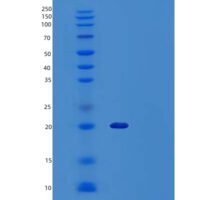
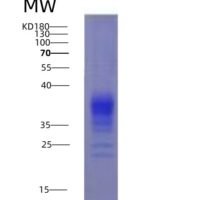
SDS-PAGE: Single band at expected molecular weight confirming purity.

ELISA: Suitable as coating antigen or detection standard.

Western Blot: Compatible with standard Western Blot protocols.

Protein Interaction: Validated for SPR (Surface Plasmon Resonance) and BLI (Bio-Layer Interferometry) studies.

Shipping: Shipped at ambient temperature. Lyophilized protein is stable during transit.

Storage: Store lyophilized protein at -20°C to -80°C. Reconstituted protein should be aliquoted and stored at -80°C. Avoid repeated freeze-thaw cycles.

Shelf Life: 12 months from date of receipt when stored as recommended.

Shipping Time: Orders placed before 2 PM EST ship same day. International orders typically deliver within 5-10 business days.

Protein Biology

Function

Responsible for host epithelial cell transcytosis, host nerve cell targeting and translocation of light chain (LC) into eukaryotic host cell cytosol. Composed of 3 subdomains; the translocation domain (TD), and N-terminus and C-terminus of the receptor-binding domain (RBD). The RBD is responsible for the adherence of the toxin to the eukaryotic target cell surface. The N-terminus of the TD wraps an extended belt around the perimeter of the LC, protecting Zn(2+) in the active site; it may also prevent premature LC dissociation from the translocation channel and protect toxin prior to translocation (PubMed:17907800). The TD inserts into synaptic vesicle membrane to allow translocation into the host cytosol (By similarity). The RBD binds eukaryotic host phosphatidylethanolamine, which may serve as toxin receptor (PubMed:16115873). Treatment of synaptosomes with proteinase K does not reduce HC binding, suggesting there is no protein receptor or it is protected from extracellular proteases (PubMed:16115873). HC significantly decreases uptake and toxicity of whole BoNT/D (PubMed:19650874, PubMed:21483489). HC also interferes with uptake of tetanus toxin (PubMed:19650874). Has 2 closely located carbohydrate-binding receptor sites and binds at least 1 GT1b ganglioside (PubMed:20704566). Bind gangliosides in the order GD2 > GT1b > GD1b (PubMed:21632541). Interacts with eukaryotic target protein SV2B (synaptic vesicle glycoprotein 2B) (PubMed:21483489). Expression of SV2A, SV2B or SV2C in mice knocked-out for the SV2 proteins restores entry of BoNT/D and cleavage of VAMP2, suggesting SV2 acts as its receptor (PubMed:21483489). Unlike BoNT/A and BoNT/E, toxin uptake is not mediated by large extracellular loop 4 of SV2 (PubMed:21483489). Another group finds very poor interaction with SV2 proteins, suggesting the possible protein receptor may not have been identified (PubMed:21632541)

Subcellular Location

Secreted

Subunit

Heterodimer; disulfide-linked heterodimer of a light chain (LC) and a heavy chain (HC) (PubMed:26324071). The LC has the proteolytic/pharmacological activity (PubMed:8175689, PubMed:8197120). The N- and C-termini of the HC mediate channel formation and eukaryotic host cell binding, respectively. Can also be purified in complex with a non-toxic component that is larger than the HC (PubMed:16252491). Single chain toxin from strain D-4947 copurifies with NTHNA, and in complexes that include NTNHA, HA-70, HA-33 and HA-17 (PubMed:11713244, PubMed:17581814). Dichain toxin from strain CB-16 phage d-16 phi copurifies with NTHNA, and in complexes that include NTNHA, HA-55, HA-33, HA-22 and HA-17 (PubMed:8569530). The stoichiometry of the whole complex has been modeled as one BoNT/D, one NTNHA, three HA-70, six HA-33 and three HA-17 (PubMed:17581814). HC interacts with eukaryotic protein synaptic vesicle glycoprotein 2B (SV2B), which may serve as its receptor (PubMed:21483489). Another group does not find a convincing interaction with SV2 (PubMed:21632541)

Gene: botD  |  Organism: Clostridium botulinum D phage  |  Synonyms: Bontoxilysin-D
Key Publications

Frequently Asked Questions

How do I order or inquire about this product?

Fill out the Online Inquiry form with your required quantity and specifications. You can also email sales@biocrestsci.com. Our team typically responds within 4 business hours with a quote and availability confirmation.

What is the shipping and delivery time?

Orders placed before 2 PM EST ship the same day. Domestic (US) delivery typically takes 2-3 business days. International orders deliver within 5-10 business days. All products are shipped at ambient temperature with appropriate packaging to ensure stability.

How should I store this recombinant protein?

Lyophilized proteins should be stored at -20°C to -80°C upon receipt. After reconstitution, aliquot and store at -80°C. Avoid repeated freeze-thaw cycles. Shelf life is 12 months from date of receipt when stored as recommended.

What quality controls are performed on your products?

Each product undergoes SDS-PAGE purity analysis (typically >85-95%), endotoxin testing, and bioactivity validation. Products are validated for ELISA, Western Blot, and SPR/BLI applications as specified on this product page. A Certificate of Analysis (CoA) is available upon request.

Shopping Cart
Scroll to Top