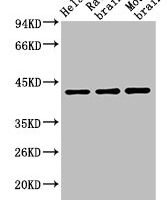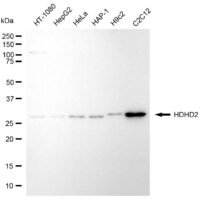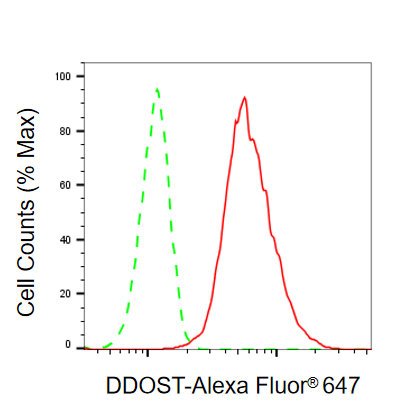
Mouse anti-Human/Mouse/Rat sapiens (Human) DDOST Monoclonal Antibody

Mouse anti-Human/Mouse/Rat sapiens (Human) DDOST Monoclonal Antibody — Subunit of the oligosaccharyl transferase (OST) complex that catalyzes the initial transfer of a defined glycan (Glc(3)Man(9)GlcNAc(2) in eukaryotes) from the lipid carrier dolichol-pyrophosphate t…

SKU: BCREC-000951MA Category:

Product Specifications

Uniprot No.P39656
Target NamesDDOST
Species ReactivityMouse
ImmunogenRecombinant Human DDOST protein
Immunogen SpeciesHomo sapiens (Human)
ConjugateNon-conjugated
IsotypeMouse IgG1
ClonalityMonoclonal
ApplicationsELISA, WB, FC
BufferPBS, 50% glycerol, 0.05% Proclin 300, 0.05%BSA
StorageUpon receipt, store at -20°C or -80°C. Avoid repeated freeze.

Function

Subunit of the oligosaccharyl transferase (OST) complex that catalyzes the initial transfer of a defined glycan (Glc(3)Man(9)GlcNAc(2) in eukaryotes) from the lipid carrier dolichol-pyrophosphate to an asparagine residue within an Asn-X-Ser/Thr consensus motif in nascent polypeptide chains, the first step in protein N-glycosylation. N-glycosylation occurs cotranslationally and the complex associates with the Sec61 complex at the channel-forming translocon complex that mediates protein translocation across the endoplasmic reticulum (ER). All subunits are required for a maximal enzyme activity.

Biological Context

Subcellular Location: Endoplasmic reticulum membrane (Single-pass type I membrane protein)
Disease Association: Congenital disorder of glycosylation 1R (CDG1R) : A form of congenital disorder of glycosylation, a multisystem disorder caused by a defect in glycoprotein biosynthesis and characterized by under-glycosylated serum glycoproteins. Congenital disorders of glycosylation result in a wide variety of clinical features, such as defects in the nervous system development, psychomotor retardation, dysmorphic features, hypotonia, coagulation disorders, and immunodeficiency. The broad spectrum of features reflects the critical role of N-glycoproteins during embryonic development, differentiation, and maintenance of cell functions. [The disease is caused by variants affecting the gene represented in this entry]
Pathway: Protein modification; protein glycosylation

Product Specifications

Mouse anti-Human/Mouse/Rat sapiens (Human) DDOST Monoclonal Antibody is a recombinant protein. Suitable for ELISA and Western Blot applications.

Applications: ELISA, WB, FC

Biological Activity: Not implied unless activity data are explicitly listed on this product page, the datasheet, or the CoA.

Storage: Upon receipt, store at -20°C or -80°C. Avoid repeated freeze.

Shipping & Lead Time: Availability, shipping conditions, and estimated lead time are confirmed in the formal quotation or order confirmation based on the product format, destination, and order requirements.

Protein Biology

Function

Subunit of the oligosaccharyl transferase (OST) complex that catalyzes the initial transfer of a defined glycan (Glc(3)Man(9)GlcNAc(2) in eukaryotes) from the lipid carrier dolichol-pyrophosphate to an asparagine residue within an Asn-X-Ser/Thr consensus motif in nascent polypeptide chains, the first step in protein N-glycosylation (PubMed:31831667). N-glycosylation occurs cotranslationally and the complex associates with the Sec61 complex at the channel-forming translocon complex that mediates protein translocation across the endoplasmic reticulum (ER). All subunits are required for a maximal enzyme activity (By similarity). Required for the assembly of both SST3A- and SS3B-containing OST complexes (PubMed:22467853)

Subcellular Location

Endoplasmic reticulum membrane (Single-pass type I membrane protein)

Disease Association

Congenital disorder of glycosylation 1R (CDG1R) : A form of congenital disorder of glycosylation, a multisystem disorder caused by a defect in glycoprotein biosynthesis and characterized by under-glycosylated serum glycoproteins. Congenital disorders of glycosylation result in a wide variety of clinical features, such as defects in the nervous system development, psychomotor retardation, dysmorphic features, hypotonia, coagulation disorders, and immunodeficiency. The broad spectrum of features reflects the critical role of N-glycoproteins during embryonic development, differentiation, and maintenance of cell functions. [The disease is caused by variants affecting the gene represented in this entry]

Subunit

Component of the oligosaccharyltransferase (OST) complex (PubMed:31831667, PubMed:36697828, PubMed:38670073). OST exists in two different complex forms which contain common core subunits RPN1, RPN2, OST48, OST4, DAD1 and TMEM258, either STT3A or STT3B as catalytic subunits, and form-specific accessory subunits (PubMed:23606741, PubMed:25135935, PubMed:31831667, PubMed:36697828, PubMed:38670073). STT3A complex assembly occurs through the formation of 3 subcomplexes. Subcomplex 1 contains RPN1 and TMEM258, subcomplex 2 contains the STT3A-specific subunits STT3A, DC2/OSTC, and KCP2 as well as the core subunit OST4, and subcomplex 3 contains RPN2, DAD1, and OST48. The STT3A complex can form stable complexes with the Sec61 complex or with both the Sec61 and TRAP complexes (By similarity). Interacts with SMIM22 (PubMed:29765154)

Pathway

Protein modification; protein glycosylation

Gene: DDOST  |  Organism: Homo sapiens
Key Publications

Frequently Asked Questions

How do I order or inquire about this product?

Submit the Online Inquiry form with your required quantity and specifications, or email sales@biocrestsci.com. Available sizes, pricing, stock status, documentation, and estimated lead time are confirmed in the formal quotation.

What is the shipping and delivery time?

Availability, dispatch timing, shipping conditions, and delivery estimates depend on the product format, destination, and order requirements. These details are confirmed in the formal quotation or order confirmation.

How should this product be stored?

Follow the storage and handling instructions in the product-specific datasheet and Certificate of Analysis (CoA). Requirements may vary by product form and formulation; contact BioCrest Sci if product-specific guidance is needed.

What quality controls are performed on your products?

Quality-control data such as identity, purity, endotoxin level, or biological activity are provided only when specified on this product page, the datasheet, or Certificate of Analysis (CoA). Biological activity is not implied unless explicitly stated.

Shopping Cart
Scroll to Top