Function
Scaffold protein in the commander complex that is essential for endosomal recycling of transmembrane cargos; the commander complex is composed of the CCC subcomplex and the retriever subcomplex (PubMed:37172566, PubMed:38459129). Can modulate activity of cullin-RING E3 ubiquitin ligase (CRL) complexes by displacing CAND1; in vitro promotes CRL E3 activity and dissociates CAND1 from CUL1 and CUL2 (PubMed:21778237). Promotes ubiquitination of NF-kappa-B subunit RELA and its subsequent proteasomal degradation. Down-regulates NF-kappa-B activity (PubMed:15799966, PubMed:17183367, PubMed:20048074). Involved in the regulation of membrane expression and ubiquitination of SLC12A2 (PubMed:23515529). Modulates Na(+) transport in epithelial cells by regulation of apical cell surface expression of amiloride-sensitive sodium channel (ENaC) subunits and by promoting their ubiquitination presumably involving NEDD4L. Promotes the localization of SCNN1D to recycling endosomes (PubMed:14645214, PubMed:20237237, PubMed:21741370). Promotes CFTR cell surface expression through regulation of its ubiquitination (PubMed:21483833). Down-regulates SOD1 activity by interfering with its homodimerization (PubMed:20595380). Plays a role in copper ion homeostasis. Involved in copper-dependent ATP7A trafficking between the trans-Golgi network and vesicles in the cell periphery; the function is proposed to depend on its association within the CCC complex and cooperation with the WASH complex on early endosomes (PubMed:25355947). Can bind one copper ion per monomer (PubMed:17309234). May function to facilitate biliary copper excretion within hepatocytes. Binds to phosphatidylinositol 4,5-bisphosphate (PtdIns(4,5)P2) (PubMed:18940794). Involved in the regulation of HIF1A-mediated transcription; competes with ARNT/Hif-1-beta for binding to HIF1A resulting in decreased DNA binding and impaired transcriptional activation by HIF-1 (PubMed:20458141). Negatively regulates neuroblastoma G1/S phase cell cycle progression and cell proliferation by stimulating ubiquitination of NF-kappa-B subunit RELA and NF-kappa-B degradation in a FAM107A- and actin-dependent manner (PubMed:28604741)
Tissue Specificity
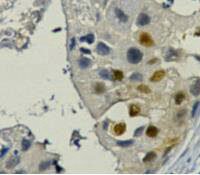
Ubiquitous. Highest expression in the liver, with lower expression in brain, lung, placenta, pancreas, small intestine, heart, skeletal muscle, kidney and placenta. Down-regulated in cancer tissues
Subunit
Component of the commander complex consisting of the CCC subcomplex and the retriever subcomplex (PubMed:37172566, PubMed:38459129, PubMed:25355947, PubMed:28892079, PubMed:15799966). Component of the CCC (COMMD/CCDC22/CCDC93) subcomplex consisting of COMMD1, COMMD2, COMMD3, COMMD4, COMMD5, COMMD6, COMMD7, COMMD8, COMMD9, COMMD10, CCDC22 and CCDC93; within the complex forms a heterodimer with COMMD6 (PubMed:37172566, PubMed:38459129, PubMed:15799966, PubMed:23563313, PubMed:25355947, PubMed:28892079). Interacts with VPS35L; the interaction associates the CCC complex with the retriever complex (PubMed:25355947, PubMed:28892079). Identified in a complex with an E3 ubiquitin ligase complex composed of TCEB1/elongin C, CUL2, SOCS1 and RBX1; in the complex interacts directly with SOCS1 and CUL2 (PubMed:17183367). Identified in a complex with NF-kappa-B (PubMed:16573520). Interacts directly with SLC12A2 (PubMed:23515529). Interacts directly with ATP7B (via the N-terminal region) (PubMed:12968035, PubMed:17919502). Interacts with ATP7A (PubMed:21667063). Interacts with FAM107A; this interaction stabilizes COMMD1 in the nucleus (PubMed:28604741). Interacts with CCS, CDKN2A, RELA, REL, RELB, NFKB1/p105, NFKB2/p100, NFKBIB, SCNN1D, SCNN1B, CFTR, CLU, SGK1, AKT1, CUL1, CUL2, CUL3, CUL4A, CUL4B, CUL5, CUL7, HIF1A (PubMed:14645214, PubMed:16573520, PubMed:18305112, PubMed:20237237, PubMed:20595380, PubMed:20458141, PubMed:20068069, PubMed:21778237, PubMed:21483833, PubMed:23637203, PubMed:23563313, PubMed:25074812)