Recombinant Clostridium botulinum D phage Botulinum neurotoxin type D (botD), partial

Recombinant Clostridium botulinum D phage Botulinum neurotoxin type D (botD), partial — Responsible for host epithelial cell transcytosis, host nerve cell targeting and translocation of light chain (LC) into eukaryotic host cell cytosol. Purity >85%.

SKU: BCRECP-002224 Category:

Product Specifications

Product SkuBCRECP-002224
Product DescriptionRecombinant Clostridium botulinum D phage Botulinum neurotoxin type D (botD) Protein is expressed from E.coli with N-terminal 6xHis-B2M-tagged. It contains 1-442aa. [Accession | P19321].
Uniprot No.P19321
Gene NamesbotD
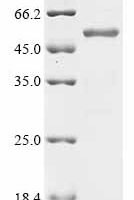
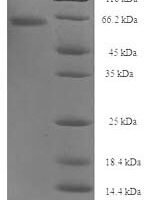
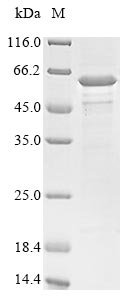
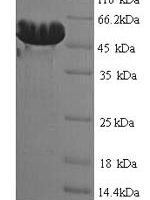
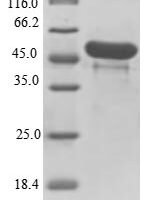
PurityGreater than 85% as determined by SDS-PAGE.
Expression SystemE.coli
Expression Region1-442aa
SpeciesClostridium botulinum
Tag InfoN-terminal 6xHis-B2M-tagged
Molecular weight64.5kDa
ActivityPlease contact us to obtain bioactivity data.
BufferIf the delivery form is liquid, the default storage buffer is Tris/PBS-based buffer, 5%-50% glycerol. If the delivery form is lyophilized powder, the buffer before lyophilization is Tris/PBS-based buffer, 6% Trehalose.
StorageStore at -20°C/-80°C upon receipt, aliquoting is necessary for mutiple use. Avoid repeated freeze-thaw cycles.
Research AreasOthers

Function

Responsible for host epithelial cell transcytosis, host nerve cell targeting and translocation of light chain (LC) into eukaryotic host cell cytosol. Composed of 3 subdomains; the translocation domain (TD), and N-terminus and C-terminus of the receptor-binding domain (RBD). The RBD is responsible for the adherence of the toxin to the eukaryotic target cell surface.

Biological Context

Subcellular Location: Secreted

Product Specifications

Recombinant Clostridium botulinum D phage Botulinum neurotoxin type D (botD), partial is a recombinant protein from Clostridium botulinum, expressed in E.coli, covering amino acids 1-442aa, with N-terminal 6xHis-B2M-tagged tag, molecular weight 64.5kDa, purity Greater than 85% as determined by SDS-PAGE.. Suitable for ELISA and Western Blot applications.
Recommended applications depend on the target, product format, and product-specific validation data. Refer to the product datasheet or Certificate of Analysis (CoA), or contact BioCrest Sci for application guidance.

Biological Activity: Please contact us to obtain bioactivity data.

Storage: Store at -20°C/-80°C upon receipt, aliquoting is necessary for mutiple use. Avoid repeated freeze-thaw cycles.

Shipping & Lead Time: Availability, shipping conditions, and estimated lead time are confirmed in the formal quotation or order confirmation based on the product format, destination, and order requirements.

Protein Biology

Function

Responsible for host epithelial cell transcytosis, host nerve cell targeting and translocation of light chain (LC) into eukaryotic host cell cytosol. Composed of 3 subdomains; the translocation domain (TD), and N-terminus and C-terminus of the receptor-binding domain (RBD). The RBD is responsible for the adherence of the toxin to the eukaryotic target cell surface. The N-terminus of the TD wraps an extended belt around the perimeter of the LC, protecting Zn(2+) in the active site; it may also prevent premature LC dissociation from the translocation channel and protect toxin prior to translocation (PubMed:17907800). The TD inserts into synaptic vesicle membrane to allow translocation into the host cytosol (By similarity). The RBD binds eukaryotic host phosphatidylethanolamine, which may serve as toxin receptor (PubMed:16115873). Treatment of synaptosomes with proteinase K does not reduce HC binding, suggesting there is no protein receptor or it is protected from extracellular proteases (PubMed:16115873). HC significantly decreases uptake and toxicity of whole BoNT/D (PubMed:19650874, PubMed:21483489). HC also interferes with uptake of tetanus toxin (PubMed:19650874). Has 2 closely located carbohydrate-binding receptor sites and binds at least 1 GT1b ganglioside (PubMed:20704566). Bind gangliosides in the order GD2 > GT1b > GD1b (PubMed:21632541). Interacts with eukaryotic target protein SV2B (synaptic vesicle glycoprotein 2B) (PubMed:21483489). Expression of SV2A, SV2B or SV2C in mice knocked-out for the SV2 proteins restores entry of BoNT/D and cleavage of VAMP2, suggesting SV2 acts as its receptor (PubMed:21483489). Unlike BoNT/A and BoNT/E, toxin uptake is not mediated by large extracellular loop 4 of SV2 (PubMed:21483489). Another group finds very poor interaction with SV2 proteins, suggesting the possible protein receptor may not have been identified (PubMed:21632541)

Subcellular Location

Secreted

Subunit

Heterodimer; disulfide-linked heterodimer of a light chain (LC) and a heavy chain (HC) (PubMed:26324071). The LC has the proteolytic/pharmacological activity (PubMed:8175689, PubMed:8197120). The N- and C-termini of the HC mediate channel formation and eukaryotic host cell binding, respectively. Can also be purified in complex with a non-toxic component that is larger than the HC (PubMed:16252491). Single chain toxin from strain D-4947 copurifies with NTHNA, and in complexes that include NTNHA, HA-70, HA-33 and HA-17 (PubMed:11713244, PubMed:17581814). Dichain toxin from strain CB-16 phage d-16 phi copurifies with NTHNA, and in complexes that include NTNHA, HA-55, HA-33, HA-22 and HA-17 (PubMed:8569530). The stoichiometry of the whole complex has been modeled as one BoNT/D, one NTNHA, three HA-70, six HA-33 and three HA-17 (PubMed:17581814). HC interacts with eukaryotic protein synaptic vesicle glycoprotein 2B (SV2B), which may serve as its receptor (PubMed:21483489). Another group does not find a convincing interaction with SV2 (PubMed:21632541)

Gene: botD  |  Organism: Clostridium botulinum D phage  |  Synonyms: Bontoxilysin-D
Key Publications

Frequently Asked Questions

How do I order or inquire about this product?

Submit the Online Inquiry form with your required quantity and specifications, or email sales@biocrestsci.com. Available sizes, pricing, stock status, documentation, and estimated lead time are confirmed in the formal quotation.

What is the shipping and delivery time?

Availability, dispatch timing, shipping conditions, and delivery estimates depend on the product format, destination, and order requirements. These details are confirmed in the formal quotation or order confirmation.

How should this product be stored?

Follow the storage and handling instructions in the product-specific datasheet and Certificate of Analysis (CoA). Requirements may vary by product form and formulation; contact BioCrest Sci if product-specific guidance is needed.

What quality controls are performed on your products?

Quality-control data such as identity, purity, endotoxin level, or biological activity are provided only when specified on this product page, the datasheet, or Certificate of Analysis (CoA). Biological activity is not implied unless explicitly stated.

Shopping Cart
Scroll to Top