Function
A component of desmosome cell-cell junctions which are required for positive regulation of cellular adhesion. Critical for cell-cell adhesion in early stage blastocysts and progression through proamniotic cavity formation. Not required for preimplantation morphogenic process in blastocysts.
Biological Context
Subcellular Location: Cell projection, axon; Cell junction, desmosome; Cell membrane; Cytoplasm; Nucleus
Tissue Specificity: Resides predominantly in tissues and cells of stratified origin
Disease Association: Keratoderma, palmoplantar, striate 2 (SPPK2) : A dermatological disorder characterized by thickening of the skin on the palms (linear pattern) and the soles (island-like pattern) and flexor aspect of the fingers. Abnormalities of the nails, the teeth and the hair are rarely present. [The disease is caused by variants affecting the gene represented in this entry] | Cardiomyopathy, dilated, with woolly hair and keratoderma (DCWHK) : An autosomal recessive cardiocutaneous syndrome characterized by a generalized striate keratoderma particularly affecting the palmoplantar epidermis, woolly hair, and dilated left ventricular cardiomyopathy. [The disease is caused by variants affecting the gene represented in this entry] | Arrhythmogenic right ventricular dysplasia, familial, 8 (ARVD8) : A congenital heart disease characterized by infiltration of adipose and fibrous tissue into the right ventricle and loss of myocardial cells, resulting in ventricular and supraventricular arrhythmias. [The disease is caused by variants affecting the gene represented in this entry] | Epidermolysis bullosa, lethal acantholytic (EBLA) : A form of epidermolysis bullosa characterized by severe fragility of skin and mucous membranes. The phenotype is lethal in the neonatal period because of immense transcutaneous fluid loss. Typical features include universal alopecia, neonatal teeth, and nail loss. Histopathology of the skin shows suprabasal clefting and acantholysis throughout the spinous layer, mimicking pemphigus. [The disease is caused by variants affecting the gene represented in this entry] | Erythroderma, congenital, with palmoplantar keratoderma, hypotrichosis, and hyper IgE (EPKHE) : A syndrome characterized by severe dermatitis, multiple allergies and metabolic wasting. Clinical features include erythroderma, yellowish papules and plaques arranged at the periphery of the palms, along the fingers and over weight-bearing areas of the feet, skin erosions and scaling, and hypotrichosis. Additionally, patients manifest severe food allergies, elevated immunoglobulin E (IgE) levels and recurrent infections with marked metabolic wasting. [The disease is caused by variants affecting the gene represented in this entry] | Cardiomyopathy, dilated, with woolly hair, keratoderma, and tooth agenesis (DCWHKTA) : A cardiocutaneous syndrome characterized by biventricular dilated cardiomyopathy, hyperkeratosis, woolly hair, palmoplantar keratoderma, and hypo/oligodontia. [The disease is caused by variants affecting the gene represented in this entry]
Product Specifications
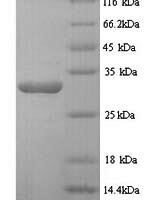
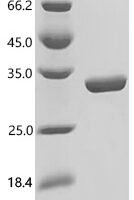
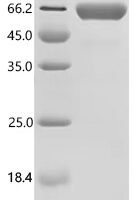
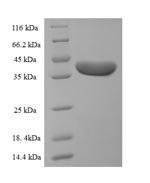
Recombinant Human Desmoplakin (DSP), partial is a recombinant protein from Homo sapiens (Human), expressed in E.coli, covering amino acids 78-300aa, with N-terminal 6xHis-SUMO-tagged tag, molecular weight 42.1kDa, purity Greater than 90% as determined by SDS-PAGE.. Suitable for ELISA and Western Blot applications.