,

Recombinant Human Fibroblast growth factor 4 (FGF4), partial (Active)

Recombinant Human Fibroblast growth factor 4 (FGF4), partial (Active) — Plays an important role in the regulation of embryonic development, cell proliferation, and cell differentiation. Purity >95%.

SKU: BCACP-001215 Categories: ,
Product SKUBCACP-001215
Product DescriptionRecombinant Human Fibroblast growth factor 4 (FGF4) protein is expressed from E.coli with Tag-Free. It contains 54-206aa. [Accession | P08620].
Uniprot No.P08620
Gene NamesFGF4
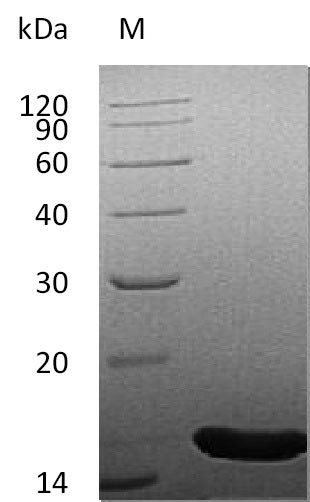
PurityGreater than 95% as determined by SDS-PAGE.
Expression SystemE.coli
Expression Region54-206aa
SpeciesHomo sapiens (Human)
Tag InfoTag-Free
Molecular weight16.9 kDa
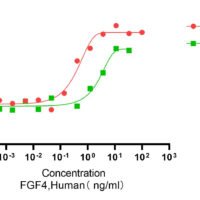
ActivityThe ED50 as determined in a cell proliferation assay using BALB/c 3T3 cells is 21.87 ng/ml.
BufferLyophilized from a 0.2 μm filtered 20 mM Tris-HCl, 0.5 M NaCl, 6% Trehalose, pH 8.0
StorageStore at -20°C/-80°C upon receipt, aliquoting is necessary for mutiple use. Avoid repeated freeze-thaw cycles.
Alternative NamesFGF-4; Fgf4; FGF4_HUMAN; Fibroblast growth factor 4; fibroblast growth factor 4 splice isoform; HBGF-4; HBGF4; Heparin secretory-transforming protein 1; Heparin-binding growth factor 4; Hst; HST-1; HST1; HSTF-1; HSTF1; Human stomach cancer transforming factor from FGF related oncogene; K FGF; Kaposi Sarcoma Oncogene; KFGF; KS3; Oncogene HST; Transforming protein KS3

Function

Plays an important role in the regulation of embryonic development, cell proliferation, and cell differentiation. Required for normal limb and cardiac valve development during embryogenesis. May play a role in embryonic molar tooth bud development via inducing the expression of MSX1, MSX2 and MSX1-mediated expression of SDC1 in dental mesenchyme cells.

Biological Context

Subcellular Location: Secreted
Disease Association: Short-rib thoracic dysplasia 22 without polydactyly (SRTD22) : A form of short-rib thoracic dysplasia, a group of autosomal recessive ciliopathies that are characterized by a constricted thoracic cage, short ribs, shortened tubular bones, and a 'trident' appearance of the acetabular roof. Polydactyly is variably present. Non-skeletal involvement can include cleft lip/palate as well as anomalies of major organs such as the brain, eye, heart, kidneys, liver, pancreas, intestines, and genitalia. Some forms of the disease are lethal in the neonatal period due to respiratory insufficiency secondary to a severely restricted thoracic cage, whereas others are compatible with life. Disease spectrum encompasses Ellis-van Creveld syndrome, asphyxiating thoracic dystrophy (Jeune syndrome), Mainzer-Saldino syndrome, and short rib-polydactyly syndrome. SRTD22 is a form characterized by short ribs, abnormally narrow chest, and respiratory insufficiency, without other diagnostic clinical or radiological signs. [The disease may be caused by variants affecting the gene represented in this entry]

Product Specifications

Recombinant Human Fibroblast growth factor 4 (FGF4), partial (Active) is a recombinant protein from Homo sapiens (Human), expressed in E.coli, covering amino acids 54-206aa, with Tag-Free tag, molecular weight 16.9 kDa, purity Greater than 95% as determined by SDS-PAGE.. Suitable for ELISA and Western Blot applications.

SDS-PAGE: Single band at expected molecular weight confirming purity.

ELISA: Suitable as coating antigen or detection standard.

Western Blot: Compatible with standard Western Blot protocols.

Protein Interaction: Validated for SPR (Surface Plasmon Resonance) and BLI (Bio-Layer Interferometry) studies.

Shipping: Shipped at ambient temperature. Lyophilized protein is stable during transit.

Storage: Store lyophilized protein at -20°C to -80°C. Reconstituted protein should be aliquoted and stored at -80°C. Avoid repeated freeze-thaw cycles.

Shelf Life: 12 months from date of receipt when stored as recommended.

Shipping Time: Orders placed before 2 PM EST ship same day. International orders typically deliver within 5-10 business days.

Protein Biology

Function

Plays an important role in the regulation of embryonic development, cell proliferation, and cell differentiation. Required for normal limb and cardiac valve development during embryogenesis. May play a role in embryonic molar tooth bud development via inducing the expression of MSX1, MSX2 and MSX1-mediated expression of SDC1 in dental mesenchyme cells (By similarity)

Subcellular Location

Secreted

Disease Association

Short-rib thoracic dysplasia 22 without polydactyly (SRTD22) : A form of short-rib thoracic dysplasia, a group of autosomal recessive ciliopathies that are characterized by a constricted thoracic cage, short ribs, shortened tubular bones, and a 'trident' appearance of the acetabular roof. Polydactyly is variably present. Non-skeletal involvement can include cleft lip/palate as well as anomalies of major organs such as the brain, eye, heart, kidneys, liver, pancreas, intestines, and genitalia. Some forms of the disease are lethal in the neonatal period due to respiratory insufficiency secondary to a severely restricted thoracic cage, whereas others are compatible with life. Disease spectrum encompasses Ellis-van Creveld syndrome, asphyxiating thoracic dystrophy (Jeune syndrome), Mainzer-Saldino syndrome, and short rib-polydactyly syndrome. SRTD22 is a form characterized by short ribs, abnormally narrow chest, and respiratory insufficiency, without other diagnostic clinical or radiological signs. [The disease may be caused by variants affecting the gene represented in this entry]

Subunit

Interacts with FGFR1, FGFR2, FGFR3 and FGFR4. Affinity between fibroblast growth factors (FGFs) and their receptors is increased by heparan sulfate glycosaminoglycans that function as coreceptors

Gene: FGF4  |  Organism: Homo sapiens  |  Synonyms: Heparin secretory-transforming protein 1; Heparin-binding growth factor 4; Transforming protein KS3
Key Publications

Frequently Asked Questions

How do I order or inquire about this product?

Fill out the Online Inquiry form with your required quantity and specifications. You can also email sales@biocrestsci.com. Our team typically responds within 4 business hours with a quote and availability confirmation.

What is the shipping and delivery time?

Orders placed before 2 PM EST ship the same day. Domestic (US) delivery typically takes 2-3 business days. International orders deliver within 5-10 business days. All products are shipped at ambient temperature with appropriate packaging to ensure stability.

How should I store this recombinant protein?

Lyophilized proteins should be stored at -20°C to -80°C upon receipt. After reconstitution, aliquot and store at -80°C. Avoid repeated freeze-thaw cycles. Shelf life is 12 months from date of receipt when stored as recommended.

What quality controls are performed on your products?

Each product undergoes SDS-PAGE purity analysis (typically >85-95%), endotoxin testing, and bioactivity validation. Products are validated for ELISA, Western Blot, and SPR/BLI applications as specified on this product page. A Certificate of Analysis (CoA) is available upon request.

Shopping Cart
Scroll to Top