Function
Glucose 1,6-bisphosphate synthase using 1,3-bisphosphoglycerate as a phosphate donor and a series of 1-phosphate sugars, including glucose 1-phosphate, mannose 1-phosphate, ribose 1-phosphate and deoxyribose 1-phosphate, as acceptors. In vitro, also exhibits very low phosphopentomutase and phosphoglucomutase activity which are most probably not physiologically relevant.
Biological Context
Subcellular Location: Cytoplasm, cytosol
Disease Association: Neurodevelopmental disorder with hypotonia, dysmorphic facies, and skin abnormalities (NEDHFS) : An autosomal recessive neurodevelopmental disorder characterized by severe developmental and speech delay, dysmorphic facial features, ear anomalies, high arched palate, strabismus, hypotonia, and keratosis pilaris. Early obesity and seizures may be present in affected individuals. [The disease is caused by variants affecting the gene represented in this entry]
Product Specifications
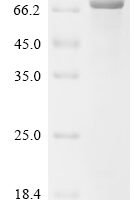
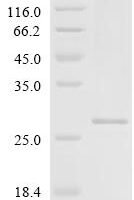
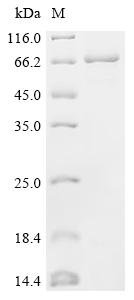
Recombinant Human Glucose 1,6-bisphosphate synthase (PGM2L1) is a recombinant protein from Homo sapiens (Human), expressed in Yeast, covering amino acids 1-622aa, with C-terminal 6xHis-tagged tag, molecular weight 71.3kDa, purity Greater than 85% as determined by SDS-PAGE.. Suitable for ELISA and Western Blot applications. Explore more Enzyme proteins →