Recombinant Human Guanine nucleotide-binding protein G (i) subunit alpha-1 (GNAI1)

Recombinant Human Guanine nucleotide-binding protein G (i) subunit alpha-1 (GNAI1) — Guanine nucleotide-binding proteins (G proteins) function as transducers downstream of G protein-coupled receptors (GPCRs) in numerous signaling cascades. Purity >90%.

SKU: BCRECP-000762 Category:

Product Specifications

Product SkuBCRECP-000762
Product DescriptionRecombinant Human Guanine nucleotide-binding protein G (i) subunit alpha-1 (GNAI1) Protein is expressed from E.coli with N-terminal 10xHis-tagged and C-terminal Myc-tagged. It contains 2-354aa. [Accession | P63096].
Uniprot No.P63096
Gene NamesGNAI1
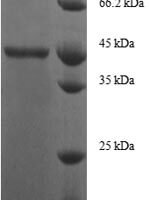
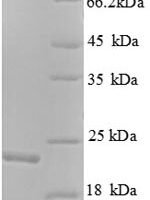
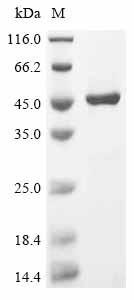
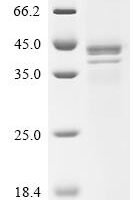
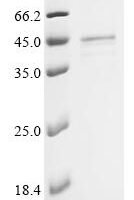
PurityGreater than 90% as determined by SDS-PAGE.
Expression SystemE.coli
Expression Region2-354aa
SpeciesHomo sapiens (Human)
Tag InfoN-terminal 10xHis-tagged and C-terminal Myc-tagged
Molecular weight47.7kDa
ActivityPlease contact us to obtain bioactivity data.
BufferIf the delivery form is liquid, the default storage buffer is Tris/PBS-based buffer, 5%-50% glycerol. If the delivery form is lyophilized powder, the buffer before lyophilization is Tris/PBS-based buffer, 6% Trehalose.
StorageStore at -20°C/-80°C upon receipt, aliquoting is necessary for mutiple use. Avoid repeated freeze-thaw cycles.
Research AreasSignal Transduction

Function

Guanine nucleotide-binding proteins (G proteins) function as transducers downstream of G protein-coupled receptors (GPCRs) in numerous signaling cascades. The alpha chain contains the guanine nucleotide binding site and alternates between an active, GTP-bound state and an inactive, GDP-bound state. Signaling by an activated GPCR promotes GDP release and GTP binding.

Biological Context

Subcellular Location: Cell membrane (Peripheral membrane protein); Nucleus; Cytoplasm; Cytoplasm, cytoskeleton, microtubule organizing center, centrosome; Cytoplasm, cell cortex
Disease Association: Neurodevelopmental disorder with hypotonia, impaired speech, and behavioral abnormalities (NEDHISB) : An autosomal dominant disorder characterized by global developmental delay, impaired intellectual development, delayed or absent speech, hypotonia, behavioral abnormalities, and epilepsy that ranges from self-limiting to intractable. More variable features include non-specific dysmorphic facial features, distal skeletal anomalies, and brain imaging abnormalities. [The disease is caused by variants affecting the gene represented in this entry]

Product Specifications

Recombinant Human Guanine nucleotide-binding protein G (i) subunit alpha-1 (GNAI1) is a recombinant protein from Homo sapiens (Human), expressed in E.coli, covering amino acids 2-354aa, with N-terminal 10xHis-tagged and C-terminal Myc-tagged tag, molecular weight 47.7kDa, purity Greater than 90% as determined by SDS-PAGE.. Suitable for ELISA and Western Blot applications.
Recommended applications depend on the target, product format, and product-specific validation data. Refer to the product datasheet or Certificate of Analysis (CoA), or contact BioCrest Sci for application guidance.

Biological Activity: Please contact us to obtain bioactivity data.

Storage: Store at -20°C/-80°C upon receipt, aliquoting is necessary for mutiple use. Avoid repeated freeze-thaw cycles.

Shipping & Lead Time: Availability, shipping conditions, and estimated lead time are confirmed in the formal quotation or order confirmation based on the product format, destination, and order requirements.

Protein Biology

Function

Guanine nucleotide-binding proteins (G proteins) function as transducers downstream of G protein-coupled receptors (GPCRs) in numerous signaling cascades (PubMed:18434541, PubMed:33762731, PubMed:34239069, PubMed:35610220, PubMed:37935376, PubMed:37935377, PubMed:37963465, PubMed:38552625, PubMed:8774883, PubMed:38918398, PubMed:40080544). The alpha chain contains the guanine nucleotide binding site and alternates between an active, GTP-bound state and an inactive, GDP-bound state (PubMed:18434541, PubMed:8774883). Signaling by an activated GPCR promotes GDP release and GTP binding (PubMed:18434541, PubMed:8774883). The alpha subunit has a low GTPase activity that converts bound GTP to GDP, thereby terminating the signal (PubMed:18434541, PubMed:8774883). Both GDP release and GTP hydrolysis are modulated by numerous regulatory proteins (PubMed:18434541, PubMed:8774883). Signaling is mediated via effector proteins, such as adenylate cyclase: inhibits adenylate cyclase activity of ADCY1, ADCY5 and ADCY6, leading to decreased intracellular cAMP levels (PubMed:8119955). The inactive GDP-bound form prevents the association of RGS14 with centrosomes and is required for the translocation of RGS14 from the cytoplasm to the plasma membrane. Required for normal cytokinesis during mitosis (PubMed:17635935). Required for cortical dynein-dynactin complex recruitment during metaphase (PubMed:22327364)

Subcellular Location

Cell membrane (Peripheral membrane protein); Nucleus; Cytoplasm; Cytoplasm, cytoskeleton, microtubule organizing center, centrosome; Cytoplasm, cell cortex

Disease Association

Neurodevelopmental disorder with hypotonia, impaired speech, and behavioral abnormalities (NEDHISB) : An autosomal dominant disorder characterized by global developmental delay, impaired intellectual development, delayed or absent speech, hypotonia, behavioral abnormalities, and epilepsy that ranges from self-limiting to intractable. More variable features include non-specific dysmorphic facial features, distal skeletal anomalies, and brain imaging abnormalities. [The disease is caused by variants affecting the gene represented in this entry]

Subunit

(Microbial infection) Interacts with human cytomegalovirus (HHV-5) US28; this interaction does not lead to the catalytic activation of Gi complex and probably interferes with the chemokine-Gi signaling

Gene: GNAI1  |  Organism: Homo sapiens  |  Synonyms: Adenylate cyclase-inhibiting G alpha protein
Key Publications

Frequently Asked Questions

How do I order or inquire about this product?

Submit the Online Inquiry form with your required quantity and specifications, or email sales@biocrestsci.com. Available sizes, pricing, stock status, documentation, and estimated lead time are confirmed in the formal quotation.

What is the shipping and delivery time?

Availability, dispatch timing, shipping conditions, and delivery estimates depend on the product format, destination, and order requirements. These details are confirmed in the formal quotation or order confirmation.

How should this product be stored?

Follow the storage and handling instructions in the product-specific datasheet and Certificate of Analysis (CoA). Requirements may vary by product form and formulation; contact BioCrest Sci if product-specific guidance is needed.

What quality controls are performed on your products?

Quality-control data such as identity, purity, endotoxin level, or biological activity are provided only when specified on this product page, the datasheet, or Certificate of Analysis (CoA). Biological activity is not implied unless explicitly stated.

Shopping Cart
Scroll to Top