Function
6-O-sulfation enzyme which catalyzes the transfer of sulfate from 3'-phosphoadenosine 5'-phosphosulfate (PAPS) to position 6 of the N-sulfoglucosamine residue (GlcNS) of heparan sulfate. Critical for normal neuronal development where it may play a role in neuron branching. May also play a role in limb development.
Biological Context
Subcellular Location: Membrane (Single-pass type II membrane protein)
Tissue Specificity: Expressed in fetal brain
Disease Association: Hypogonadotropic hypogonadism 15 with or without anosmia (HH15) : A disorder characterized by absent or incomplete sexual maturation by the age of 18 years, in conjunction with low levels of circulating gonadotropins and testosterone and no other abnormalities of the hypothalamic-pituitary axis. In some cases, it is associated with non-reproductive phenotypes, such as anosmia, cleft palate, and sensorineural hearing loss. Anosmia or hyposmia is related to the absence or hypoplasia of the olfactory bulbs and tracts. Hypogonadism is due to deficiency in gonadotropin-releasing hormone and probably results from a failure of embryonic migration of gonadotropin-releasing hormone-synthesizing neurons. In the presence of anosmia, idiopathic hypogonadotropic hypogonadism is referred to as Kallmann syndrome, whereas in the presence of a normal sense of smell, it has been termed normosmic idiopathic hypogonadotropic hypogonadism (nIHH). [The disease is caused by variants affecting distinct genetic loci, including the gene represented in this entry]
Product Specifications
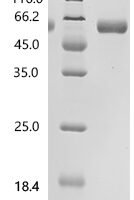
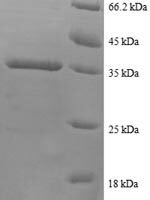
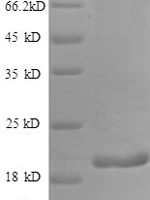
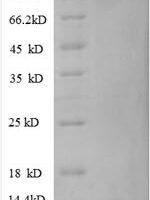
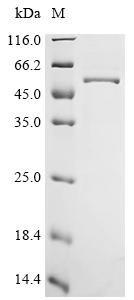
Recombinant Human Heparan-sulfate 6-O-sulfotransferase 1 (HS6ST1), partial is a recombinant protein from Homo sapiens (Human), expressed in E.coli, covering amino acids 38-411aa, with C-terminal 6xHis-tagged tag, molecular weight 51.0kDa, purity Greater than 85% as determined by SDS-PAGE.. Suitable for ELISA and Western Blot applications. Explore more Enzyme proteins →