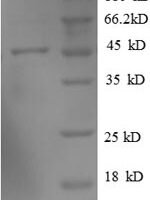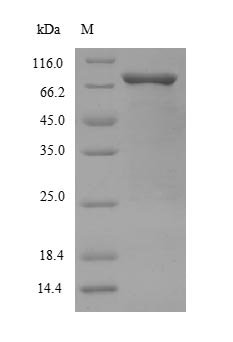
Recombinant Human Mothers against decapentaplegic homolog 2 (SMAD2)

Recombinant Human Mothers against decapentaplegic homolog 2 (SMAD2) — Receptor-regulated SMAD (R-SMAD) that is an intracellular signal transducer and transcriptional modulator activated by TGF-beta (transforming growth factor) and activin type 1 receptor kinases. Purity >90%.

SKU: BCRECP-001661 Category:

Product Specifications

Product SkuBCRECP-001661
Product DescriptionRecombinant Human Mothers against decapentaplegic homolog 2 (SMAD2) Protein is expressed from E.coli with N-terminal 6xHis-SUMO-tagged. It contains 2-467aa. [Accession | Q15796].
Uniprot No.Q15796
Gene NamesSMAD2
PurityGreater than 90% as determined by SDS-PAGE.
Expression SystemE.coli
Expression Region2-467aa
SpeciesHomo sapiens (Human)
Tag InfoN-terminal 6xHis-SUMO-tagged
Molecular weight68.2kDa
ActivityPlease contact us to obtain bioactivity data.
BufferIf the delivery form is liquid, the default storage buffer is Tris/PBS-based buffer, 5%-50% glycerol. If the delivery form is lyophilized powder, the buffer before lyophilization is Tris/PBS-based buffer, 6% Trehalose.
StorageStore at -20°C/-80°C upon receipt, aliquoting is necessary for mutiple use. Avoid repeated freeze-thaw cycles.
Research AreasSignal Transduction

Function

Receptor-regulated SMAD (R-SMAD) that is an intracellular signal transducer and transcriptional modulator activated by TGF-beta (transforming growth factor) and activin type 1 receptor kinases. Binds the TRE element in the promoter region of many genes that are regulated by TGF-beta and, on formation of the SMAD2/SMAD4 complex, activates transcription. Promotes TGFB1-mediated transcription of odontoblastic differentiation genes in dental papilla cells.

Biological Context

Subcellular Location: Cytoplasm; Nucleus
Tissue Specificity: Expressed at high levels in skeletal muscle, endothelial cells, heart and placenta
Disease Association: Congenital heart defects, multiple types, 8, with or without heterotaxy (CHTD8) : An autosomal dominant disorder characterized by congenital developmental abnormalities involving structures of the heart. Common CHTD8 features include double-outlet right ventricle, unbalanced complete atrioventricular canal, and valvular anomalies. Vascular anomalies include dextroposition of the great arteries, anomalous pulmonary venous return, and superior vena cava to left atrium defect. Patients may also exhibit laterality defects, including dextrocardia, atrial isomerism, dextrogastria, left-sided gallbladder, and intestinal malrotation. [The disease is caused by variants affecting the gene represented in this entry] | Loeys-Dietz syndrome 6 (LDS6) : A form of Loeys-Dietz syndrome, a syndrome with widespread systemic involvement characterized by arterial tortuosity and aneurysms, hypertelorism, and bifid uvula or cleft palate. Most LDS6 patients have thoracic aortic aneurysm involving the ascending aorta and/or aortic root, but cerebral and iliac arteries can be affected, and abdominal aortic aneurysm has been observed. Arterial tortuosity involving cerebral vessels, the aorta, and/or iliac arteries has also been reported. LDS6 inheritance is autosomal dominant. [The disease is caused by variants affecting the gene represented in this entry]

Product Specifications

Recombinant Human Mothers against decapentaplegic homolog 2 (SMAD2) is a recombinant protein from Homo sapiens (Human), expressed in E.coli, covering amino acids 2-467aa, with N-terminal 6xHis-SUMO-tagged tag, molecular weight 68.2kDa, purity Greater than 90% as determined by SDS-PAGE.. Suitable for ELISA and Western Blot applications.
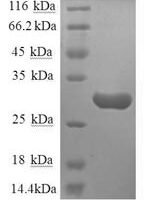
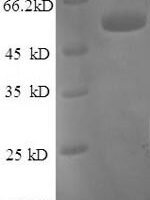
SDS-PAGE: Single band at expected molecular weight confirming purity.

ELISA: Suitable as coating antigen or detection standard.

Western Blot: Compatible with standard Western Blot protocols.

Protein Interaction: Validated for SPR (Surface Plasmon Resonance) and BLI (Bio-Layer Interferometry) studies.

Shipping: Shipped at ambient temperature. Lyophilized protein is stable during transit.

Storage: Store lyophilized protein at -20°C to -80°C. Reconstituted protein should be aliquoted and stored at -80°C. Avoid repeated freeze-thaw cycles.

Shelf Life: 12 months from date of receipt when stored as recommended.

Shipping Time: Orders placed before 2 PM EST ship same day. International orders typically deliver within 5-10 business days.

Protein Biology

Function

Receptor-regulated SMAD (R-SMAD) that is an intracellular signal transducer and transcriptional modulator activated by TGF-beta (transforming growth factor) and activin type 1 receptor kinases. Binds the TRE element in the promoter region of many genes that are regulated by TGF-beta and, on formation of the SMAD2/SMAD4 complex, activates transcription. Promotes TGFB1-mediated transcription of odontoblastic differentiation genes in dental papilla cells (By similarity). Positively regulates PDPK1 kinase activity by stimulating its dissociation from the 14-3-3 protein YWHAQ which acts as a negative regulator. May act as a tumor suppressor in colorectal carcinoma (PubMed:8752209)

Subcellular Location

Cytoplasm; Nucleus

Disease Association

Congenital heart defects, multiple types, 8, with or without heterotaxy (CHTD8) : An autosomal dominant disorder characterized by congenital developmental abnormalities involving structures of the heart. Common CHTD8 features include double-outlet right ventricle, unbalanced complete atrioventricular canal, and valvular anomalies. Vascular anomalies include dextroposition of the great arteries, anomalous pulmonary venous return, and superior vena cava to left atrium defect. Patients may also exhibit laterality defects, including dextrocardia, atrial isomerism, dextrogastria, left-sided gallbladder, and intestinal malrotation. [The disease is caused by variants affecting the gene represented in this entry] | Loeys-Dietz syndrome 6 (LDS6) : A form of Loeys-Dietz syndrome, a syndrome with widespread systemic involvement characterized by arterial tortuosity and aneurysms, hypertelorism, and bifid uvula or cleft palate. Most LDS6 patients have thoracic aortic aneurysm involving the ascending aorta and/or aortic root, but cerebral and iliac arteries can be affected, and abdominal aortic aneurysm has been observed. Arterial tortuosity involving cerebral vessels, the aorta, and/or iliac arteries has also been reported. LDS6 inheritance is autosomal dominant. [The disease is caused by variants affecting the gene represented in this entry]

Tissue Specificity

Expressed at high levels in skeletal muscle, endothelial cells, heart and placenta

Subunit

Monomer; in the absence of TGF-beta (PubMed:9670020). Heterodimer; in the presence of TGF-beta (PubMed:9670020). Forms a heterodimer with co-SMAD, SMAD4, in the nucleus to form the transactivation complex SMAD2/SMAD4 (PubMed:15350224, PubMed:24324267, PubMed:9670020). Found in a complex with SMAD3 and TRIM33 upon addition of TGF-beta (PubMed:16751102). Identified in a complex that contains at least ZNF451, SMAD2, SMAD3 and SMAD4 (PubMed:24324267). Interacts (via the MH2 domain) with ZFYVE9; may form trimers with the SMAD4 co-SMAD (PubMed:10615055). Interacts with TAZ/WWRT1 (PubMed:18568018). Interacts with FOXH1 (PubMed:9702198). Interacts with SNW1 (PubMed:11278756). Interacts with CREB-binding protein (CBP) and EP300 (PubMed:16862174). Interacts with SNON (PubMed:11389444). Interacts with ALK4/ACVR1B (PubMed:10615055, PubMed:9892009). Interacts with SKOR1 (PubMed:17292623). Interacts with SKOR2 (PubMed:16200078). Interacts with PRDM16 (PubMed:19049980). Interacts (via MH2 domain) with LEMD3 (PubMed:15601644, PubMed:15647271). Interacts with RBPMS (PubMed:17099224). Interacts with WWP1. Interacts (dephosphorylated form, via the MH1 and MH2 domains) with RANBP3 (via its C-terminal R domain); the interaction results in the export of dephosphorylated SMAD3 out of the nucleus and termination of the TGF-beta signaling (PubMed:19289081). Interacts with PDPK1 (via PH domain) (PubMed:17327236). Interacts with DAB2; the interactions are enhanced upon TGF-beta stimulation (PubMed:11387212). Interacts with USP15 (PubMed:21947082). Interacts with PPP5C (PubMed:22781750). Interacts with LDLRAD4 (via the SMAD interaction motif) (PubMed:24627487). Interacts (via MH2 domain) with PMEPA1 (via the SMAD interaction motif) (PubMed:20129061). Interacts with ZFHX3 (PubMed:25105025). Interacts with ZNF451 (PubMed:24324267). Interacts with SMURF2 when phosphorylated on Ser-465/467 (PubMed:11389444). Interacts with PPM1A (PubMed:16751101). Interacts with TGF-beta (PubMed:8980228). Interacts with TGFBR1 (PubMed:9865696). Interacts with TGIF (PubMed:10835638). Interacts with SMAD3 and TRIM33 (PubMed:16751102). Interacts with ZNF580 (PubMed:21599657). Interacts with NEDD4L in response to TGF-beta (By similarity). Interacts with HGS (By similarity). Interacts with AIP1 (By similarity). Interacts with WWP1 (By similarity). Interacts with PML (By similarity). Interacts weakly with ZNF8 (By similarity). Interacts (when phosphorylated) with RNF111; RNF111 acts as an enhancer of the transcriptional responses by mediating ubiquitination and degradation of SMAD2 inhibitors (By similarity). Interacts with YAP1 (when phosphorylated at 'Ser-127') (By similarity). Interacts when phosphorylated with IPO7; the interaction facilitates translocation of SMAD2 to the nucleus (By similarity). Interacts with MTMR4; negatively regulates TGF-beta signaling through SMAD2 dephosphorylation and retention in endosomes (Probable). Interacts with AMDHD1; this interaction promotes SMAD2 phosphorylation (PubMed:39143229)

Gene: SMAD2  |  Organism: Homo sapiens  |  Synonyms: JV18-1; Mad-related protein 2; Mothers against decapentaplegic homolog 2
Key Publications

Frequently Asked Questions

How do I order or inquire about this product?

Fill out the Online Inquiry form with your required quantity and specifications. You can also email sales@biocrestsci.com. Our team typically responds within 4 business hours with a quote and availability confirmation.

What is the shipping and delivery time?

Orders placed before 2 PM EST ship the same day. Domestic (US) delivery typically takes 2-3 business days. International orders deliver within 5-10 business days. All products are shipped at ambient temperature with appropriate packaging to ensure stability.

How should I store this recombinant protein?

Lyophilized proteins should be stored at -20°C to -80°C upon receipt. After reconstitution, aliquot and store at -80°C. Avoid repeated freeze-thaw cycles. Shelf life is 12 months from date of receipt when stored as recommended.

What quality controls are performed on your products?

Each product undergoes SDS-PAGE purity analysis (typically >85-95%), endotoxin testing, and bioactivity validation. Products are validated for ELISA, Western Blot, and SPR/BLI applications as specified on this product page. A Certificate of Analysis (CoA) is available upon request.

Shopping Cart
Scroll to Top