,

Recombinant Human Phospholipid hydroperoxide glutathione peroxidase GPX4 (GPX4) (U73S), partial

Recombinant Human Phospholipid hydroperoxide glutathione peroxidase GPX4 (GPX4) (U73S), partial — Essential antioxidant peroxidase that directly reduces phospholipid hydroperoxide even if they are incorporated in membranes and lipoproteins. Purity >90%.

SKU: BCRECP-000784 Categories: ,

Product Specifications

Product SkuBCRECP-000784
Product DescriptionRecombinant Human Phospholipid hydroperoxide glutathione peroxidase GPX4 (GPX4) (U73S) Protein is expressed from Yeast with C-terminal 10xHis-tagged. It contains 29-197aa(U73S). [Accession | P36969].
Uniprot No.P36969
Gene NamesGPX4
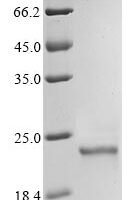
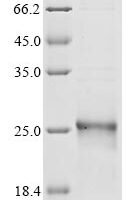
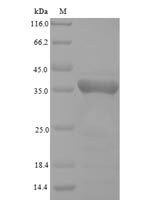
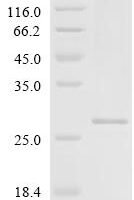
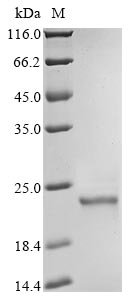
PurityGreater than 90% as determined by SDS-PAGE.
Expression SystemYeast
Expression Region29-197aa(U73S)
SpeciesHomo sapiens (Human)
Tag InfoC-terminal 10xHis-tagged
Molecular weight21.4kDa
ActivityPlease contact us to obtain bioactivity data.
BufferIf the delivery form is liquid, the default storage buffer is Tris/PBS-based buffer, 5%-50% glycerol. If the delivery form is lyophilized powder, the buffer before lyophilization is Tris/PBS-based buffer, 6% Trehalose.
StorageStore at -20°C/-80°C upon receipt, aliquoting is necessary for mutiple use. Avoid repeated freeze-thaw cycles.
Research AreasCancer

Function

Essential antioxidant peroxidase that directly reduces phospholipid hydroperoxide even if they are incorporated in membranes and lipoproteins. Can also reduce cholesterol hydroperoxide and thymine hydroperoxide. Plays a key role in protecting cells from oxidative damage by preventing membrane lipid peroxidation.

Biological Context

Subcellular Location: Cytoplasm
Tissue Specificity: Present primarily in testis. Expressed in platelets (at protein level)
Disease Association: Spondylometaphyseal dysplasia, Sedaghatian type (SMDS) : A form of spondylometaphyseal dysplasia, a group of short stature disorders distinguished by abnormalities in the vertebrae and the metaphyses of the tubular bones. SMDS is a neonatal lethal form characterized by severe metaphyseal chondrodysplasia with mild limb shortening, platyspondyly, cardiac conduction defects, and central nervous system abnormalities. [The disease is caused by variants affecting the gene represented in this entry]

Product Specifications

Recombinant Human Phospholipid hydroperoxide glutathione peroxidase GPX4 (GPX4) (U73S), partial is a recombinant protein from Homo sapiens (Human), expressed in Yeast, covering amino acids 29-197aa(U73S), with C-terminal 10xHis-tagged tag, molecular weight 21.4kDa, purity Greater than 90% as determined by SDS-PAGE.. Suitable for ELISA and Western Blot applications.

SDS-PAGE: Single band at expected molecular weight confirming purity.

ELISA: Suitable as coating antigen or detection standard.

Western Blot: Compatible with standard Western Blot protocols.

Protein Interaction: Validated for SPR (Surface Plasmon Resonance) and BLI (Bio-Layer Interferometry) studies.

Shipping: Shipped at ambient temperature. Lyophilized protein is stable during transit.

Storage: Store lyophilized protein at -20°C to -80°C. Reconstituted protein should be aliquoted and stored at -80°C. Avoid repeated freeze-thaw cycles.

Shelf Life: 12 months from date of receipt when stored as recommended.

Shipping Time: Orders placed before 2 PM EST ship same day. International orders typically deliver within 5-10 business days.

Protein Biology

Function

Essential antioxidant peroxidase that directly reduces phospholipid hydroperoxide even if they are incorporated in membranes and lipoproteins (PubMed:40281343). Can also reduce cholesterol hydroperoxide and thymine hydroperoxide (By similarity). Plays a key role in protecting cells from oxidative damage by preventing membrane lipid peroxidation (PubMed:40281343). Required to prevent cells from ferroptosis, a non-apoptotic cell death resulting from an iron-dependent accumulation of lipid reactive oxygen species (PubMed:24439385, PubMed:40281343). The presence of selenocysteine (Sec) versus Cys at the active site is essential for life: it provides resistance to overoxidation and prevents cells against ferroptosis (By similarity). The presence of Sec at the active site is also essential for the survival of a specific type of parvalbumin-positive interneurons, thereby preventing against fatal epileptic seizures (By similarity). May be required to protect cells from the toxicity of ingested lipid hydroperoxides (By similarity). Required for normal sperm development and male fertility (By similarity). Essential for maturation and survival of photoreceptor cells (By similarity). Plays a role in a primary T-cell response to viral and parasitic infection by protecting T-cells from ferroptosis and by supporting T-cell expansion (By similarity). Plays a role of glutathione peroxidase in platelets in the arachidonic acid metabolism (PubMed:11115402). Reduces hydroperoxy ester lipids formed by a 15-lipoxygenase that may play a role as down-regulator of the cellular 15-lipoxygenase pathway (By similarity). Can reduce fatty acid-derived hydroperoxides (PubMed:11115402, PubMed:36608588). Can also reduce small soluble hydroperoxides such as H2O2, cumene hydroperoxide and tert-butyl hydroperoxide (PubMed:17630701, PubMed:36608588)

Subcellular Location

Cytoplasm

Disease Association

Spondylometaphyseal dysplasia, Sedaghatian type (SMDS) : A form of spondylometaphyseal dysplasia, a group of short stature disorders distinguished by abnormalities in the vertebrae and the metaphyses of the tubular bones. SMDS is a neonatal lethal form characterized by severe metaphyseal chondrodysplasia with mild limb shortening, platyspondyly, cardiac conduction defects, and central nervous system abnormalities. [The disease is caused by variants affecting the gene represented in this entry]

Tissue Specificity

Present primarily in testis. Expressed in platelets (at protein level) (PubMed:11115402)

Subunit

Monomer. Has a tendency to form higher mass oligomers (PubMed:17630701). Interacts with FUNDC1; this interaction promotes GPX4 recruitment into mitochondria through TOM/TIM complex where it is degraded by mitophagy (PubMed:36828120). Interacts (via KFERQ motif) with HSPA8; promoting its association with LAMP2 and degradation via chaperone-mediated autophagy (By similarity)

Gene: GPX4  |  Organism: Homo sapiens  |  Synonyms: Glutathione peroxidase 4
Key Publications

Frequently Asked Questions

How do I order or inquire about this product?

Fill out the Online Inquiry form with your required quantity and specifications. You can also email sales@biocrestsci.com. Our team typically responds within 4 business hours with a quote and availability confirmation.

What is the shipping and delivery time?

Orders placed before 2 PM EST ship the same day. Domestic (US) delivery typically takes 2-3 business days. International orders deliver within 5-10 business days. All products are shipped at ambient temperature with appropriate packaging to ensure stability.

How should I store this recombinant protein?

Lyophilized proteins should be stored at -20°C to -80°C upon receipt. After reconstitution, aliquot and store at -80°C. Avoid repeated freeze-thaw cycles. Shelf life is 12 months from date of receipt when stored as recommended.

What quality controls are performed on your products?

Each product undergoes SDS-PAGE purity analysis (typically >85-95%), endotoxin testing, and bioactivity validation. Products are validated for ELISA, Western Blot, and SPR/BLI applications as specified on this product page. A Certificate of Analysis (CoA) is available upon request.

Shopping Cart
Scroll to Top