Recombinant Human Poly [ADP-ribose] polymerase 2 (PARP2), partial

Recombinant Human Poly [ADP-ribose] polymerase 2 (PARP2), partial — Poly-ADP-ribosyltransferase that mediates poly-ADP-ribosylation of proteins and plays a key role in DNA repair. Purity >85%.

SKU: BCRECP-001337 Category:

Product Specifications

Product SkuBCRECP-001337
Product DescriptionRecombinant Human Poly [ADP-ribose] polymerase 2 (PARP2) Protein is expressed from E.coli with C-terminal 10xHis-tagged. It contains 233-583aa. [Accession | Q9UGN5].
Uniprot No.Q9UGN5
Gene NamesPARP2
PurityGreater than 85% as determined by SDS-PAGE.
Expression SystemE.coli
Expression Region233-583aa
SpeciesHomo sapiens (Human)
Tag InfoC-terminal 10xHis-tagged
Molecular weight41.3kDa
ActivityPlease contact us to obtain bioactivity data.
BufferIf the delivery form is liquid, the default storage buffer is Tris/PBS-based buffer, 5%-50% glycerol. If the delivery form is lyophilized powder, the buffer before lyophilization is Tris/PBS-based buffer, 6% Trehalose.
StorageStore at -20°C/-80°C upon receipt, aliquoting is necessary for mutiple use. Avoid repeated freeze-thaw cycles.
Research AreasEpigenetics and Nuclear Signaling

Function

Poly-ADP-ribosyltransferase that mediates poly-ADP-ribosylation of proteins and plays a key role in DNA repair. Mediates glutamate, aspartate or serine ADP-ribosylation of proteins: the ADP-D-ribosyl group of NAD(+) is transferred to the acceptor carboxyl group of target residues and further ADP-ribosyl groups are transferred to the 2'-position of the terminal adenosine moiety, building up a polymer with an average chain length of 20-30 units. Serine ADP-ribosylation of proteins constitutes the primary form of ADP-ribosylation of proteins in response to DNA damage.

Biological Context

Subcellular Location: Nucleus; Chromosome
Tissue Specificity: Widely expressed, mainly in actively dividing tissues. The highest levels are in the brain, heart, pancreas, skeletal muscle and testis; also detected in kidney, liver, lung, placenta, ovary and spleen; levels are low in leukocytes, colon, small intestine, prostate and thymus

Product Specifications

Recombinant Human Poly [ADP-ribose] polymerase 2 (PARP2), partial is a recombinant protein from Homo sapiens (Human), expressed in E.coli, covering amino acids 233-583aa, with C-terminal 10xHis-tagged tag, molecular weight 41.3kDa, purity Greater than 85% as determined by SDS-PAGE.. Suitable for ELISA and Western Blot applications.
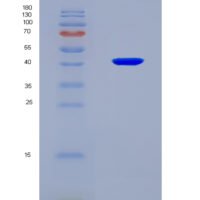
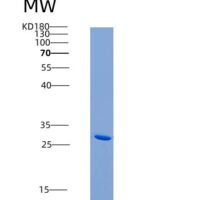
SDS-PAGE: Single band at expected molecular weight confirming purity.

ELISA: Suitable as coating antigen or detection standard.

Western Blot: Compatible with standard Western Blot protocols.

Protein Interaction: Validated for SPR (Surface Plasmon Resonance) and BLI (Bio-Layer Interferometry) studies.

Shipping: Shipped at ambient temperature. Lyophilized protein is stable during transit.

Storage: Store lyophilized protein at -20°C to -80°C. Reconstituted protein should be aliquoted and stored at -80°C. Avoid repeated freeze-thaw cycles.

Shelf Life: 12 months from date of receipt when stored as recommended.

Shipping Time: Orders placed before 2 PM EST ship same day. International orders typically deliver within 5-10 business days.

Protein Biology

Function

Poly-ADP-ribosyltransferase that mediates poly-ADP-ribosylation of proteins and plays a key role in DNA repair (PubMed:10364231, PubMed:25043379, PubMed:27471034, PubMed:30104678, PubMed:32028527, PubMed:32939087, PubMed:34108479, PubMed:34486521, PubMed:34874266). Mediates glutamate, aspartate or serine ADP-ribosylation of proteins: the ADP-D-ribosyl group of NAD(+) is transferred to the acceptor carboxyl group of target residues and further ADP-ribosyl groups are transferred to the 2'-position of the terminal adenosine moiety, building up a polymer with an average chain length of 20-30 units (PubMed:25043379, PubMed:30104678, PubMed:30321391). Serine ADP-ribosylation of proteins constitutes the primary form of ADP-ribosylation of proteins in response to DNA damage (PubMed:32939087). Mediates glutamate and aspartate ADP-ribosylation of target proteins in absence of HPF1 (PubMed:25043379). Following interaction with HPF1, catalyzes serine ADP-ribosylation of target proteins; HPF1 conferring serine specificity by completing the PARP2 active site (PubMed:28190768, PubMed:32028527, PubMed:34108479, PubMed:34486521, PubMed:34874266). PARP2 initiates the repair of double-strand DNA breaks: recognizes and binds DNA breaks within chromatin and recruits HPF1, licensing serine ADP-ribosylation of target proteins, such as histones, thereby promoting decompaction of chromatin and the recruitment of repair factors leading to the reparation of DNA strand breaks (PubMed:10364231, PubMed:32939087, PubMed:34108479). HPF1 initiates serine ADP-ribosylation but restricts the polymerase activity of PARP2 in order to limit the length of poly-ADP-ribose chains (PubMed:34732825, PubMed:34795260). Specifically mediates formation of branched poly-ADP-ribosylation (PubMed:30104678). Branched poly-ADP-ribose chains are specifically recognized by some factors, such as APLF (PubMed:30104678). In addition to proteins, also able to ADP-ribosylate DNA: preferentially acts on 5'-terminal phosphates at DNA strand breaks termini in nicked duplex (PubMed:27471034, PubMed:29361132)

Subcellular Location

Nucleus; Chromosome

Tissue Specificity

Widely expressed, mainly in actively dividing tissues (PubMed:10364231). The highest levels are in the brain, heart, pancreas, skeletal muscle and testis; also detected in kidney, liver, lung, placenta, ovary and spleen; levels are low in leukocytes, colon, small intestine, prostate and thymus (PubMed:10364231)

Subunit

Component of a base excision repair (BER) complex, containing at least XRCC1, PARP1, POLB and LRIG3 (By similarity). Homo- and heterodimer with PARP1 (PubMed:20092359). Interacts (via the PARP catalytic domain) with HPF1 (PubMed:27067600, PubMed:28190768, PubMed:32028527, PubMed:32939087, PubMed:33141820, PubMed:34108479). Interacts with core nucleosomes (PubMed:32939087, PubMed:33141820)

Gene: PARP2  |  Organism: Homo sapiens  |  Synonyms: ADP-ribosyltransferase diphtheria toxin-like 2; DNA ADP-ribosyltransferase PARP2; NAD(+) ADP-ribosyltransferase 2; Poly[ADP-ribose] synthase 2; Protein poly-ADP-ribosyltransferase PARP2
Key Publications

Frequently Asked Questions

How do I order or inquire about this product?

Fill out the Online Inquiry form with your required quantity and specifications. You can also email sales@biocrestsci.com. Our team typically responds within 4 business hours with a quote and availability confirmation.

What is the shipping and delivery time?

Orders placed before 2 PM EST ship the same day. Domestic (US) delivery typically takes 2-3 business days. International orders deliver within 5-10 business days. All products are shipped at ambient temperature with appropriate packaging to ensure stability.

How should I store this recombinant protein?

Lyophilized proteins should be stored at -20°C to -80°C upon receipt. After reconstitution, aliquot and store at -80°C. Avoid repeated freeze-thaw cycles. Shelf life is 12 months from date of receipt when stored as recommended.

What quality controls are performed on your products?

Each product undergoes SDS-PAGE purity analysis (typically >85-95%), endotoxin testing, and bioactivity validation. Products are validated for ELISA, Western Blot, and SPR/BLI applications as specified on this product page. A Certificate of Analysis (CoA) is available upon request.

Shopping Cart
Scroll to Top