,

Recombinant Human Pyruvate dehydrogenase E1 component subunit beta, mitochondrial (PDHB)

Recombinant Human Pyruvate dehydrogenase E1 component subunit beta, mitochondrial (PDHB) — Together with PDHA1 forms the heterotetrameric E1 subunit of the pyruvate dehydrogenase (PDH) complex. Purity >90%.

SKU: BCRECP-001363 Categories: ,

Product Specifications

Product SkuBCRECP-001363
Product DescriptionRecombinant Human Pyruvate dehydrogenase E1 component subunit beta, mitochondrial (PDHB) Protein is expressed from E.coli with N-terminal 6xHis-tagged. It contains 31-359aa. [Accession | P11177].
Uniprot No.P11177
Gene NamesPDHB
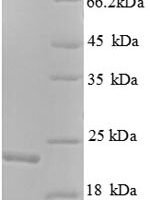
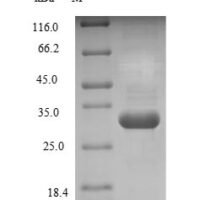
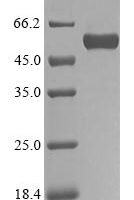
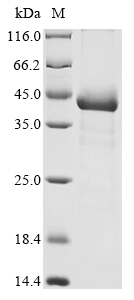
PurityGreater than 90% as determined by SDS-PAGE.
Expression SystemE.coli
Expression Region31-359aa
SpeciesHomo sapiens (Human)
Tag InfoN-terminal 6xHis-tagged
Molecular weight41.9kDa
ActivityPlease contact us to obtain bioactivity data.
BufferIf the delivery form is liquid, the default storage buffer is Tris/PBS-based buffer, 5%-50% glycerol. If the delivery form is lyophilized powder, the buffer before lyophilization is Tris/PBS-based buffer, 6% Trehalose.
StorageStore at -20°C/-80°C upon receipt, aliquoting is necessary for mutiple use. Avoid repeated freeze-thaw cycles.
Research AreasCancer

Function

Together with PDHA1 forms the heterotetrameric E1 subunit of the pyruvate dehydrogenase (PDH) complex. The PDH complex catalyzes the overall conversion of pyruvate to acetyl-CoA and CO(2), and thereby links cytoplasmic glycolysis and the mitochondrial tricarboxylic acid (TCA) cycle (Probable). It contains multiple copies of three enzymatic components: pyruvate dehydrogenase (E1), dihydrolipoamide acetyltransferase (E2) and dihydrolipoamide dehydrogenase (E3) (Probable).

Biological Context

Subcellular Location: Mitochondrion matrix
Disease Association: Pyruvate dehydrogenase E1-beta deficiency (PDHBD) : An enzymatic defect causing primary lactic acidosis in children. It is associated with a broad clinical spectrum ranging from fatal lactic acidosis in the newborn to chronic neurologic dysfunction with structural abnormalities in the central nervous system without systemic acidosis. [The disease is caused by variants affecting the gene represented in this entry]

Product Specifications

Recombinant Human Pyruvate dehydrogenase E1 component subunit beta, mitochondrial (PDHB) is a recombinant protein from Homo sapiens (Human), expressed in E.coli, covering amino acids 31-359aa, with N-terminal 6xHis-tagged tag, molecular weight 41.9kDa, purity Greater than 90% as determined by SDS-PAGE.. Suitable for ELISA and Western Blot applications.

SDS-PAGE: Single band at expected molecular weight confirming purity.

ELISA: Suitable as coating antigen or detection standard.

Western Blot: Compatible with standard Western Blot protocols.

Protein Interaction: Validated for SPR (Surface Plasmon Resonance) and BLI (Bio-Layer Interferometry) studies.

Shipping: Shipped at ambient temperature. Lyophilized protein is stable during transit.

Storage: Store lyophilized protein at -20°C to -80°C. Reconstituted protein should be aliquoted and stored at -80°C. Avoid repeated freeze-thaw cycles.

Shelf Life: 12 months from date of receipt when stored as recommended.

Shipping Time: Orders placed before 2 PM EST ship same day. International orders typically deliver within 5-10 business days.

Protein Biology

Function

Together with PDHA1 forms the heterotetrameric E1 subunit of the pyruvate dehydrogenase (PDH) complex (PubMed:17474719, PubMed:19081061). The PDH complex catalyzes the overall conversion of pyruvate to acetyl-CoA and CO(2), and thereby links cytoplasmic glycolysis and the mitochondrial tricarboxylic acid (TCA) cycle (Probable). It contains multiple copies of three enzymatic components: pyruvate dehydrogenase (E1), dihydrolipoamide acetyltransferase (E2) and dihydrolipoamide dehydrogenase (E3) (Probable). The E1 subunit catalyzes both the thiamine pyrophosphate (TPP)-dependent decarboxylation of pyruvate and the reductive acetylation of a lipoyl group covalently linked to the lipoyl-bearing domains of E2 (PubMed:19081061)

Subcellular Location

Mitochondrion matrix

Disease Association

Pyruvate dehydrogenase E1-beta deficiency (PDHBD) : An enzymatic defect causing primary lactic acidosis in children. It is associated with a broad clinical spectrum ranging from fatal lactic acidosis in the newborn to chronic neurologic dysfunction with structural abnormalities in the central nervous system without systemic acidosis. [The disease is caused by variants affecting the gene represented in this entry]

Subunit

Heterotetramer of two PDHA1 and two PDHB subunits (PubMed:12651851, PubMed:17474719, PubMed:19081061, PubMed:29970614). The heterotetramer interacts with DLAT, and is part of the multimeric pyruvate dehydrogenase (PDH) complex that contains multiple copies of pyruvate dehydrogenase (E1), dihydrolipoamide acetyltransferase (DLAT, E2) and lipoamide dehydrogenase (DLD, E3) (PubMed:14638692). These subunits are bound to an inner core composed of about 48 DLAT and 12 PDHX molecules (PubMed:14638692). Interacts with DLAT (PubMed:20160912)

Gene: PDHB  |  Organism: Homo sapiens
Key Publications

Frequently Asked Questions

How do I order or inquire about this product?

Fill out the Online Inquiry form with your required quantity and specifications. You can also email sales@biocrestsci.com. Our team typically responds within 4 business hours with a quote and availability confirmation.

What is the shipping and delivery time?

Orders placed before 2 PM EST ship the same day. Domestic (US) delivery typically takes 2-3 business days. International orders deliver within 5-10 business days. All products are shipped at ambient temperature with appropriate packaging to ensure stability.

How should I store this recombinant protein?

Lyophilized proteins should be stored at -20°C to -80°C upon receipt. After reconstitution, aliquot and store at -80°C. Avoid repeated freeze-thaw cycles. Shelf life is 12 months from date of receipt when stored as recommended.

What quality controls are performed on your products?

Each product undergoes SDS-PAGE purity analysis (typically >85-95%), endotoxin testing, and bioactivity validation. Products are validated for ELISA, Western Blot, and SPR/BLI applications as specified on this product page. A Certificate of Analysis (CoA) is available upon request.

Shopping Cart
Scroll to Top