Function
Serine/threonine kinase that acts as a key regulator of ciliogenesis: controls the initiation of ciliogenesis by binding to the distal end of the basal body and promoting the removal of CCP110, which caps the mother centriole, leading to the recruitment of IFT proteins, which build the ciliary axoneme. Has some substrate preference for proteins that are already phosphorylated on a Tyr residue at the +2 position relative to the phosphorylation site. Able to phosphorylate tau on serines in vitro.
Biological Context
Subcellular Location: Cell projection, cilium; Cytoplasm, cytoskeleton, cilium basal body; Cytoplasm, cytoskeleton, microtubule organizing center, centrosome, centriole; Cytoplasm, cytosol; Nucleus
Disease Association: Spinocerebellar ataxia 11 (SCA11) : Spinocerebellar ataxia is a clinically and genetically heterogeneous group of cerebellar disorders. Patients show progressive incoordination of gait and often poor coordination of hands, speech and eye movements, due to degeneration of the cerebellum with variable involvement of the brainstem and spinal cord. SCA11 is an autosomal dominant cerebellar ataxia (ADCA). It is a relatively benign, late-onset, slowly progressive neurologic disorder. [The disease is caused by variants affecting the gene represented in this entry]
Product Specifications
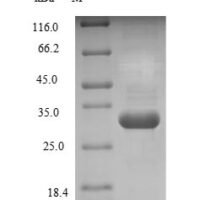
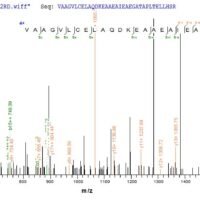
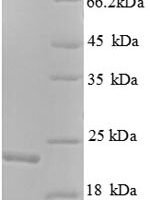
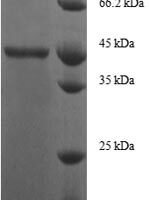
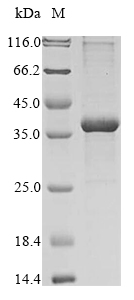
Recombinant Human Tau-tubulin kinase 2 (TTBK2), partial is a recombinant protein from Homo sapiens (Human), expressed in E.coli, covering amino acids 18-287aa, with N-terminal 10xHis-tagged and C-terminal Myc-tagged tag, molecular weight 38.7kDa, purity Greater than 85% as determined by SDS-PAGE.. Suitable for ELISA and Western Blot applications. Explore more Kinase proteins →