,

Recombinant Human Tyrosine-protein phosphatase non-receptor type 11 (PTPN11)

Recombinant Human Tyrosine-protein phosphatase non-receptor type 11 (PTPN11) — Acts downstream of various receptor and cytoplasmic protein tyrosine kinases to participate in the signal transduction from the cell surface to the nucleus. Purity >90%.

SKU: BCRECP-001475 Categories: ,

Product Specifications

Product SkuBCRECP-001475
Product DescriptionRecombinant Human Tyrosine-protein phosphatase non-receptor type 11 (PTPN11) Protein is expressed from E.coli with N-terminal 6xHis-tagged. It contains 2-593aa. [Accession | Q06124].
Uniprot No.Q06124
Gene NamesPTPN11
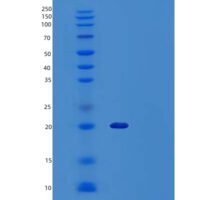
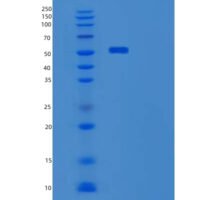
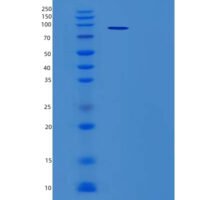
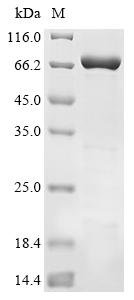
PurityGreater than 90% as determined by SDS-PAGE.
Expression SystemE.coli
Expression Region2-593aa
SpeciesHomo sapiens (Human)
Tag InfoN-terminal 6xHis-tagged
Molecular weight72.0kDa
ActivityPlease contact us to obtain bioactivity data.
BufferIf the delivery form is liquid, the default storage buffer is Tris/PBS-based buffer, 5%-50% glycerol. If the delivery form is lyophilized powder, the buffer before lyophilization is Tris/PBS-based buffer, 6% Trehalose.
StorageStore at -20°C/-80°C upon receipt, aliquoting is necessary for mutiple use. Avoid repeated freeze-thaw cycles.
Research AreasNeuroscience

Function

Acts downstream of various receptor and cytoplasmic protein tyrosine kinases to participate in the signal transduction from the cell surface to the nucleus. Positively regulates MAPK signal transduction pathway. Dephosphorylates GAB1, ARHGAP35 and EGFR.

Biological Context

Subcellular Location: Cytoplasm; Nucleus
Tissue Specificity: Widely expressed, with highest levels in heart, brain, and skeletal muscle
Disease Association: LEOPARD syndrome 1 (LPRD1) : A disorder characterized by lentigines, electrocardiographic conduction abnormalities, ocular hypertelorism, pulmonic stenosis, abnormalities of genitalia, retardation of growth, and sensorineural deafness. [The disease is caused by variants affecting the gene represented in this entry] | Noonan syndrome 1 (NS1) : A form of Noonan syndrome, a disease characterized by short stature, facial dysmorphic features such as hypertelorism, a downward eyeslant and low-set posteriorly rotated ears, and a high incidence of congenital heart defects and hypertrophic cardiomyopathy. Other features can include a short neck with webbing or redundancy of skin, deafness, motor delay, variable intellectual deficits, multiple skeletal defects, cryptorchidism, and bleeding diathesis. Individuals with Noonan syndrome are at risk of juvenile myelomonocytic leukemia, a myeloproliferative disorder characterized by excessive production of myelomonocytic cells. Some patients with NS1 develop multiple giant cell lesions of the jaw or other bony or soft tissues, which are classified as pigmented villonodular synovitis (PVNS) when occurring in the jaw or joints. [The disease is caused by variants affecting the gene represented in this entry. Mutations in PTPN11 account for more than 50% of the cases] | Leukemia, juvenile myelomonocytic (JMML) : An aggressive pediatric myelodysplastic syndrome/myeloproliferative disorder characterized by malignant transformation in the hematopoietic stem cell compartment with proliferation of differentiated progeny. Patients have splenomegaly, enlarged lymph nodes, rashes, and hemorrhages. [The disease is caused by variants affecting the gene represented in this entry] | Metachondromatosis (MC) : A skeletal disorder with radiologic features of both multiple exostoses and Ollier disease, characterized by the presence of exostoses, commonly of the bones of the hands and feet, and enchondromas of the metaphyses of long bones and iliac crest. [The disease is caused by variants affecting the gene represented in this entry]

Product Specifications

Recombinant Human Tyrosine-protein phosphatase non-receptor type 11 (PTPN11) is a recombinant protein from Homo sapiens (Human), expressed in E.coli, covering amino acids 2-593aa, with N-terminal 6xHis-tagged tag, molecular weight 72.0kDa, purity Greater than 90% as determined by SDS-PAGE.. Suitable for ELISA and Western Blot applications.

SDS-PAGE: Single band at expected molecular weight confirming purity.

ELISA: Suitable as coating antigen or detection standard.

Western Blot: Compatible with standard Western Blot protocols.

Protein Interaction: Validated for SPR (Surface Plasmon Resonance) and BLI (Bio-Layer Interferometry) studies.

Shipping: Shipped at ambient temperature. Lyophilized protein is stable during transit.

Storage: Store lyophilized protein at -20°C to -80°C. Reconstituted protein should be aliquoted and stored at -80°C. Avoid repeated freeze-thaw cycles.

Shelf Life: 12 months from date of receipt when stored as recommended.

Shipping Time: Orders placed before 2 PM EST ship same day. International orders typically deliver within 5-10 business days.

Protein Biology

Function

Acts downstream of various receptor and cytoplasmic protein tyrosine kinases to participate in the signal transduction from the cell surface to the nucleus (PubMed:10655584, PubMed:14739280, PubMed:18559669, PubMed:18829466, PubMed:26742426, PubMed:28074573, PubMed:32184441). Positively regulates MAPK signal transduction pathway (PubMed:28074573). Dephosphorylates GAB1, ARHGAP35 and EGFR (PubMed:28074573). Dephosphorylates ROCK2 at 'Tyr-722' resulting in stimulation of its RhoA binding activity (PubMed:18559669). Dephosphorylates CDC73 (PubMed:26742426). Dephosphorylates SOX9 on tyrosine residues, leading to inactivate SOX9 and promote ossification (By similarity). Dephosphorylates tyrosine-phosphorylated NEDD9/CAS-L (PubMed:19275884). Acts as an effector of PDCD1-mediated inhibition of T-cell response: recruited by phosphorylated PDCD1, mediating dephosphorylation of key T-cell receptor (TCR) proximal signaling molecules, leading to TCR signaling inhibition (PubMed:32184441)

Subcellular Location

Cytoplasm; Nucleus

Disease Association

LEOPARD syndrome 1 (LPRD1) : A disorder characterized by lentigines, electrocardiographic conduction abnormalities, ocular hypertelorism, pulmonic stenosis, abnormalities of genitalia, retardation of growth, and sensorineural deafness. [The disease is caused by variants affecting the gene represented in this entry] | Noonan syndrome 1 (NS1) : A form of Noonan syndrome, a disease characterized by short stature, facial dysmorphic features such as hypertelorism, a downward eyeslant and low-set posteriorly rotated ears, and a high incidence of congenital heart defects and hypertrophic cardiomyopathy. Other features can include a short neck with webbing or redundancy of skin, deafness, motor delay, variable intellectual deficits, multiple skeletal defects, cryptorchidism, and bleeding diathesis. Individuals with Noonan syndrome are at risk of juvenile myelomonocytic leukemia, a myeloproliferative disorder characterized by excessive production of myelomonocytic cells. Some patients with NS1 develop multiple giant cell lesions of the jaw or other bony or soft tissues, which are classified as pigmented villonodular synovitis (PVNS) when occurring in the jaw or joints. [The disease is caused by variants affecting the gene represented in this entry. Mutations in PTPN11 account for more than 50% of the cases] | Leukemia, juvenile myelomonocytic (JMML) : An aggressive pediatric myelodysplastic syndrome/myeloproliferative disorder characterized by malignant transformation in the hematopoietic stem cell compartment with proliferation of differentiated progeny. Patients have splenomegaly, enlarged lymph nodes, rashes, and hemorrhages. [The disease is caused by variants affecting the gene represented in this entry] | Metachondromatosis (MC) : A skeletal disorder with radiologic features of both multiple exostoses and Ollier disease, characterized by the presence of exostoses, commonly of the bones of the hands and feet, and enchondromas of the metaphyses of long bones and iliac crest. [The disease is caused by variants affecting the gene represented in this entry]

Tissue Specificity

Widely expressed, with highest levels in heart, brain, and skeletal muscle

Subunit

Interacts with phosphorylated LIME1 and BCAR3. Interacts with SHB and INPP5D/SHIP1 (By similarity). Interacts with MILR1 (tyrosine-phosphorylated). Interacts with FLT1 (tyrosine-phosphorylated), FLT3 (tyrosine-phosphorylated), FLT4 (tyrosine-phosphorylated), KIT and GRB2. Interacts with PDGFRA (tyrosine phosphorylated). Interacts (via SH2 domain) with TEK/TIE2 (tyrosine phosphorylated) (By similarity). Interacts with PTPNS1 and CD84. Interacts with phosphorylated SIT1 and MPZL1. Interacts with FCRL4, FCRL6 and ANKHD1. Interacts with KIR2DL1; the interaction is enhanced by ARRB2. Interacts with GAB2. Interacts with TERT; the interaction retains TERT in the nucleus. Interacts with PECAM1 and FER. Interacts with EPHA2 (activated); participates in PTK2/FAK1 dephosphorylation in EPHA2 downstream signaling. Interacts with ROS1; mediates PTPN11 phosphorylation. Interacts with PDGFRB (tyrosine phosphorylated); this interaction increases the PTPN11 phosphatase activity. Interacts with GAREM1 isoform 1 (tyrosine phosphorylated); the interaction increases MAPK/ERK activity and does not affect the GRB2/SOS complex formation. Interacts with CDC73 (PubMed:26742426). Interacts with CEACAM1 (via cytoplasmic domain); this interaction depends on the monomer/dimer equilibrium and is phosphorylation-dependent (By similarity). Interacts with MPIG6B (via ITIM motif) (PubMed:23112346). Interacts with SIGLEC10 (By similarity). Interacts with FCRL3 (via phosphorylated ITIM motifs) (PubMed:11162587, PubMed:19843936). Interacts with CLEC12B (via ITIM motif); this interaction triggers dephosphorylation and activation of PTPN11. Interacts (via SH2 domains) with NEDD9/CAS-L; the interaction is enhanced when NEDD9/CAS-L is tyrosine phosphorylated (PubMed:19275884)

Gene: PTPN11  |  Organism: Homo sapiens  |  Synonyms: Protein-tyrosine phosphatase 1D; Protein-tyrosine phosphatase 2C; SH-PTP2; SH-PTP3
Key Publications

Frequently Asked Questions

How do I order or inquire about this product?

Fill out the Online Inquiry form with your required quantity and specifications. You can also email sales@biocrestsci.com. Our team typically responds within 4 business hours with a quote and availability confirmation.

What is the shipping and delivery time?

Orders placed before 2 PM EST ship the same day. Domestic (US) delivery typically takes 2-3 business days. International orders deliver within 5-10 business days. All products are shipped at ambient temperature with appropriate packaging to ensure stability.

How should I store this recombinant protein?

Lyophilized proteins should be stored at -20°C to -80°C upon receipt. After reconstitution, aliquot and store at -80°C. Avoid repeated freeze-thaw cycles. Shelf life is 12 months from date of receipt when stored as recommended.

What quality controls are performed on your products?

Each product undergoes SDS-PAGE purity analysis (typically >85-95%), endotoxin testing, and bioactivity validation. Products are validated for ELISA, Western Blot, and SPR/BLI applications as specified on this product page. A Certificate of Analysis (CoA) is available upon request.

Shopping Cart
Scroll to Top