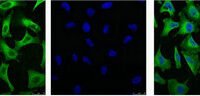
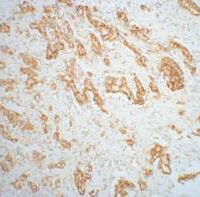
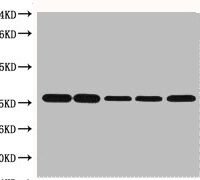
Mouse anti-Human/Rat/Mouse/Monkey/Dog/Chicken/Hamster/Rabbit/Sheep/Insect/Yeast TUBB3 Monoclonal Antibody

Mouse anti-Human/Rat/Mouse/Monkey/Dog/Chicken/Hamster/Rabbit/Sheep/Insect/Yeast TUBB3 Monoclonal Antibody — Tubulin is the major constituent of microtubules, protein filaments consisting of alpha- and beta-tubulin heterodimers.

SKU: BCREC-000004MA Category:

Product Specifications

Uniprot No.Q13509
Target NamesTUBB3
Species ReactivityMouse
ImmunogenSynthetic Peptide
ConjugateNon-conjugated
IsotypeIgG
ClonalityMonoclonal
ApplicationsELISA,WB,IHC
BufferPBS, 50% glycerol, 0.05% Proclin 300, 0.05%BSA
StorageUpon receipt, store at -20°C or -80°C. Avoid repeated freeze.

Function

Tubulin is the major constituent of microtubules, protein filaments consisting of alpha- and beta-tubulin heterodimers. Microtubules grow by the addition of GTP-tubulin dimers to the microtubule end, where a stabilizing cap forms. Below the cap, alpha-beta tubulin heterodimers are in GDP-bound state, owing to GTPase activity of alpha-tubulin.

Biological Context

Subcellular Location: Cytoplasm, cytoskeleton; Cell projection, growth cone; Cell projection, lamellipodium; Cell projection, filopodium
Tissue Specificity: Expression is primarily restricted to central and peripheral nervous system. Greatly increased expression in most cancerous tissues
Disease Association: Fibrosis of extraocular muscles, congenital, 3A (CFEOM3A) : A congenital ocular motility disorder marked by restrictive ophthalmoplegia affecting extraocular muscles innervated by the oculomotor and/or trochlear nerves. It is clinically characterized by anchoring of the eyes in downward gaze, ptosis, and backward tilt of the head. Congenital fibrosis of extraocular muscles type 3 presents as a non-progressive, autosomal dominant disorder with variable expression. Patients may be bilaterally or unilaterally affected, and their oculo-motility defects range from complete ophthalmoplegia (with the eyes fixed in a hypo- and exotropic position), to mild asymptomatic restrictions of ocular movement. Ptosis, refractive error, amblyopia, and compensatory head positions are associated with the more severe forms of the disorder. In some cases, the ocular phenotype is accompanied by additional features including developmental delay, corpus callosum agenesis, basal ganglia dysmorphism, facial weakness, polyneuropathy. [The disease is caused by variants affecting the gene represented in this entry] | Cortical dysplasia, complex, with other brain malformations 1 (CDCBM1) : A disorder of aberrant neuronal migration and disturbed axonal guidance. Affected individuals have mild to severe intellectual disability, strabismus, axial hypotonia, and spasticity. Brain imaging shows variable malformations of cortical development, including polymicrogyria, gyral disorganization, and fusion of the basal ganglia, as well as thin corpus callosum, hypoplastic brainstem, and dysplastic cerebellar vermis. Extraocular muscles are not involved. [The disease is caused by variants affecting the gene represented in this entry]

Product Specifications

Mouse anti-Human/Rat/Mouse/Monkey/Dog/Chicken/Hamster/Rabbit/Sheep/Insect/Yeast TUBB3 Monoclonal Antibody is a recombinant protein. Suitable for ELISA and Western Blot applications.

SDS-PAGE: Single band at expected molecular weight confirming purity.

ELISA: Suitable as coating antigen or detection standard.

Western Blot: Compatible with standard Western Blot protocols.

Protein Interaction: Validated for SPR (Surface Plasmon Resonance) and BLI (Bio-Layer Interferometry) studies.

Shipping: Shipped at ambient temperature. Lyophilized protein is stable during transit.

Storage: Store lyophilized protein at -20°C to -80°C. Reconstituted protein should be aliquoted and stored at -80°C. Avoid repeated freeze-thaw cycles.

Shelf Life: 12 months from date of receipt when stored as recommended.

Shipping Time: Orders placed before 2 PM EST ship same day. International orders typically deliver within 5-10 business days.

Protein Biology

Function

Tubulin is the major constituent of microtubules, protein filaments consisting of alpha- and beta-tubulin heterodimers (PubMed:34996871, PubMed:38305685, PubMed:38609661). Microtubules grow by the addition of GTP-tubulin dimers to the microtubule end, where a stabilizing cap forms (PubMed:34996871, PubMed:38305685, PubMed:38609661). Below the cap, alpha-beta tubulin heterodimers are in GDP-bound state, owing to GTPase activity of alpha-tubulin (PubMed:34996871, PubMed:38609661). TUBB3 plays a critical role in proper axon guidance and maintenance (PubMed:20074521). Binding of NTN1/Netrin-1 to its receptor UNC5C might cause dissociation of UNC5C from polymerized TUBB3 in microtubules and thereby lead to increased microtubule dynamics and axon repulsion (PubMed:28483977). Plays a role in dorsal root ganglion axon projection towards the spinal cord (PubMed:28483977)

Subcellular Location

Cytoplasm, cytoskeleton; Cell projection, growth cone; Cell projection, lamellipodium; Cell projection, filopodium

Disease Association

Fibrosis of extraocular muscles, congenital, 3A (CFEOM3A) : A congenital ocular motility disorder marked by restrictive ophthalmoplegia affecting extraocular muscles innervated by the oculomotor and/or trochlear nerves. It is clinically characterized by anchoring of the eyes in downward gaze, ptosis, and backward tilt of the head. Congenital fibrosis of extraocular muscles type 3 presents as a non-progressive, autosomal dominant disorder with variable expression. Patients may be bilaterally or unilaterally affected, and their oculo-motility defects range from complete ophthalmoplegia (with the eyes fixed in a hypo- and exotropic position), to mild asymptomatic restrictions of ocular movement. Ptosis, refractive error, amblyopia, and compensatory head positions are associated with the more severe forms of the disorder. In some cases, the ocular phenotype is accompanied by additional features including developmental delay, corpus callosum agenesis, basal ganglia dysmorphism, facial weakness, polyneuropathy. [The disease is caused by variants affecting the gene represented in this entry] | Cortical dysplasia, complex, with other brain malformations 1 (CDCBM1) : A disorder of aberrant neuronal migration and disturbed axonal guidance. Affected individuals have mild to severe intellectual disability, strabismus, axial hypotonia, and spasticity. Brain imaging shows variable malformations of cortical development, including polymicrogyria, gyral disorganization, and fusion of the basal ganglia, as well as thin corpus callosum, hypoplastic brainstem, and dysplastic cerebellar vermis. Extraocular muscles are not involved. [The disease is caused by variants affecting the gene represented in this entry]

Tissue Specificity

Expression is primarily restricted to central and peripheral nervous system. Greatly increased expression in most cancerous tissues

Subunit

Heterodimer of alpha- and beta-tubulin (PubMed:34996871, PubMed:35482892, PubMed:38305685, PubMed:38609661). A typical microtubule is a hollow water-filled tube with an outer diameter of 25 nm and an inner diameter of 15 nM (PubMed:34996871, PubMed:35482892). Alpha-beta heterodimers associate head-to-tail to form protofilaments running lengthwise along the microtubule wall with the beta-tubulin subunit facing the microtubule plus end conferring a structural polarity (PubMed:34996871, PubMed:35482892, PubMed:38305685, PubMed:38609661). Microtubules usually have 13 protofilaments but different protofilament numbers can be found in some organisms and specialized cells (PubMed:34996871, PubMed:35482892, PubMed:38305685, PubMed:38609661). Interacts with gamma-tubulin; the interaction allows microtubules to nucleate from the gamma-tubulin ring complex (gTuRC) (PubMed:38305685, PubMed:38609661). Interacts with UNC5C (via cytoplasmic domain); this interaction is decreased by NTN1/Netrin-1 (PubMed:28483977). Interacts with NLRP5/MATER at cytoskeleton microtubules (PubMed:24374158). Interacts with DPYSL5 (PubMed:33894126). Interacts with CFAP61 (By similarity)

Gene: TUBB3  |  Organism: Homo sapiens  |  Synonyms: Tubulin beta-4 chain; Tubulin beta-III
Key Publications

Frequently Asked Questions

How do I order or inquire about this product?

Fill out the Online Inquiry form with your required quantity and specifications. You can also email sales@biocrestsci.com. Our team typically responds within 4 business hours with a quote and availability confirmation.

What is the shipping and delivery time?

Orders placed before 2 PM EST ship the same day. Domestic (US) delivery typically takes 2-3 business days. International orders deliver within 5-10 business days. All products are shipped at ambient temperature with appropriate packaging to ensure stability.

How should I store this recombinant protein?

Lyophilized proteins should be stored at -20°C to -80°C upon receipt. After reconstitution, aliquot and store at -80°C. Avoid repeated freeze-thaw cycles. Shelf life is 12 months from date of receipt when stored as recommended.

What quality controls are performed on your products?

Each product undergoes SDS-PAGE purity analysis (typically >85-95%), endotoxin testing, and bioactivity validation. Products are validated for ELISA, Western Blot, and SPR/BLI applications as specified on this product page. A Certificate of Analysis (CoA) is available upon request.

Shopping Cart
Scroll to Top