Function
Integrin alpha-IIb/beta-3 (ITGA2B:ITGB3) is a receptor for fibronectin, fibrinogen, plasminogen, prothrombin, thrombospondin and vitronectin. It recognizes the sequence R-G-D in a wide array of ligands. It recognizes the sequence H-H-L-G-G-G-A-K-Q-A-G-D-V in fibrinogen gamma chain.
Biological Context
Subcellular Location: Cell membrane (Single-pass type I membrane protein)
Tissue Specificity: Isoform 1 and isoform 2 are expressed in platelets and megakaryocytes, but not in reticulocytes. Not detected in Jurkat, nor in U937 cell lines. Isoform 3 is expressed in prostate adenocarcinoma, as well as in several erythroleukemia, prostate adenocarcinoma and melanoma cell lines, including PC-3, DU-145, HEL, WM983A, WM983B and WM35. Not detected in platelets, nor in normal prostate (at protein level)
Disease Association: Fetomaternal alloimmune thrombocytopenia 2 (FMAIT2) : A form of fetomaternal alloimmune thrombocytopenia, a bleeding disorder caused by maternal/fetal incompatibility for platelet alloantigens and arising when a fetus inherits a paternal platelet alloantigen that the mother does not possess. During pregnancy, as well as parturition, maternal alloantibodies against paternally-inherited platelet antigens cause destruction of fetal platelets and fetal/neonatal thrombocytopenia. Disease severity and clinical features in the fetus or neonate are heterogeneous. While most fetuses remain asymptomatic, others develop skin bleedings (petechiae) or internal organ bleedings. The most severe symptom is intracranial hemorrhage that is mostly discovered postnatally and can result in neurological complications or even death. Mothers with circulating platelet alloantibodies may experience miscarriage. FMAIT2 transmission pattern is consistent with autosomal dominant paternal inheritance. [Disease susceptibility is associated with variants affecting the gene represented in this entry] | Glanzmann thrombasthenia 1 (GT1) : A form of Glanzmann thrombasthenia, a disorder characterized by failure of platelet aggregation, absent or diminished clot retraction, and mucocutaneous bleeding of mild-to-moderate severity. Glanzmann thrombasthenia has been classified into clinical types I and II. In type I, platelets show absence of glycoprotein IIb-IIIa complexes at their surface and lack fibrinogen and clot retraction capability. In type II, the platelets express glycoprotein IIb-IIIa complexes at reduced levels, have detectable amounts of fibrinogen, and have low or moderate clot retraction capability. GT1 inheritance is autosomal recessive. [The disease is caused by variants affecting the gene represented in this entry] | Bleeding disorder, platelet-type, 16 (BDPLT16) : An autosomal dominant form of congenital macrothrombocytopenia associated with platelet anisocytosis. It is a disorder of platelet production. Affected individuals may have no or only mildly increased bleeding tendency. In vitro studies show mild platelet functional abnormalities. [The disease is caused by variants affecting the gene represented in this entry]
Product Specifications
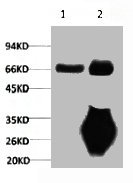
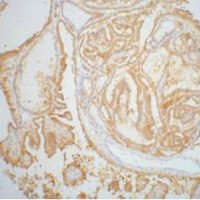
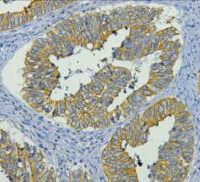
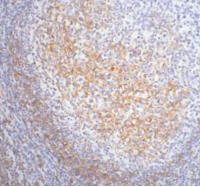
Mouse anti-Human ITGA2B Monoclonal Antibody is a recombinant protein. Suitable for ELISA and Western Blot applications. Explore more Antibody products →