Function
Structural component of intermediate filaments in suprabasal keratinocytes of stratified epithelia. Forms heteropolymers with a type I keratin, assembling into keratin intermediate filament networks that provide mechanical strength and structural stability to differentiating epidermal cells. May regulate the activity of kinases such as PKC and SRC by interacting with integrin beta-1 (ITB1) and the receptor of activated protein C kinase 1 (RACK1).
Biological Context
Subcellular Location: Cell membrane; Cytoplasm
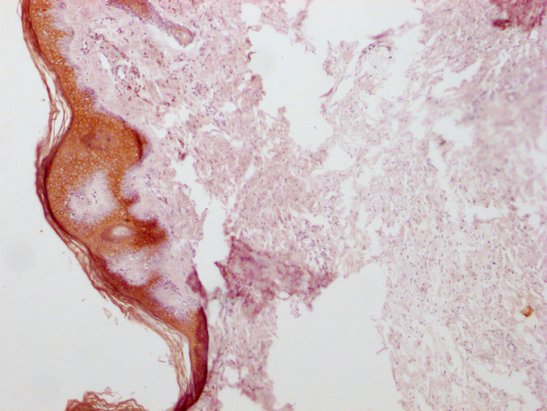
Tissue Specificity: The source of this protein is neonatal foreskin. The 67-kDa type II keratins are expressed in terminally differentiating epidermis
Disease Association: Epidermolytic hyperkeratosis 1 (EHK1) : A skin disorder characterized by widespread blistering and an ichthyotic erythroderma at birth that persist into adulthood. Histologically there is a diffuse epidermolytic degeneration in the lower spinous layer of the epidermis. Within a few weeks from birth, erythroderma and blister formation diminish and hyperkeratoses develop. EHK1 inheritance is autosomal dominant or autosomal recessive. [The disease is caused by variants affecting the gene represented in this entry] | Ichthyosis hystrix, Curth-Macklin type (IHCM) : A genodermatosis with severe verrucous hyperkeratosis. Affected individuals manifest congenital verrucous black scale on the scalp, neck, and limbs with truncal erythema, palmoplantar keratoderma and keratoses on the lips, ears, nipples and buttocks. [The disease is caused by variants affecting the gene represented in this entry] | Keratoderma, palmoplantar, non-epidermolytic (NEPPK) : A dermatological disorder characterized by well-demarcated hyperkeratosis is present over the palms and soles. A red band is frequently present at the periphery of the keratosis. It is usually non-transgredient, with a sharp demarcation of the lesions at the wrists. [The disease is caused by variants affecting the gene represented in this entry] | Ichthyosis, annular epidermolytic, 2 (AEI2) : A form of annular epidermolytic ichthyosis, an autosomal dominant skin disorder characterized by polycyclic, migratory erythematous and scaly plaques. AEI2 patients manifest erythema and blistering of skin at birth that improves without scarring, as well as palmoplantar keratoderma. [The disease is caused by variants affecting the gene represented in this entry] | Keratoderma, palmoplantar, striate 3 (SPPK3) : A dermatological disorder characterized by thickening of the stratum corneum and epidermal layers on palms and soles. There is no involvement of non-palmoplantar skin, and both hair and nails are normal. [The disease is caused by variants affecting the gene represented in this entry] | Palmoplantar keratoderma, epidermolytic, 2 (EPPK2) : A form of epidermolytic palmoplantar keratoderma, a dermatological disorder characterized by diffuse thickening of the epidermis on the entire surface of palms and soles sharply bordered with erythematous margins. Some patients may present knuckle pads, thick pads of skin appearing over the proximal phalangeal joints. EPPK2 is an autosomal dominant form in which hyperkeratosis is restricted to palms and soles and is apparent from birth or childhood. [The disease is caused by variants affecting the gene represented in this entry]
Product Specifications
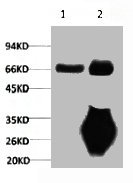
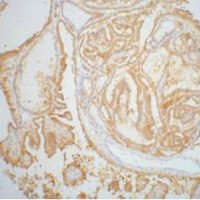
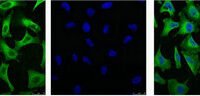
Mouse anti-Human sapiens (Human) KRT1 Monoclonal Antibody is a recombinant protein. Suitable for ELISA and Western Blot applications. Explore more Antibody products →