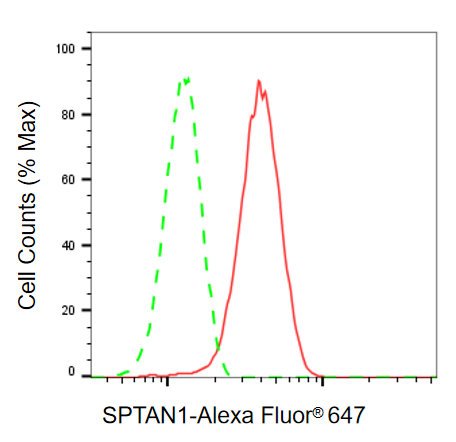
Mouse anti-Human/Mouse/Rat sapiens (Human) SPTAN1 Monoclonal Antibody

Mouse anti-Human/Mouse/Rat sapiens (Human) SPTAN1 Monoclonal Antibody — recombinant protein.

SKU: BCREC-000787MA Category:

Product Specifications

Uniprot No.Q13813
Target NamesSPTAN1
Species ReactivityMouse
ImmunogenRecombinant Human SPTAN1 protein
Immunogen SpeciesHomo sapiens (Human)
ConjugateNon-conjugated
IsotypeMouse IgG1
ClonalityMonoclonal
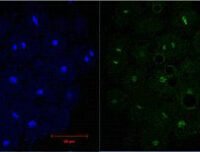
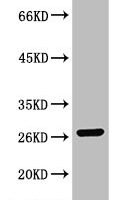
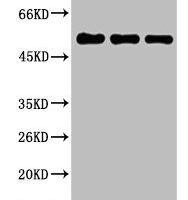
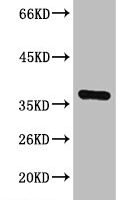
ApplicationsELISA, WB, FC, ICC
BufferPBS, 50% glycerol, 0.05% Proclin 300, 0.05%BSA
StorageUpon receipt, store at -20°C or -80°C. Avoid repeated freeze.

Function

Fodrin, which seems to be involved in secretion, interacts with calmodulin in a calcium-dependent manner and is thus candidate for the calcium-dependent movement of the cytoskeleton at the membrane.

Biological Context

Subcellular Location: Cytoplasm, cytoskeleton; Cytoplasm, cell cortex
Disease Association: Developmental and epileptic encephalopathy 5 (DEE5) : A disorder characterized by seizures associated with hypsarrhythmia, profound intellectual disability with lack of visual attention and speech development, as well as spastic quadriplegia. [The disease is caused by variants affecting the gene represented in this entry] | Developmental delay with or without epilepsy (DEVEP) : An autosomal dominant neurodevelopmental disorder apparent from infancy or early childhood, and characterized by impaired intellectual development, speech delay, motor delay, and behavioral abnormalities. About half of patients develop various types of seizures. Some affected individuals have cerebellar atrophy and ataxia. [The disease is caused by variants affecting the gene represented in this entry] | Neuronopathy, distal hereditary motor, autosomal dominant 11 (HMND11) : A form of distal hereditary motor neuronopathy, a heterogeneous group of neuromuscular diseases caused by selective degeneration of motor neurons in the anterior horn of the spinal cord, without sensory deficit in the posterior horn. HMND11 is an autosomal dominant form with incomplete penetrance, characterized by juvenile or young-adult onset of distal limb muscle weakness and atrophy mainly affecting the lower limbs, resulting in gait instability and walking difficulties. Some affected individuals may have distal upper limb and hand involvement or mild distal sensory abnormalities, but motor symptoms dominate the clinical picture. [The disease is caused by variants affecting the gene represented in this entry] | Spastic paraplegia 91, autosomal dominant, with or without cerebellar ataxia (SPG91) : A form of spastic paraplegia, a neurodegenerative disorder characterized by a slow, gradual, progressive weakness and spasticity of the lower limbs. Rate of progression and the severity of symptoms are quite variable. Initial symptoms may include difficulty with balance, weakness and stiffness in the legs, muscle spasms, and dragging the toes when walking. In some forms of the disorder, bladder symptoms (such as incontinence) may appear, or the weakness and stiffness may spread to other parts of the body. SPG91 is an autosomal dominant form characterized by gait abnormalities, sometimes associated with cerebellar ataxia. Additional features may include sensory abnormalities, peripheral neuropathy, optic neuropathy, developmental delay, impaired intellectual development, and seizures. Most patients have symptoms onset in the first decade of life, although age at onset is highly variable and ranges from birth to young adulthood. [The disease is caused by variants affecting the gene represented in this entry]

Product Specifications

Mouse anti-Human/Mouse/Rat sapiens (Human) SPTAN1 Monoclonal Antibody is a recombinant protein. Suitable for ELISA and Western Blot applications.

SDS-PAGE: Single band at expected molecular weight confirming purity.

ELISA: Suitable as coating antigen or detection standard.

Western Blot: Compatible with standard Western Blot protocols.

Protein Interaction: Validated for SPR (Surface Plasmon Resonance) and BLI (Bio-Layer Interferometry) studies.

Shipping: Shipped at ambient temperature. Lyophilized protein is stable during transit.

Storage: Store lyophilized protein at -20°C to -80°C. Reconstituted protein should be aliquoted and stored at -80°C. Avoid repeated freeze-thaw cycles.

Shelf Life: 12 months from date of receipt when stored as recommended.

Shipping Time: Orders placed before 2 PM EST ship same day. International orders typically deliver within 5-10 business days.

Protein Biology

Function

Fodrin, which seems to be involved in secretion, interacts with calmodulin in a calcium-dependent manner and is thus candidate for the calcium-dependent movement of the cytoskeleton at the membrane

Subcellular Location

Cytoplasm, cytoskeleton; Cytoplasm, cell cortex

Disease Association

Developmental and epileptic encephalopathy 5 (DEE5) : A disorder characterized by seizures associated with hypsarrhythmia, profound intellectual disability with lack of visual attention and speech development, as well as spastic quadriplegia. [The disease is caused by variants affecting the gene represented in this entry] | Developmental delay with or without epilepsy (DEVEP) : An autosomal dominant neurodevelopmental disorder apparent from infancy or early childhood, and characterized by impaired intellectual development, speech delay, motor delay, and behavioral abnormalities. About half of patients develop various types of seizures. Some affected individuals have cerebellar atrophy and ataxia. [The disease is caused by variants affecting the gene represented in this entry] | Neuronopathy, distal hereditary motor, autosomal dominant 11 (HMND11) : A form of distal hereditary motor neuronopathy, a heterogeneous group of neuromuscular diseases caused by selective degeneration of motor neurons in the anterior horn of the spinal cord, without sensory deficit in the posterior horn. HMND11 is an autosomal dominant form with incomplete penetrance, characterized by juvenile or young-adult onset of distal limb muscle weakness and atrophy mainly affecting the lower limbs, resulting in gait instability and walking difficulties. Some affected individuals may have distal upper limb and hand involvement or mild distal sensory abnormalities, but motor symptoms dominate the clinical picture. [The disease is caused by variants affecting the gene represented in this entry] | Spastic paraplegia 91, autosomal dominant, with or without cerebellar ataxia (SPG91) : A form of spastic paraplegia, a neurodegenerative disorder characterized by a slow, gradual, progressive weakness and spasticity of the lower limbs. Rate of progression and the severity of symptoms are quite variable. Initial symptoms may include difficulty with balance, weakness and stiffness in the legs, muscle spasms, and dragging the toes when walking. In some forms of the disorder, bladder symptoms (such as incontinence) may appear, or the weakness and stiffness may spread to other parts of the body. SPG91 is an autosomal dominant form characterized by gait abnormalities, sometimes associated with cerebellar ataxia. Additional features may include sensory abnormalities, peripheral neuropathy, optic neuropathy, developmental delay, impaired intellectual development, and seizures. Most patients have symptoms onset in the first decade of life, although age at onset is highly variable and ranges from birth to young adulthood. [The disease is caused by variants affecting the gene represented in this entry]

Subunit

Like erythrocyte spectrin, the spectrin-like proteins are capable of forming dimers which can further associate to tetramers. Interacts (via C-terminal spectrin repeats) with TRPC4. Interacts with CALM and EMD. Interacts with isoform 1 of ACP1. Identified in a complex with ACTN4, CASK, IQGAP1, MAGI2, NPHS1 and SPTBN1. Interacts with SHANK3 (via ANK repeats). Interacts with CLN3; this interaction regulates the fodrin localization at the plasma membrane (Probable)

Gene: SPTAN1  |  Organism: Homo sapiens  |  Synonyms: Alpha-II spectrin; Fodrin alpha chain; Spectrin, non-erythroid alpha subunit
Key Publications

Frequently Asked Questions

How do I order or inquire about this product?

Fill out the Online Inquiry form with your required quantity and specifications. You can also email sales@biocrestsci.com. Our team typically responds within 4 business hours with a quote and availability confirmation.

What is the shipping and delivery time?

Orders placed before 2 PM EST ship the same day. Domestic (US) delivery typically takes 2-3 business days. International orders deliver within 5-10 business days. All products are shipped at ambient temperature with appropriate packaging to ensure stability.

How should I store this recombinant protein?

Lyophilized proteins should be stored at -20°C to -80°C upon receipt. After reconstitution, aliquot and store at -80°C. Avoid repeated freeze-thaw cycles. Shelf life is 12 months from date of receipt when stored as recommended.

What quality controls are performed on your products?

Each product undergoes SDS-PAGE purity analysis (typically >85-95%), endotoxin testing, and bioactivity validation. Products are validated for ELISA, Western Blot, and SPR/BLI applications as specified on this product page. A Certificate of Analysis (CoA) is available upon request.

Shopping Cart
Scroll to Top