Mouse anti-Human/Mouse/Rat/Yeast Histone H3 Monoclonal Antibody

Mouse anti-Human/Mouse/Rat/Yeast Histone H3 Monoclonal Antibody — Core component of nucleosome.

SKU: BCREC-000012MA Category:

Product Specifications

Uniprot No.P68431
Species ReactivityMouse
ImmunogenRecombinant Protein
ConjugateNon-conjugated
IsotypeIgG
ClonalityMonoclonal
ApplicationsELISA,WB,IF,IP
BufferPBS, 50% glycerol, 0.05% Proclin 300, 0.05%BSA
StorageUpon receipt, store at -20°C or -80°C. Avoid repeated freeze.

Function

Core component of nucleosome. Nucleosomes wrap and compact DNA into chromatin, limiting DNA accessibility to the cellular machineries which require DNA as a template. Histones thereby play a central role in transcription regulation, DNA repair, DNA replication and chromosomal stability.

Biological Context

Subcellular Location: Nucleus; Chromosome
Disease Association: Glioma (GLM) : Gliomas are benign or malignant central nervous system neoplasms derived from glial cells. They comprise astrocytomas and glioblastoma multiforme that are derived from astrocytes, oligodendrogliomas derived from oligodendrocytes and ependymomas derived from ependymocytes. [The gene represented in this entry is involved in disease pathogenesis. HIST1H3B mutations affecting residue Lys-28 involved in post-translational modifications of histone H3.1 are recurrent in malignant, aggressive gliomas including pediatric non-brain stem glioblastoma and diffuse intrinsic pontine glioma (DIPG). The mechanism through which mutations lead to tumorigenesis involves altered histone methylation, impaired regulation of Polycomb repressive complex 2 (PRC2) activity, and aberrant epigenetic regulation of gene expression ] | [HIST1H3B or HIST1H3C mutations affecting residue Lys-37 of histone H3.1 are involved in the pathogenesis of pediatric undifferentiated soft tissue sarcomas. The mechanism through which mutations lead to tumorigenesis involves altered histones methylation with gain of global H3K27 methylation, altered Polycomb repressive complex 1 (PRC1) activity, aberrant epigenetic regulation of gene expression and impaired differentiation of mesenchimal progenitor cells]

Product Specifications

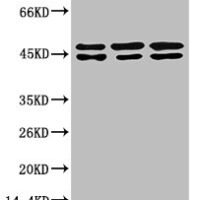
Mouse anti-Human/Mouse/Rat/Yeast Histone H3 Monoclonal Antibody is a recombinant protein. Suitable for ELISA and Western Blot applications.

Applications: ELISA,WB,IF,IP

Biological Activity: Not implied unless activity data are explicitly listed on this product page, the datasheet, or the CoA.

Storage: Upon receipt, store at -20°C or -80°C. Avoid repeated freeze.

Shipping & Lead Time: Availability, shipping conditions, and estimated lead time are confirmed in the formal quotation or order confirmation based on the product format, destination, and order requirements.

Protein Biology

Function

Core component of nucleosome. Nucleosomes wrap and compact DNA into chromatin, limiting DNA accessibility to the cellular machineries which require DNA as a template. Histones thereby play a central role in transcription regulation, DNA repair, DNA replication and chromosomal stability. DNA accessibility is regulated via a complex set of post-translational modifications of histones, also called histone code, and nucleosome remodeling

Subcellular Location

Nucleus; Chromosome

Disease Association

Glioma (GLM) : Gliomas are benign or malignant central nervous system neoplasms derived from glial cells. They comprise astrocytomas and glioblastoma multiforme that are derived from astrocytes, oligodendrogliomas derived from oligodendrocytes and ependymomas derived from ependymocytes. [The gene represented in this entry is involved in disease pathogenesis. HIST1H3B mutations affecting residue Lys-28 involved in post-translational modifications of histone H3.1 are recurrent in malignant, aggressive gliomas including pediatric non-brain stem glioblastoma and diffuse intrinsic pontine glioma (DIPG) (PubMed:22286216). The mechanism through which mutations lead to tumorigenesis involves altered histone methylation, impaired regulation of Polycomb repressive complex 2 (PRC2) activity, and aberrant epigenetic regulation of gene expression (PubMed:23603901)] | [HIST1H3B or HIST1H3C mutations affecting residue Lys-37 of histone H3.1 are involved in the pathogenesis of pediatric undifferentiated soft tissue sarcomas. The mechanism through which mutations lead to tumorigenesis involves altered histones methylation with gain of global H3K27 methylation, altered Polycomb repressive complex 1 (PRC1) activity, aberrant epigenetic regulation of gene expression and impaired differentiation of mesenchimal progenitor cells]

Subunit

The nucleosome is a histone octamer containing two molecules each of H2A, H2B, H3 and H4 assembled in one H3-H4 heterotetramer and two H2A-H2B heterodimers (PubMed:36435862). The octamer wraps approximately 147 bp of DNA. Interacts with TONSL; CHAF1A; CHAF1B; MCM2 and DNAJC9 (PubMed:33857403). Interacts with NASP; NASP is a histone chaperone that stabilizes and maintains a soluble pool of Histone H3-H4 dimers (PubMed:22195965)

Gene: H3C1, H3C2, H3C3, H3C4, H3C6, H3C7, H3C8, H3C10, H3C11, H3C12  |  Organism: Homo sapiens  |  Synonyms: Histone H3/a; Histone H3/b; Histone H3/c; Histone H3/d; Histone H3/f; Histone H3/h; Histone H3/i; Histone H3/j; Histone H3/k; Histone H3/l
Key Publications

Frequently Asked Questions

How do I order or inquire about this product?

Submit the Online Inquiry form with your required quantity and specifications, or email sales@biocrestsci.com. Available sizes, pricing, stock status, documentation, and estimated lead time are confirmed in the formal quotation.

What is the shipping and delivery time?

Availability, dispatch timing, shipping conditions, and delivery estimates depend on the product format, destination, and order requirements. These details are confirmed in the formal quotation or order confirmation.

How should this product be stored?

Follow the storage and handling instructions in the product-specific datasheet and Certificate of Analysis (CoA). Requirements may vary by product form and formulation; contact BioCrest Sci if product-specific guidance is needed.

What quality controls are performed on your products?

Quality-control data such as identity, purity, endotoxin level, or biological activity are provided only when specified on this product page, the datasheet, or Certificate of Analysis (CoA). Biological activity is not implied unless explicitly stated.

Shopping Cart
Scroll to Top