

Function
Inhibits peroxisomal division when overexpressed.
Biological Context
Subcellular Location: Cytoplasm, cytosol; Golgi apparatus; Endomembrane system (Peripheral membrane protein); Mitochondrion outer membrane (Peripheral membrane protein); Peroxisome; Membrane, clathrin-coated pit; Cytoplasmic vesicle, secretory vesicle, synaptic vesicle membrane
Tissue Specificity: Ubiquitously expressed with highest levels found in skeletal muscles, heart, kidney and brain. Isoform 1 is brain-specific. Isoform 2 and isoform 3 are predominantly expressed in testis and skeletal muscles respectively. Isoform 4 is weakly expressed in brain, heart and kidney. Isoform 5 is dominantly expressed in liver, heart and kidney. Isoform 6 is expressed in neurons
Disease Association: [May be associated with Alzheimer disease through amyloid-beta-induced increased S-nitrosylation of DNM1L, which triggers, directly or indirectly, excessive mitochondrial fission, synaptic loss and neuronal damage] | Encephalopathy due to defective mitochondrial and peroxisomal fission 1 (EMPF1) : A rare autosomal dominant systemic disorder resulting in lack of neurologic development and death in infancy. After birth, infants present in the first week of life with poor feeding and neurologic impairment, including hypotonia, little spontaneous movement, no tendon reflexes, no response to light stimulation, and poor visual fixation. Other features include mildly elevated plasma concentration of very-long-chain fatty acids, lactic acidosis, microcephaly, deep-set eyes, optic atrophy and hypoplasia, and an abnormal gyral pattern in both frontal lobes associated with dysmyelination. [The disease is caused by variants affecting the gene represented in this entry] | Optic atrophy 5 (OPA5) : A form of optic atrophy, a disease characterized by progressive visual loss in association with a deficiency in the number of nerve fibers which arise in the retina and converge to form the optic disk, optic nerve, optic chiasm and optic tracts. OPA5 is an autosomal dominant non-syndromic form that manifests as slowly progressive visual loss with variable onset from the first to third decades. Additional ocular abnormalities may include central scotoma and dyschromatopsia. [The disease is caused by variants affecting the gene represented in this entry]
Product Specifications
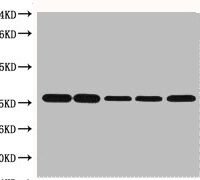
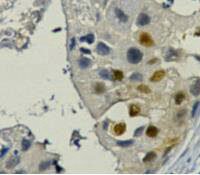
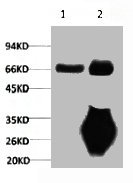
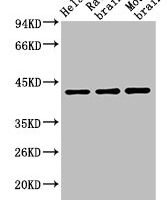
Mouse anti-Human/Mouse/Rat sapiens (Human) DNM1L Monoclonal Antibody is a recombinant protein. Suitable for ELISA and Western Blot applications. Explore more Antibody products →