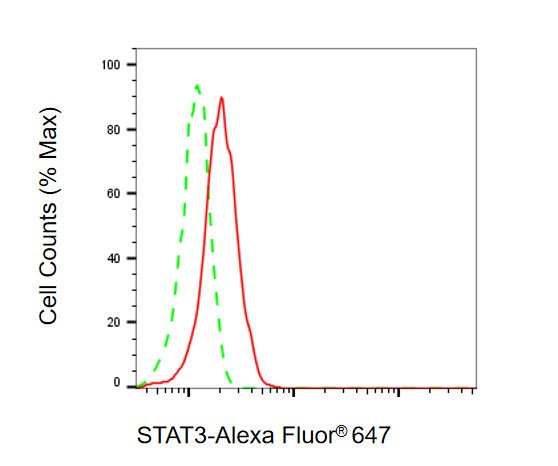
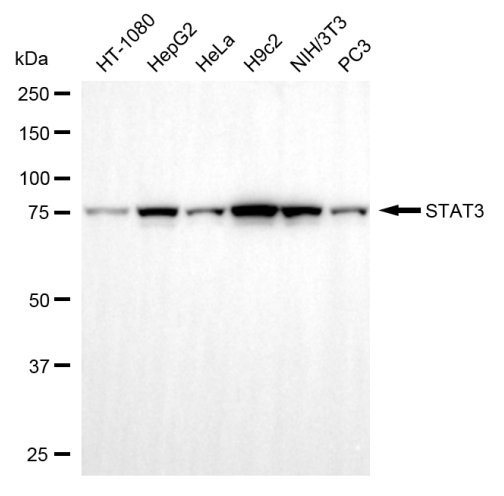
Mouse anti-Human/Mouse/Rat sapiens (Human) STAT3 Monoclonal Antibody

Mouse anti-Human/Mouse/Rat sapiens (Human) STAT3 Monoclonal Antibody — Signal transducer and transcription activator that mediates cellular responses to interleukins, KITLG/SCF, LEP and other growth factors.

SKU: BCREC-000963MA Category:

Product Specifications

Uniprot No.P40763
Target NamesSTAT3
Species ReactivityMouse
ImmunogenRecombinant Human STAT3 protein
Immunogen SpeciesHomo sapiens (Human)
ConjugateNon-conjugated
IsotypeMouse IgG1
ClonalityMonoclonal
ApplicationsELISA, WB, FC
BufferPBS, 50% glycerol, 0.05% Proclin 300, 0.05%BSA
StorageUpon receipt, store at -20°C or -80°C. Avoid repeated freeze.

Function

Signal transducer and transcription activator that mediates cellular responses to interleukins, KITLG/SCF, LEP and other growth factors. Once activated, recruits coactivators, such as NCOA1 or MED1, to the promoter region of the target gene. May mediate cellular responses to activated FGFR1, FGFR2, FGFR3 and FGFR4.

Biological Context

Subcellular Location: Cytoplasm; Nucleus
Tissue Specificity: Heart, brain, placenta, lung, liver, skeletal muscle, kidney and pancreas. Expressed in naive CD4(+) T cells as well as T-helper Th17, Th1 and Th2 cells
Disease Association: Hyper-IgE syndrome 1, autosomal dominant, with recurrent infections (HIES1) : A rare disorder of immunity and connective tissue characterized by immunodeficiency, chronic eosinophilia, distinctive coarse facial appearance, abnormal dentition, hyperextensibility of the joints, and bone fractures. [The disease is caused by variants affecting the gene represented in this entry] | Autoimmune disease, multisystem, infantile-onset, 1 (ADMIO1) : A disorder characterized by early childhood onset of a spectrum of autoimmune manifestations affecting multiple organs, including insulin-dependent diabetes mellitus and autoimmune enteropathy or celiac disease. Other features include short stature, non-specific dermatitis, hypothyroidism, autoimmune arthritis, and delayed puberty. [The disease is caused by variants affecting the gene represented in this entry]

Product Specifications

Mouse anti-Human/Mouse/Rat sapiens (Human) STAT3 Monoclonal Antibody is a recombinant protein. Suitable for ELISA and Western Blot applications.

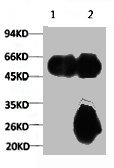
SDS-PAGE: Single band at expected molecular weight confirming purity.

ELISA: Suitable as coating antigen or detection standard.

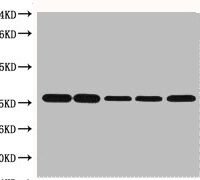
Western Blot: Compatible with standard Western Blot protocols.

Protein Interaction: Validated for SPR (Surface Plasmon Resonance) and BLI (Bio-Layer Interferometry) studies.

Shipping: Shipped at ambient temperature. Lyophilized protein is stable during transit.

Storage: Store lyophilized protein at -20°C to -80°C. Reconstituted protein should be aliquoted and stored at -80°C. Avoid repeated freeze-thaw cycles.

Shelf Life: 12 months from date of receipt when stored as recommended.

Shipping Time: Orders placed before 2 PM EST ship same day. International orders typically deliver within 5-10 business days.

Protein Biology

Function

Signal transducer and transcription activator that mediates cellular responses to interleukins, KITLG/SCF, LEP and other growth factors (PubMed:10688651, PubMed:11294841, PubMed:12359225, PubMed:12873986, PubMed:15194700, PubMed:15653507, PubMed:16285960, PubMed:17344214, PubMed:18242580, PubMed:18782771, PubMed:22306293, PubMed:23084476, PubMed:28262505, PubMed:32929201, PubMed:38404237). Once activated, recruits coactivators, such as NCOA1 or MED1, to the promoter region of the target gene (PubMed:15653507, PubMed:16285960, PubMed:17344214, PubMed:18782771, PubMed:28262505, PubMed:32929201). May mediate cellular responses to activated FGFR1, FGFR2, FGFR3 and FGFR4 (PubMed:12873986). Upon activation of IL6ST/gp130 signaling by interleukin-6 (IL6), binds to the IL6-responsive elements identified in the promoters of various acute-phase protein genes (PubMed:12359225). Activated by IL31 through IL31RA (PubMed:15194700). Acts as a regulator of inflammatory response by regulating differentiation of naive CD4(+) T-cells into T-helper Th17 or regulatory T-cells (Treg): acetylation promotes its transcription activity and cell differentiation while deacetylation and oxidation of lysine residues by LOXL3 inhibits differentiation (PubMed:28065600, PubMed:28262505). Involved in cell cycle regulation by inducing the expression of key genes for the progression from G1 to S phase, such as CCND1 (PubMed:17344214). Mediates the effects of LEP on melanocortin production, body energy homeostasis and lactation (By similarity). May play an apoptotic role by transctivating BIRC5 expression under LEP activation (PubMed:18242580). Cytoplasmic STAT3 represses macroautophagy by inhibiting EIF2AK2/PKR activity (PubMed:23084476). Plays a crucial role in basal beta cell functions, such as regulation of insulin secretion (By similarity). Following JAK/STAT signaling activation and as part of a complex with NFATC3 and NFATC4, binds to the alpha-beta E4 promoter region of CRYAB and activates transcription in cardiomyocytes (By similarity). Involved in the oncostatin-M-mediated signaling pathway through both type I OSM receptor complex (heterodimers composed of LIFR and IL6ST) and type II OSM receptor complex (heterodimers composed of OSMR and IL6ST) (PubMed:9188471)

Subcellular Location

Cytoplasm; Nucleus

Disease Association

Hyper-IgE syndrome 1, autosomal dominant, with recurrent infections (HIES1) : A rare disorder of immunity and connective tissue characterized by immunodeficiency, chronic eosinophilia, distinctive coarse facial appearance, abnormal dentition, hyperextensibility of the joints, and bone fractures. [The disease is caused by variants affecting the gene represented in this entry] | Autoimmune disease, multisystem, infantile-onset, 1 (ADMIO1) : A disorder characterized by early childhood onset of a spectrum of autoimmune manifestations affecting multiple organs, including insulin-dependent diabetes mellitus and autoimmune enteropathy or celiac disease. Other features include short stature, non-specific dermatitis, hypothyroidism, autoimmune arthritis, and delayed puberty. [The disease is caused by variants affecting the gene represented in this entry]

Tissue Specificity

Heart, brain, placenta, lung, liver, skeletal muscle, kidney and pancreas. Expressed in naive CD4(+) T cells as well as T-helper Th17, Th1 and Th2 cells (PubMed:31899195)

Subunit

(Microbial infection) Interacts with human cytomegalovirus (HHV-5) immediate early protein IE1; this interaction leads to STAT3 nuclear accumulation and disruption of IL6-induced STAT3 phosphorylation

Gene: STAT3  |  Organism: Homo sapiens  |  Synonyms: Acute-phase response factor
Key Publications

Frequently Asked Questions

How do I order or inquire about this product?

Fill out the Online Inquiry form with your required quantity and specifications. You can also email sales@biocrestsci.com. Our team typically responds within 4 business hours with a quote and availability confirmation.

What is the shipping and delivery time?

Orders placed before 2 PM EST ship the same day. Domestic (US) delivery typically takes 2-3 business days. International orders deliver within 5-10 business days. All products are shipped at ambient temperature with appropriate packaging to ensure stability.

How should I store this recombinant protein?

Lyophilized proteins should be stored at -20°C to -80°C upon receipt. After reconstitution, aliquot and store at -80°C. Avoid repeated freeze-thaw cycles. Shelf life is 12 months from date of receipt when stored as recommended.

What quality controls are performed on your products?

Each product undergoes SDS-PAGE purity analysis (typically >85-95%), endotoxin testing, and bioactivity validation. Products are validated for ELISA, Western Blot, and SPR/BLI applications as specified on this product page. A Certificate of Analysis (CoA) is available upon request.

Shopping Cart
Scroll to Top