Recombinant Human Growth/differentiation factor 5 (GDF5) (Active)

Recombinant Human Growth/differentiation factor 5 (GDF5) (Active) — Growth factor involved in bone and cartilage formation. Purity > 95 %.

SKU: BCACP-000018 Category:
Product SKUBCACP-000018
Product DescriptionRecombinant Human Growth/differentiation factor 5 (GDF5) protein is expressed from E.Coli with Tag-Free. It contains 382-501aa. [Accession | P43026].
Uniprot No.P43026
Gene NamesGDF5
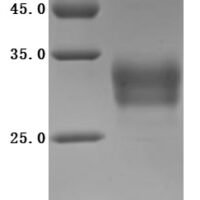
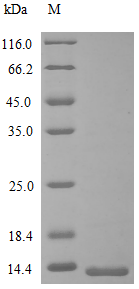
Purity> 95 % as determined by SDS-PAGE
Expression SystemE.Coli
Expression Region382-501aa
SpeciesHomo sapiens (Human)
Tag InfoTag-Free
Molecular weight13.6 kDa
ActivityFully biologically active when compared to standard. The ED50 as determined by inducing alkaline phosphatase production of murine ATDC5 cells is less than 1.0 μg/ml, corresponding to a specific activity of > 1000 IU/mg.
BufferLyophilized from a 0.2 μm filtered 20 mM Tris-HCl, 0.5 M NaCl, 6% Trehalose, pH 8.0
StorageStore at -20°C/-80°C upon receipt, aliquoting is necessary for mutiple use. Avoid repeated freeze-thaw cycles.
Alternative NamesBMP14; Cartilage derived morphogenetic protein 1; Cartilage-derived morphogenetic protein 1; CDMP-1; CDMP1; GDF-5; Gdf5; GDF5_HUMAN; Growth differentiation factor 5; Growth/differentiation factor 5; LAP4; OS5; Radotermin; SYNS2

Function

Growth factor involved in bone and cartilage formation. During cartilage development regulates differentiation of chondrogenic tissue through two pathways. Firstly, positively regulates differentiation of chondrogenic tissue through its binding of high affinity with BMPR1B and of less affinity with BMPR1A, leading to induction of SMAD1-SMAD5-SMAD8 complex phosphorylation and then SMAD protein signaling transduction.

Biological Context

Subcellular Location: Secreted; Cell membrane
Tissue Specificity: Predominantly expressed in long bones during embryonic development. Expressed in monocytes (at protein level)
Disease Association: Acromesomelic dysplasia 2A (AMD2A) : A form of acromesomelic dysplasia, a skeletal disorder characterized by short stature, very short limbs and hand/foot malformations. The severity of limb abnormalities increases from proximal to distal with profoundly affected hands and feet showing brachydactyly and/or rudimentary fingers (knob-like fingers). AMD2A is an autosomal recessive form characterized by normal axial skeletons and missing or fused skeletal elements within the hands and feet. [The disease is caused by variants affecting the gene represented in this entry] | Acromesomelic dysplasia 2C (AMD2C) : A form of acromesomelic dysplasia, a skeletal disorder characterized by short stature, very short limbs and hand/foot malformations. The severity of limb abnormalities increases from proximal to distal with profoundly affected hands and feet showing brachydactyly and/or rudimentary fingers (knob-like fingers). AMD2C is an autosomal recessive form characterized by skeletal abnormalities restricted to the limbs. The craniofacial skeleton and axial skeletal structures are normal. [The disease is caused by variants affecting the gene represented in this entry] | Brachydactyly C (BDC) : A form of brachydactyly. Brachydactyly defines a group of inherited malformations characterized by shortening of the digits due to abnormal development of the phalanges and/or the metacarpals. Brachydactyly type C is characterized by deformity of the middle and proximal phalanges of the second and third fingers, sometimes with hypersegmentation of the proximal phalanx. The ring finger may be essentially normal and project beyond the others. [The disease is caused by variants affecting the gene represented in this entry. Some BDC patients with GDF5 mutations also manifest clinical features of ASPED angel-shaped phalango-epiphyseal dysplasia (ASPED), an autosomal dominant skeletal abnormality characterized by a typical angel-shaped phalanx, brachydactyly, specific radiological findings, abnormal dentition, hip dysplasia, and delayed bone age. This suggests that BDC and ASPED are part of the same clinical spectrum ] | Acromesomelic dysplasia 2B (AMD2B) : A form of acromesomelic dysplasia, a skeletal disorder characterized by short stature, very short limbs and hand/foot malformations. The severity of limb abnormalities increases from proximal to distal with profoundly affected hands and feet showing brachydactyly and/or rudimentary fingers (knob-like fingers). AMD2B is an autosomal recessive form characterized by acromesomelic limb shortening with severe reduction or absence of the fibula, and severe hand and feet abnormalities including complex brachydactyly. [The disease is caused by variants affecting the gene represented in this entry] | Symphalangism, proximal 1B (SYM1B) : A disease characterized by the hereditary absence of the proximal interphalangeal joints. Distal interphalangeal joints are less frequently involved and metacarpophalangeal joints are rarely affected whereas carpal bone malformation and fusion are common. In the lower extremities, tarsal bone coalition is common. Conductive hearing loss is seen and is due to fusion of the stapes to the petrous part of the temporal bone. [The disease is caused by variants affecting the gene represented in this entry] | Multiple synostoses syndrome 2 (SYNS2) : A bone disease characterized by multiple progressive joint fusions that commonly involve proximal interphalangeal, tarsal-carpal, humeroradial and cervical spine joints. Additional features can include progressive conductive deafness and facial dysmorphism. [The disease is caused by variants affecting the gene represented in this entry] | Brachydactyly A2 (BDA2) : A form of brachydactyly. Brachydactyly defines a group of inherited malformations characterized by shortening of the digits due to abnormal development of the phalanges and/or the metacarpals. In brachydactyly type A2 shortening of the middle phalanges is confined to the index finger and the second toe, all other digits being more or less normal. Because of a rhomboid or triangular shape of the affected middle phalanx, the end of the second finger usually deviates radially. [The disease is caused by variants affecting the gene represented in this entry] | Osteoarthritis 5 (OS5) : A degenerative disease of the joints characterized by degradation of the hyaline articular cartilage and remodeling of the subchondral bone with sclerosis. Clinical symptoms include pain and joint stiffness often leading to significant disability and joint replacement. [Disease susceptibility is associated with variants affecting the gene represented in this entry] | Brachydactyly A1, C (BDA1C) : A form of brachydactyly type A1. Brachydactyly defines a group of inherited malformations characterized by shortening of the digits due to abnormal development of the phalanges and/or the metacarpals. Brachydactyly type A1 is characterized by middle phalanges of all the digits rudimentary or fused with the terminal phalanges. The proximal phalanges of the thumbs and big toes are short. BDA1C inheritance can be autosomal dominant or autosomal recessive. Autosomal dominant BDA1C has a milder phenotype. [The disease is caused by variants affecting the gene represented in this entry]

Product Specifications

Recombinant Human Growth/differentiation factor 5 (GDF5) (Active) is a recombinant protein from Homo sapiens (Human), expressed in E.Coli, covering amino acids 382-501aa, with Tag-Free tag, molecular weight 13.6 kDa, purity > 95 % as determined by SDS-PAGE. Suitable for ELISA and Western Blot applications.
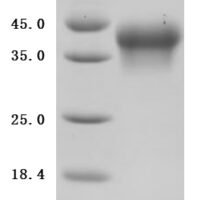
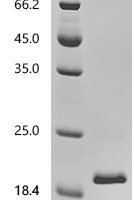
SDS-PAGE: Single band at expected molecular weight confirming purity.

ELISA: Suitable as coating antigen or detection standard.

Western Blot: Compatible with standard Western Blot protocols.

Protein Interaction: Validated for SPR (Surface Plasmon Resonance) and BLI (Bio-Layer Interferometry) studies.

Shipping: Shipped at ambient temperature. Lyophilized protein is stable during transit.

Storage: Store lyophilized protein at -20°C to -80°C. Reconstituted protein should be aliquoted and stored at -80°C. Avoid repeated freeze-thaw cycles.

Shelf Life: 12 months from date of receipt when stored as recommended.

Shipping Time: Orders placed before 2 PM EST ship same day. International orders typically deliver within 5-10 business days.

Protein Biology

Function

Growth factor involved in bone and cartilage formation. During cartilage development regulates differentiation of chondrogenic tissue through two pathways. Firstly, positively regulates differentiation of chondrogenic tissue through its binding of high affinity with BMPR1B and of less affinity with BMPR1A, leading to induction of SMAD1-SMAD5-SMAD8 complex phosphorylation and then SMAD protein signaling transduction (PubMed:15530414, PubMed:21976273, PubMed:24098149, PubMed:25092592). Secondly, negatively regulates chondrogenic differentiation through its interaction with NOG (PubMed:21976273). Required to prevent excessive muscle loss upon denervation. This function requires SMAD4 and is mediated by phosphorylated SMAD1/5/8 (By similarity). Binds bacterial lipopolysaccharide (LPS) and mediates LPS-induced inflammatory response, including TNF secretion by monocytes (PubMed:11276205)

Subcellular Location

Secreted; Cell membrane

Disease Association

Acromesomelic dysplasia 2A (AMD2A) : A form of acromesomelic dysplasia, a skeletal disorder characterized by short stature, very short limbs and hand/foot malformations. The severity of limb abnormalities increases from proximal to distal with profoundly affected hands and feet showing brachydactyly and/or rudimentary fingers (knob-like fingers). AMD2A is an autosomal recessive form characterized by normal axial skeletons and missing or fused skeletal elements within the hands and feet. [The disease is caused by variants affecting the gene represented in this entry] | Acromesomelic dysplasia 2C (AMD2C) : A form of acromesomelic dysplasia, a skeletal disorder characterized by short stature, very short limbs and hand/foot malformations. The severity of limb abnormalities increases from proximal to distal with profoundly affected hands and feet showing brachydactyly and/or rudimentary fingers (knob-like fingers). AMD2C is an autosomal recessive form characterized by skeletal abnormalities restricted to the limbs. The craniofacial skeleton and axial skeletal structures are normal. [The disease is caused by variants affecting the gene represented in this entry] | Brachydactyly C (BDC) : A form of brachydactyly. Brachydactyly defines a group of inherited malformations characterized by shortening of the digits due to abnormal development of the phalanges and/or the metacarpals. Brachydactyly type C is characterized by deformity of the middle and proximal phalanges of the second and third fingers, sometimes with hypersegmentation of the proximal phalanx. The ring finger may be essentially normal and project beyond the others. [The disease is caused by variants affecting the gene represented in this entry. Some BDC patients with GDF5 mutations also manifest clinical features of ASPED angel-shaped phalango-epiphyseal dysplasia (ASPED), an autosomal dominant skeletal abnormality characterized by a typical angel-shaped phalanx, brachydactyly, specific radiological findings, abnormal dentition, hip dysplasia, and delayed bone age. This suggests that BDC and ASPED are part of the same clinical spectrum (PubMed:22828468)] | Acromesomelic dysplasia 2B (AMD2B) : A form of acromesomelic dysplasia, a skeletal disorder characterized by short stature, very short limbs and hand/foot malformations. The severity of limb abnormalities increases from proximal to distal with profoundly affected hands and feet showing brachydactyly and/or rudimentary fingers (knob-like fingers). AMD2B is an autosomal recessive form characterized by acromesomelic limb shortening with severe reduction or absence of the fibula, and severe hand and feet abnormalities including complex brachydactyly. [The disease is caused by variants affecting the gene represented in this entry] | Symphalangism, proximal 1B (SYM1B) : A disease characterized by the hereditary absence of the proximal interphalangeal joints. Distal interphalangeal joints are less frequently involved and metacarpophalangeal joints are rarely affected whereas carpal bone malformation and fusion are common. In the lower extremities, tarsal bone coalition is common. Conductive hearing loss is seen and is due to fusion of the stapes to the petrous part of the temporal bone. [The disease is caused by variants affecting the gene represented in this entry] | Multiple synostoses syndrome 2 (SYNS2) : A bone disease characterized by multiple progressive joint fusions that commonly involve proximal interphalangeal, tarsal-carpal, humeroradial and cervical spine joints. Additional features can include progressive conductive deafness and facial dysmorphism. [The disease is caused by variants affecting the gene represented in this entry] | Brachydactyly A2 (BDA2) : A form of brachydactyly. Brachydactyly defines a group of inherited malformations characterized by shortening of the digits due to abnormal development of the phalanges and/or the metacarpals. In brachydactyly type A2 shortening of the middle phalanges is confined to the index finger and the second toe, all other digits being more or less normal. Because of a rhomboid or triangular shape of the affected middle phalanx, the end of the second finger usually deviates radially. [The disease is caused by variants affecting the gene represented in this entry] | Osteoarthritis 5 (OS5) : A degenerative disease of the joints characterized by degradation of the hyaline articular cartilage and remodeling of the subchondral bone with sclerosis. Clinical symptoms include pain and joint stiffness often leading to significant disability and joint replacement. [Disease susceptibility is associated with variants affecting the gene represented in this entry] | Brachydactyly A1, C (BDA1C) : A form of brachydactyly type A1. Brachydactyly defines a group of inherited malformations characterized by shortening of the digits due to abnormal development of the phalanges and/or the metacarpals. Brachydactyly type A1 is characterized by middle phalanges of all the digits rudimentary or fused with the terminal phalanges. The proximal phalanges of the thumbs and big toes are short. BDA1C inheritance can be autosomal dominant or autosomal recessive. Autosomal dominant BDA1C has a milder phenotype. [The disease is caused by variants affecting the gene represented in this entry]

Tissue Specificity

Predominantly expressed in long bones during embryonic development. Expressed in monocytes (at protein level)

Subunit

Homodimer; disulfide-linked (By similarity). Interacts with serine proteases, HTRA1 and HTRA3 (By similarity). Following LPS binding, may form a complex with CXCR4, HSP90AA1 and HSPA8. Interacts with high affinity with NOG; inhibits chondrogenesis. Interacts with high affinity with BMPR1B and lower affinity with BMPR1A; positively regulates chondrocyte differentiation and induces SMAD dependent signaling. Interacts with FBN1 (via N-terminal domain) and FBN2 (PubMed:18339631). Interacts with TGFBR3 (PubMed:18184661)

Gene: GDF5  |  Organism: Homo sapiens  |  Synonyms: Bone morphogenetic protein 14; Cartilage-derived morphogenetic protein 1; Lipopolysaccharide-associated protein 4; Radotermin
Key Publications

Frequently Asked Questions

How do I order or inquire about this product?

Fill out the Online Inquiry form with your required quantity and specifications. You can also email sales@biocrestsci.com. Our team typically responds within 4 business hours with a quote and availability confirmation.

What is the shipping and delivery time?

Orders placed before 2 PM EST ship the same day. Domestic (US) delivery typically takes 2-3 business days. International orders deliver within 5-10 business days. All products are shipped at ambient temperature with appropriate packaging to ensure stability.

How should I store this recombinant protein?

Lyophilized proteins should be stored at -20°C to -80°C upon receipt. After reconstitution, aliquot and store at -80°C. Avoid repeated freeze-thaw cycles. Shelf life is 12 months from date of receipt when stored as recommended.

What quality controls are performed on your products?

Each product undergoes SDS-PAGE purity analysis (typically >85-95%), endotoxin testing, and bioactivity validation. Products are validated for ELISA, Western Blot, and SPR/BLI applications as specified on this product page. A Certificate of Analysis (CoA) is available upon request.

Shopping Cart
Scroll to Top