Recombinant Mouse Cell adhesion molecule 1 (Cadm1), partial (Active)

Recombinant Mouse Cell adhesion molecule 1 (Cadm1), partial (Active) — Mediates homophilic cell-cell adhesion in a Ca(2+)-independent manner. Purity >95%.

SKU: BCACP-000236 Category:
Product SKUBCACP-000236
Product DescriptionRecombinant Mouse Cell adhesion molecule 1 (Cadm1) protein is expressed from Mammalian cell with C-terminal 10xHis-tagged. It contains 48-388aa. [Accession | Q8R5M8].
Uniprot No.Q8R5M8
Gene NamesCadm1
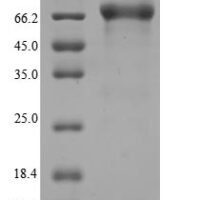
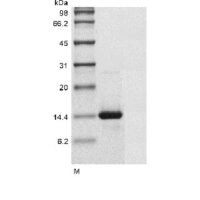
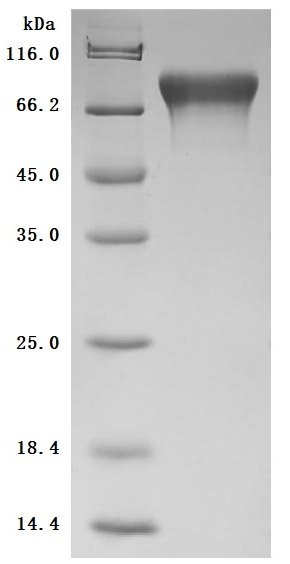
PurityGreater than 95% as determined by SDS-PAGE.
Expression SystemMammalian cell
Expression Region48-388aa
SpeciesMus musculus (Mouse)
Tag InfoC-terminal 10xHis-tagged
Molecular weight39.6 kDa
ActivityMeasured by its binding ability in a functional ELISA. Immobilized Mouse Ly6g6d at 2 μg/ml can bind Anti-Ly6g6d recombinant antibody . The EC50 is 5.260-6.497 ng/mL.
BufferLyophilized from a 0.2 μm filtered 20 mM Tris-HCl, 0.5 M NaCl, 6% Trehalose, pH 8.0
StorageStore at -20°C/-80°C upon receipt, aliquoting is necessary for mutiple use. Avoid repeated freeze-thaw cycles.
Alternative Names(Immunoglobulin superfamily member 4)(Nectin-like protein 2 )(Spermatogenic immunoglobulin superfamily)(Synaptic cell adhesion molecule)(Tumor suppressor in lung cancer 1)

Function

Mediates homophilic cell-cell adhesion in a Ca(2+)-independent manner. Also mediates heterophilic cell-cell adhesion with CADM3 and NECTIN3 in a Ca(2+)-independent manner. Interaction with CRTAM promotes natural killer (NK) cell cytotoxicity and interferon-gamma (IFN-gamma) secretion by CD8+ T-cells in vitro as well as NK cell-mediated rejection of tumors expressing CADM1 in vivo.

Biological Context

Subcellular Location: Cell membrane (Single-pass type I membrane protein); Synaptic cell membrane (Single-pass type I membrane protein)
Tissue Specificity: Expressed dominantly in epithelial cells but not expressed in fibroblast cells (at protein level). Expressed in the T-cell area of lymph nodes, specifically in CD8+ and CD4- CD8- dendritic cells (at protein level). Expressed in CD8+ dendritic cells in the spleen (at protein level). Expressed in CD103+ dendritic cells in the small intestine lamina propria and mesenteric lymph nodes (at protein level). Expressed in brain, lung, kidney, testis, heart, spleen and liver, but not expressed in skeletal muscle

Product Specifications

Recombinant Mouse Cell adhesion molecule 1 (Cadm1), partial (Active) is a recombinant protein from Mus musculus (Mouse), expressed in Mammalian cell, covering amino acids 48-388aa, with C-terminal 10xHis-tagged tag, molecular weight 39.6 kDa, purity Greater than 95% as determined by SDS-PAGE.. Suitable for ELISA and Western Blot applications.

SDS-PAGE: Single band at expected molecular weight confirming purity.

ELISA: Suitable as coating antigen or detection standard.

Western Blot: Compatible with standard Western Blot protocols.

Protein Interaction: Validated for SPR (Surface Plasmon Resonance) and BLI (Bio-Layer Interferometry) studies.

Shipping: Shipped at ambient temperature. Lyophilized protein is stable during transit.

Storage: Store lyophilized protein at -20°C to -80°C. Reconstituted protein should be aliquoted and stored at -80°C. Avoid repeated freeze-thaw cycles.

Shelf Life: 12 months from date of receipt when stored as recommended.

Shipping Time: Orders placed before 2 PM EST ship same day. International orders typically deliver within 5-10 business days.

Protein Biology

Function

Mediates homophilic cell-cell adhesion in a Ca(2+)-independent manner (PubMed:12202822, PubMed:12799182, PubMed:12826663). Also mediates heterophilic cell-cell adhesion with CADM3 and NECTIN3 in a Ca(2+)-independent manner (PubMed:12826663). Interaction with CRTAM promotes natural killer (NK) cell cytotoxicity and interferon-gamma (IFN-gamma) secretion by CD8+ T-cells in vitro as well as NK cell-mediated rejection of tumors expressing CADM1 in vivo (PubMed:15811952). In mast cells, may mediate attachment to and promote communication with nerves (By similarity). CADM1, together with MITF, is essential for development and survival of mast cells in vivo (PubMed:15158462, PubMed:16605125). By interacting with CRTAM and thus promoting the adhesion between CD8+ T-cells and CD8+ dendritic cells, regulates the retention of activated CD8+ T-cell within the draining lymph node (PubMed:19752223). Required for the intestinal retention of intraepithelial CD4+ CD8+ T-cells and, to a lesser extent, intraepithelial and lamina propria CD8+ T-cells and CD4+ T-cells (PubMed:24687959). Interaction with CRTAM promotes the adhesion to gut-associated CD103+ dendritic cells, which may facilitate the expression of gut-homing and adhesion molecules on T-cells and the conversion of CD4+ T-cells into CD4+ CD8+ T-cells (PubMed:24687959). Acts as a synaptic cell adhesion molecule and plays a role in the formation of dendritic spines and in synapse assembly (PubMed:12202822, PubMed:23209303). May be involved in neuronal migration, axon growth, pathfinding, and fasciculation on the axons of differentiating neurons (PubMed:15707673). May play diverse roles in the spermatogenesis including in the adhesion of spermatocytes and spermatids to Sertoli cells and for their normal differentiation into mature spermatozoa (PubMed:12606335, PubMed:16612000)

Subcellular Location

Cell membrane (Single-pass type I membrane protein); Synaptic cell membrane (Single-pass type I membrane protein)

Tissue Specificity

Expressed dominantly in epithelial cells but not expressed in fibroblast cells (at protein level) (PubMed:12826663). Expressed in the T-cell area of lymph nodes, specifically in CD8+ and CD4- CD8- dendritic cells (at protein level) (PubMed:19752223). Expressed in CD8+ dendritic cells in the spleen (at protein level) (PubMed:19752223). Expressed in CD103+ dendritic cells in the small intestine lamina propria and mesenteric lymph nodes (at protein level) (PubMed:24687959). Expressed in brain, lung, kidney, testis, heart, spleen and liver, but not expressed in skeletal muscle (PubMed:12202822, PubMed:12242005, PubMed:12606335)

Subunit

Homodimer (via Ig-like V-type domain) (By similarity). Interacts with FARP1 (PubMed:23209303). Interacts (via Ig-like V-type domain) with CRTAM (via Ig-like V-type domain); the interaction competes with CRTAM homodimerization and CADM1 homodimerization (PubMed:15781451, PubMed:15811952). Interacts (via C-terminus) with EPB41L3/DAL1 (By similarity). The interaction with EPB41L3/DAL1 may act to anchor CADM1 to the actin cytoskeleton (By similarity). Interacts (via C-terminus) with MPP2 (via PDZ domain) (By similarity). Interacts (via C-terminus) with MPP3 (via PDZ domain); this interaction connects CADM1 with DLG1 (By similarity). Interacts (via C-terminus) with PALS2 (via PDZ domain) (PubMed:12826663)

Gene: Cadm1  |  Organism: Mus musculus  |  Synonyms: Immunoglobulin superfamily member 4; Nectin-like protein 2; Spermatogenic immunoglobulin superfamily; Synaptic cell adhesion molecule; Tumor suppressor in lung cancer 1
Key Publications

Frequently Asked Questions

How do I order or inquire about this product?

Fill out the Online Inquiry form with your required quantity and specifications. You can also email sales@biocrestsci.com. Our team typically responds within 4 business hours with a quote and availability confirmation.

What is the shipping and delivery time?

Orders placed before 2 PM EST ship the same day. Domestic (US) delivery typically takes 2-3 business days. International orders deliver within 5-10 business days. All products are shipped at ambient temperature with appropriate packaging to ensure stability.

How should I store this recombinant protein?

Lyophilized proteins should be stored at -20°C to -80°C upon receipt. After reconstitution, aliquot and store at -80°C. Avoid repeated freeze-thaw cycles. Shelf life is 12 months from date of receipt when stored as recommended.

What quality controls are performed on your products?

Each product undergoes SDS-PAGE purity analysis (typically >85-95%), endotoxin testing, and bioactivity validation. Products are validated for ELISA, Western Blot, and SPR/BLI applications as specified on this product page. A Certificate of Analysis (CoA) is available upon request.

Shopping Cart
Scroll to Top