Recombinant Cricetulus griseus Endoplasmic reticulum chaperone BiP (HSPA5) (Active)

Recombinant Cricetulus griseus Endoplasmic reticulum chaperone BiP (HSPA5) (Active) — Endoplasmic reticulum chaperone that plays a key role in protein folding and quality control in the endoplasmic reticulum lumen. Purity >95%.

SKU: BCACP-000549 Category:
Product SKUBCACP-000549
Product DescriptionRecombinant Cricetulus barabensis griseus Endoplasmic reticulum chaperone BiP (HSPA5) protein is expressed from Mammalian cell with C-terminal 10xHis-tagged. It contains 19-654aa. [Accession | G3I8R9].
Uniprot No.G3I8R9
Gene NamesHSPA5
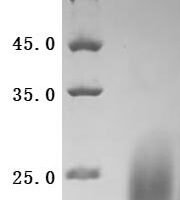
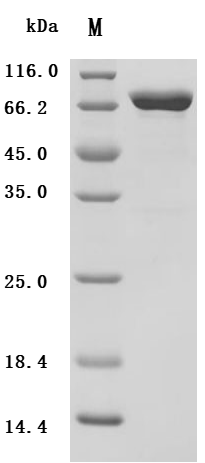
PurityGreater than 95% as determined by SDS-PAGE.
Expression SystemMammalian cell
Expression Region19-654aa
SpeciesCricetulus griseus (Chinese hamster) (Cricetulus barabensis griseus)
Tag InfoC-terminal 10xHis-tagged
Molecular weight71.8 kDa
ActivityMeasured by its binding ability in a functional ELISA. Immobilized Human FGFR2 at 2 μg/mL can bind Anti-FGFR2 recombinant antibody . The EC50 is 2.051-2.322 ng/mL.
BufferLyophilized from a 0.2 μm filtered 20 mM Tris-HCl, 0.5 M NaCl, 6% Trehalose, pH 8.0
StorageStore at -20°C/-80°C upon receipt, aliquoting is necessary for mutiple use. Avoid repeated freeze-thaw cycles.
Alternative NamesEndoplasmic reticulum chaperone BiP; EC:3.6.4.10; 8 kDa glucose-regulated protein; Binding-immunoglobulin protein; Heat shock protein 70 family protein 5; Heat shock protein family A member 5; Immunoglobulin heavy chain-binding protein ; HSPA5; GRP78; I79_019946

Function

Endoplasmic reticulum chaperone that plays a key role in protein folding and quality control in the endoplasmic reticulum lumen. Involved in the correct folding of proteins and degradation of misfolded proteins via its interaction with DNAJC10/ERdj5, probably to facilitate the release of DNAJC10/ERdj5 from its substrate. Acts as a key repressor of the EIF2AK3/PERK and ERN1/IRE1-mediated unfolded protein response (UPR).

Product Specifications

Recombinant Cricetulus griseus Endoplasmic reticulum chaperone BiP (HSPA5) (Active) is a recombinant protein, expressed in Mammalian cell, covering amino acids 19-654aa, with C-terminal 10xHis-tagged tag, molecular weight 71.8 kDa, purity Greater than 95% as determined by SDS-PAGE.. Suitable for ELISA and Western Blot applications.
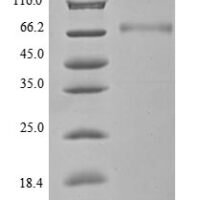
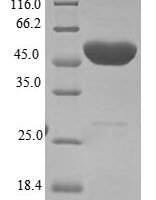
SDS-PAGE: Single band at expected molecular weight confirming purity.

ELISA: Suitable as coating antigen or detection standard.

Western Blot: Compatible with standard Western Blot protocols.

Protein Interaction: Validated for SPR (Surface Plasmon Resonance) and BLI (Bio-Layer Interferometry) studies.

Shipping: Shipped at ambient temperature. Lyophilized protein is stable during transit.

Storage: Store lyophilized protein at -20°C to -80°C. Reconstituted protein should be aliquoted and stored at -80°C. Avoid repeated freeze-thaw cycles.

Shelf Life: 12 months from date of receipt when stored as recommended.

Shipping Time: Orders placed before 2 PM EST ship same day. International orders typically deliver within 5-10 business days.

Protein Biology

Function

Endoplasmic reticulum chaperone that plays a key role in protein folding and quality control in the endoplasmic reticulum lumen (By similarity). Involved in the correct folding of proteins and degradation of misfolded proteins via its interaction with DNAJC10/ERdj5, probably to facilitate the release of DNAJC10/ERdj5 from its substrate (By similarity). Acts as a key repressor of the EIF2AK3/PERK and ERN1/IRE1-mediated unfolded protein response (UPR) (PubMed:29198525, PubMed:30710085). In the unstressed endoplasmic reticulum, recruited by DNAJB9/ERdj4 to the luminal region of ERN1/IRE1, leading to disrupt the dimerization of ERN1/IRE1, thereby inactivating ERN1/IRE1 (PubMed:29198525). Also binds and inactivates EIF2AK3/PERK in unstressed cells (By similarity). Accumulation of misfolded protein in the endoplasmic reticulum causes release of HSPA5/BiP from ERN1/IRE1 and EIF2AK3/PERK, allowing their homodimerization and subsequent activation (PubMed:29198525). Plays an auxiliary role in post-translational transport of small presecretory proteins across endoplasmic reticulum (ER). May function as an allosteric modulator for SEC61 channel-forming translocon complex, likely cooperating with SEC62 to enable the productive insertion of these precursors into SEC61 channel. Appears to specifically regulate translocation of precursors having inhibitory residues in their mature region that weaken channel gating. May also play a role in apoptosis and cell proliferation (By similarity)

Gene: HSPA5  |  Organism: Cricetulus griseus

Frequently Asked Questions

How do I order or inquire about this product?

Fill out the Online Inquiry form with your required quantity and specifications. You can also email sales@biocrestsci.com. Our team typically responds within 4 business hours with a quote and availability confirmation.

What is the shipping and delivery time?

Orders placed before 2 PM EST ship the same day. Domestic (US) delivery typically takes 2-3 business days. International orders deliver within 5-10 business days. All products are shipped at ambient temperature with appropriate packaging to ensure stability.

How should I store this recombinant protein?

Lyophilized proteins should be stored at -20°C to -80°C upon receipt. After reconstitution, aliquot and store at -80°C. Avoid repeated freeze-thaw cycles. Shelf life is 12 months from date of receipt when stored as recommended.

What quality controls are performed on your products?

Each product undergoes SDS-PAGE purity analysis (typically >85-95%), endotoxin testing, and bioactivity validation. Products are validated for ELISA, Western Blot, and SPR/BLI applications as specified on this product page. A Certificate of Analysis (CoA) is available upon request.

Shopping Cart
Scroll to Top