,

Recombinant Mouse Tumor necrosis factor receptor superfamily member 14 (Tnfrsf14), partial (Active)

Recombinant Mouse Tumor necrosis factor receptor superfamily member 14 (Tnfrsf14), partial (Active) — Receptor for four distinct ligands: The TNF superfamily members TNFSF14/LIGHT and homotrimeric LTA/lymphotoxin-alpha and the immunoglobulin superfamily members BTLA and CD160, altogether defining…

SKU: BCACP-001286 Categories: ,
Product SKUBCACP-001286
Product DescriptionRecombinant Mouse Tumor necrosis factor receptor superfamily member 14 (Tnfrsf14) protein is expressed from Mammalian cell with C-terminal hFc-tagged. It contains 39-207aa. [Accession | Q80WM9].
Uniprot No.Q80WM9
Gene NamesTnfrsf14
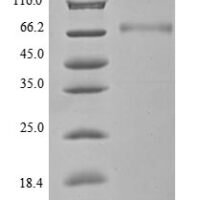
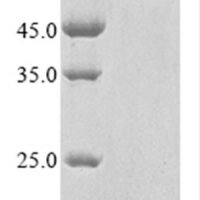
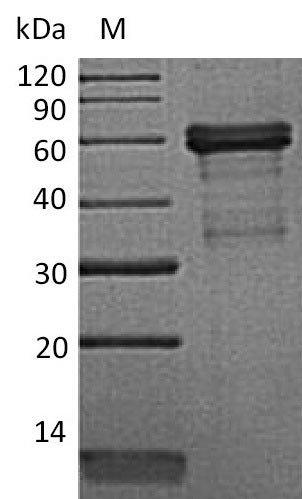
PurityGreater than 95% as determined by SDS-PAGE.
Expression SystemMammalian cell
Expression Region39-207aa
SpeciesMus musculus (Mouse)
Tag InfoC-terminal hFc-tagged
Molecular weight45.6 kDa
ActivityThe ED50 as determined by its ability to bind Human BTLA in functional ELISA is typically 1.17 ug/ml
BufferLyophilized from a 0.2 μm filtered 20 mM Tris-HCl, 0.5 M NaCl, 6% Trehalose, pH 8.0
StorageStore at -20°C/-80°C upon receipt, aliquoting is necessary for mutiple use. Avoid repeated freeze-thaw cycles.
Alternative NamesTnfrsf14; hvem; Tumor necrosis factor receptor superfamily member 14; Herpes virus entry mediator A; Herpesvirus entry mediator A; HveA; Tumor necrosis factor receptor-like 2; TR2; CD antigen CD270

Function

Receptor for four distinct ligands: The TNF superfamily members TNFSF14/LIGHT and homotrimeric LTA/lymphotoxin-alpha and the immunoglobulin superfamily members BTLA and CD160, altogether defining a complex stimulatory and inhibitory signaling network. Signals via the TRAF2-TRAF3 E3 ligase pathway to promote immune cell survival and differentiation. Participates in bidirectional cell-cell contact signaling between antigen presenting cells and lymphocytes.

Product Specifications

Recombinant Mouse Tumor necrosis factor receptor superfamily member 14 (Tnfrsf14), partial (Active) is a recombinant protein, expressed in Mammalian cell, covering amino acids 39-207aa, with C-terminal hFc-tagged tag, molecular weight 45.6 kDa, purity Greater than 95% as determined by SDS-PAGE.. Suitable for ELISA and Western Blot applications.

SDS-PAGE: Single band at expected molecular weight confirming purity.

ELISA: Suitable as coating antigen or detection standard.

Western Blot: Compatible with standard Western Blot protocols.

Protein Interaction: Validated for SPR (Surface Plasmon Resonance) and BLI (Bio-Layer Interferometry) studies.

Shipping: Shipped at ambient temperature. Lyophilized protein is stable during transit.

Storage: Store lyophilized protein at -20°C to -80°C. Reconstituted protein should be aliquoted and stored at -80°C. Avoid repeated freeze-thaw cycles.

Shelf Life: 12 months from date of receipt when stored as recommended.

Shipping Time: Orders placed before 2 PM EST ship same day. International orders typically deliver within 5-10 business days.

Protein Biology

Function

Receptor for four distinct ligands: The TNF superfamily members TNFSF14/LIGHT and homotrimeric LTA/lymphotoxin-alpha and the immunoglobulin superfamily members BTLA and CD160, altogether defining a complex stimulatory and inhibitory signaling network (By similarity). Signals via the TRAF2-TRAF3 E3 ligase pathway to promote immune cell survival and differentiation (PubMed:19915044). Participates in bidirectional cell-cell contact signaling between antigen presenting cells and lymphocytes. In response to ligation of TNFSF14/LIGHT, delivers costimulatory signals to T cells, promoting cell proliferation and effector functions (By similarity). Interacts with CD160 on NK cells, enhancing IFNG production and anti-tumor immune response (PubMed:25711213). In the context of bacterial infection, acts as a signaling receptor on epithelial cells for CD160 from intraepithelial lymphocytes, triggering the production of antimicrobial proteins and pro-inflammatory cytokines (PubMed:22801499). Upon binding to CD160 on activated CD4+ T cells, down-regulates CD28 costimulatory signaling, restricting memory and alloantigen-specific immune response (By similarity). May interact in cis (on the same cell) or in trans (on other cells) with BTLA (PubMed:15568026, PubMed:19915044). In cis interactions, appears to play an immune regulatory role inhibiting in trans interactions in naive T cells to maintain a resting state. In trans interactions, can predominate during adaptive immune response to provide survival signals to effector T cells (PubMed:15568026, PubMed:19915044)

Gene: Tnfrsf14  |  Organism: Mus musculus

Frequently Asked Questions

How do I order or inquire about this product?

Fill out the Online Inquiry form with your required quantity and specifications. You can also email sales@biocrestsci.com. Our team typically responds within 4 business hours with a quote and availability confirmation.

What is the shipping and delivery time?

Orders placed before 2 PM EST ship the same day. Domestic (US) delivery typically takes 2-3 business days. International orders deliver within 5-10 business days. All products are shipped at ambient temperature with appropriate packaging to ensure stability.

How should I store this recombinant protein?

Lyophilized proteins should be stored at -20°C to -80°C upon receipt. After reconstitution, aliquot and store at -80°C. Avoid repeated freeze-thaw cycles. Shelf life is 12 months from date of receipt when stored as recommended.

What quality controls are performed on your products?

Each product undergoes SDS-PAGE purity analysis (typically >85-95%), endotoxin testing, and bioactivity validation. Products are validated for ELISA, Western Blot, and SPR/BLI applications as specified on this product page. A Certificate of Analysis (CoA) is available upon request.

Shopping Cart
Scroll to Top