,

Recombinant Human CD276 antigen (CD276), partial (Active)

Recombinant Human CD276 antigen (CD276), partial (Active) — May participate in the regulation of T-cell-mediated immune response. Purity >90%.

SKU: BCACP-000008 Categories: ,
Product SKUBCACP-000008
Product DescriptionRecombinant Human CD276 antigen (CD276) protein is expressed from Mammalian cell with C-terminal hFc1-Myc-tagged. It contains 29-245aa. [Accession | Q5ZPR3].
Uniprot No.Q5ZPR3
Gene NamesCD276
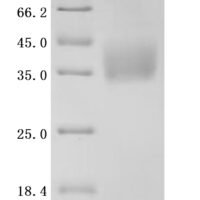
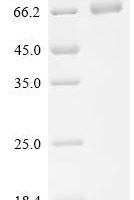
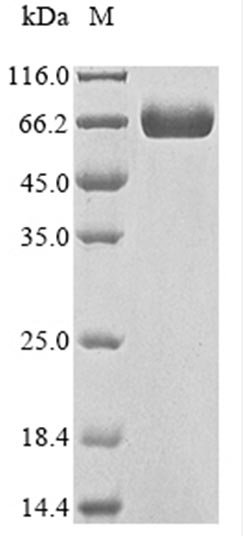
PurityGreater than 90% as determined by SDS-PAGE.
Expression SystemMammalian cell
Expression Region29-245aa
SpeciesHomo sapiens (Human)
Tag InfoC-terminal hFc1-Myc-tagged
Molecular weight53.4 kDa
ActivityMeasured by its binding ability in a functional ELISA. Immobilized CD276 at 2 μg/ml can bind Anti-CD276 rabbit monoclonal antibody, the EC50 of human CD276 protein is 1.961-2.243 ng/ml.
BufferLyophilized from a 0.2 μm filtered 20 mM Tris-HCl, 0.5 M NaCl, 6% Trehalose, pH 8.0
StorageStore at -20°C/-80°C upon receipt, aliquoting is necessary for mutiple use. Avoid repeated freeze-thaw cycles.
Alternative Names4Ig B7 H3; 4Ig-B7-H3; AU016588; B7 H3; B7 homolog 3; B7-H3; B7H3; B7RP-2; CD_antigen=CD276; CD276; CD276 antigen; CD276 molecule; CD276_HUMAN; Costimulatory molecule; Flags: Precursor; PSEC0249; UNQ309/PRO352

Function

May participate in the regulation of T-cell-mediated immune response. May play a protective role in tumor cells by inhibiting natural-killer mediated cell lysis as well as a role of marker for detection of neuroblastoma cells. May be involved in the development of acute and chronic transplant rejection and in the regulation of lymphocytic activity at mucosal surfaces.

Biological Context

Subcellular Location: Membrane (Single-pass type I membrane protein)
Tissue Specificity: Ubiquitous but not detectable in peripheral blood lymphocytes or granulocytes. Weakly expressed in resting monocytes. Expressed in dendritic cells derived from monocytes. Expressed in epithelial cells of sinonasal tissue. Expressed in extravillous trophoblast cells and Hofbauer cells of the first trimester placenta and term placenta

Product Specifications

Recombinant Human CD276 antigen (CD276), partial (Active) is a recombinant protein from Homo sapiens (Human), expressed in Mammalian cell, covering amino acids 29-245aa, with C-terminal hFc1-Myc-tagged tag, molecular weight 53.4 kDa, purity Greater than 90% as determined by SDS-PAGE.. Suitable for ELISA and Western Blot applications.

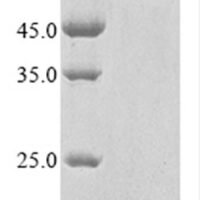
SDS-PAGE: Single band at expected molecular weight confirming purity.

ELISA: Suitable as coating antigen or detection standard.

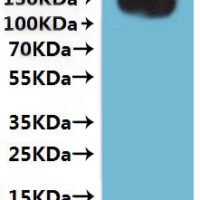
Western Blot: Compatible with standard Western Blot protocols.

Protein Interaction: Validated for SPR (Surface Plasmon Resonance) and BLI (Bio-Layer Interferometry) studies.

Shipping: Shipped at ambient temperature. Lyophilized protein is stable during transit.

Storage: Store lyophilized protein at -20°C to -80°C. Reconstituted protein should be aliquoted and stored at -80°C. Avoid repeated freeze-thaw cycles.

Shelf Life: 12 months from date of receipt when stored as recommended.

Shipping Time: Orders placed before 2 PM EST ship same day. International orders typically deliver within 5-10 business days.

Protein Biology

Function

May participate in the regulation of T-cell-mediated immune response. May play a protective role in tumor cells by inhibiting natural-killer mediated cell lysis as well as a role of marker for detection of neuroblastoma cells. May be involved in the development of acute and chronic transplant rejection and in the regulation of lymphocytic activity at mucosal surfaces. Could also play a key role in providing the placenta and fetus with a suitable immunological environment throughout pregnancy. Both isoform 1 and isoform 2 appear to be redundant in their ability to modulate CD4 T-cell responses. Isoform 2 is shown to enhance the induction of cytotoxic T-cells and selectively stimulates interferon gamma production in the presence of T-cell receptor signaling

Subcellular Location

Membrane (Single-pass type I membrane protein)

Tissue Specificity

Ubiquitous but not detectable in peripheral blood lymphocytes or granulocytes. Weakly expressed in resting monocytes. Expressed in dendritic cells derived from monocytes. Expressed in epithelial cells of sinonasal tissue. Expressed in extravillous trophoblast cells and Hofbauer cells of the first trimester placenta and term placenta

Subunit

Interacts with TREML2 and this interaction enhances T-cell activation

Gene: CD276  |  Organism: Homo sapiens  |  Synonyms: 4Ig-B7-H3; B7 homolog 3; Costimulatory molecule
Key Publications

Frequently Asked Questions

How do I order or inquire about this product?

Fill out the Online Inquiry form with your required quantity and specifications. You can also email sales@biocrestsci.com. Our team typically responds within 4 business hours with a quote and availability confirmation.

What is the shipping and delivery time?

Orders placed before 2 PM EST ship the same day. Domestic (US) delivery typically takes 2-3 business days. International orders deliver within 5-10 business days. All products are shipped at ambient temperature with appropriate packaging to ensure stability.

How should I store this recombinant protein?

Lyophilized proteins should be stored at -20°C to -80°C upon receipt. After reconstitution, aliquot and store at -80°C. Avoid repeated freeze-thaw cycles. Shelf life is 12 months from date of receipt when stored as recommended.

What quality controls are performed on your products?

Each product undergoes SDS-PAGE purity analysis (typically >85-95%), endotoxin testing, and bioactivity validation. Products are validated for ELISA, Western Blot, and SPR/BLI applications as specified on this product page. A Certificate of Analysis (CoA) is available upon request.

Shopping Cart
Scroll to Top