Recombinant Human Potassium channel subfamily K member 9 (KCNK9) Protein

Recombinant Human Potassium channel subfamily K member 9 (KCNK9) Protein — K(+) channel that conducts voltage-dependent outward rectifying currents upon membrane depolarization. Purity >90%.

SKU: BCRECP-00011TM Category:

Product Specifications

Uniprot No.Q9NPC2
Gene NamesKCNK9
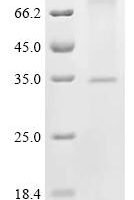
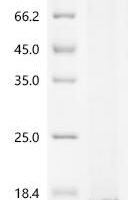
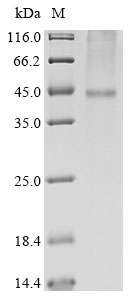
PurityGreater than 90% as determined by SDS-PAGE.
Expression Systemin vitro E.coli expression system
Expression Region1-374aa
SpeciesHomo sapiens (Human)
Tag InfoN-terminal 10xHis-tagged
Molecular weight48.3kDa
BufferIf the delivery form is liquid, the default storage buffer is Tris/PBS-based buffer, 5%-50% glycerol.If the delivery form is lyophilized powder, the buffer before lyophilization is Tris/PBS-based buffer, 6% Trehalose.
StorageStore at -20°C/-80°C upon receipt, aliquoting is necessary for mutiple use. Avoid repeated freeze-thaw cycles.

Function

K(+) channel that conducts voltage-dependent outward rectifying currents upon membrane depolarization. Voltage sensing is coupled to K(+) electrochemical gradient in an 'ion flux gating' mode where outward but not inward ion flow opens the gate. Changes ion selectivity and becomes permeable to Na(+) ions in response to extracellular acidification.

Biological Context

Subcellular Location: Cell membrane (Multi-pass membrane protein); Mitochondrion inner membrane (Multi-pass membrane protein); Cell projection, dendrite
Tissue Specificity: Mainly found in the cerebellum. Also found in adrenal gland, kidney and lung
Disease Association: Birk-Barel syndrome (BIBARS) : A syndrome characterized by intellectual disability, hypotonia, hyperactivity, and facial dysmorphism. BIBARS transmission pattern is consistent with autosomal dominant inheritance with paternal imprinting. [The disease is caused by variants affecting the gene represented in this entry]

Product Specifications

Recombinant Human Potassium channel subfamily K member 9 (KCNK9) Protein is a recombinant protein from Homo sapiens (Human), expressed in in vitro E.coli expression system, covering amino acids 1-374aa, with N-terminal 10xHis-tagged tag, molecular weight 48.3kDa, purity Greater than 90% as determined by SDS-PAGE.. Suitable for ELISA and Western Blot applications.
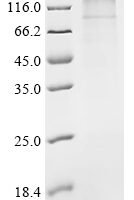
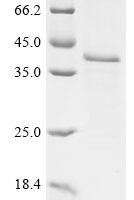
SDS-PAGE: Single band at expected molecular weight confirming purity.

ELISA: Suitable as coating antigen or detection standard.

Western Blot: Compatible with standard Western Blot protocols.

Protein Interaction: Validated for SPR (Surface Plasmon Resonance) and BLI (Bio-Layer Interferometry) studies.

Shipping: Shipped at ambient temperature. Lyophilized protein is stable during transit.

Storage: Store lyophilized protein at -20°C to -80°C. Reconstituted protein should be aliquoted and stored at -80°C. Avoid repeated freeze-thaw cycles.

Shelf Life: 12 months from date of receipt when stored as recommended.

Shipping Time: Orders placed before 2 PM EST ship same day. International orders typically deliver within 5-10 business days.

Protein Biology

Function

K(+) channel that conducts voltage-dependent outward rectifying currents upon membrane depolarization. Voltage sensing is coupled to K(+) electrochemical gradient in an 'ion flux gating' mode where outward but not inward ion flow opens the gate (PubMed:11042359, PubMed:11431495, PubMed:26919430, PubMed:38630723). Changes ion selectivity and becomes permeable to Na(+) ions in response to extracellular acidification. Protonation of the pH sensor His-98 stabilizes C-type inactivation conformation likely converting the channel from outward K(+)-conducting, to inward Na(+)-conducting to nonconductive state (PubMed:22948150, PubMed:38630723). Homo- and heterodimerizes to form functional channels with distinct regulatory and gating properties (By similarity) (PubMed:23169818, PubMed:38630723). Allows K(+) currents with fast-gating kinetics important for the repolarization and hyperpolarization phases of action potentials (By similarity). In granule neurons, hyperpolarizes the resting membrane potential to limit intrinsic neuronal excitability, but once the action potential threshold is reached, supports high-frequency action potential firing and increased neuronal excitability. Homomeric and/or heteromeric KCNK3:KCNK9 channels operate in cerebellar granule cells, whereas heteromeric KCNK1:KCNK9 enables currents in hippocampal dentate gyrus granule neurons (By similarity). Dispensable for central chemosensory respiration i.e. breathing controlled by brainstem CO2/pH, it rather conducts pH-sensitive currents and controls the firing rate of serotonergic raphe neurons involved in potentiation of the respiratory chemoreflex (By similarity). In retinal ganglion cells, mediates outward currents that regulate action potentials in response to acidification of the synaptic cleft. Involved in transmission of image-forming and nonimage-forming visual information in the retina (By similarity). In adrenal gland, contributes to the maintenance of a hyperpolarized resting membrane potential of aldosterone-producing cells at zona glomerulosa and limits aldosterone release as part of a regulatory mechanism that controls arterial blood pressure and electrolyte homeostasis (By similarity)

Subcellular Location

Cell membrane (Multi-pass membrane protein); Mitochondrion inner membrane (Multi-pass membrane protein); Cell projection, dendrite

Disease Association

Birk-Barel syndrome (BIBARS) : A syndrome characterized by intellectual disability, hypotonia, hyperactivity, and facial dysmorphism. BIBARS transmission pattern is consistent with autosomal dominant inheritance with paternal imprinting. [The disease is caused by variants affecting the gene represented in this entry]

Tissue Specificity

Mainly found in the cerebellum. Also found in adrenal gland, kidney and lung

Subunit

Homodimer (PubMed:38630723). Heterodimer with KCNK1 (PubMed:23169818). Heterodimer with KCNK3 (By similarity)

Gene: KCNK9  |  Organism: Homo sapiens  |  Synonyms: Acid-sensitive potassium channel protein TASK-3; TWIK-related acid-sensitive K(+) channel 3; Two pore potassium channel KT3.2
Key Publications

Frequently Asked Questions

How do I order or inquire about this product?

Fill out the Online Inquiry form with your required quantity and specifications. You can also email sales@biocrestsci.com. Our team typically responds within 4 business hours with a quote and availability confirmation.

What is the shipping and delivery time?

Orders placed before 2 PM EST ship the same day. Domestic (US) delivery typically takes 2-3 business days. International orders deliver within 5-10 business days. All products are shipped at ambient temperature with appropriate packaging to ensure stability.

How should I store this recombinant protein?

Lyophilized proteins should be stored at -20°C to -80°C upon receipt. After reconstitution, aliquot and store at -80°C. Avoid repeated freeze-thaw cycles. Shelf life is 12 months from date of receipt when stored as recommended.

What quality controls are performed on your products?

Each product undergoes SDS-PAGE purity analysis (typically >85-95%), endotoxin testing, and bioactivity validation. Products are validated for ELISA, Western Blot, and SPR/BLI applications as specified on this product page. A Certificate of Analysis (CoA) is available upon request.

Shopping Cart
Scroll to Top