Recombinant Rat Small conductance calcium-activated potassium channel protein 2 (Kcnn2) Protein

Recombinant Rat Small conductance calcium-activated potassium channel protein 2 (Kcnn2) Protein — Small conductance calcium-activated potassium channel that mediates the voltage-independent transmembrane transfer of potassium across the cell membrane through a constitutive interaction with calm…

SKU: BCRECP-00233TM Category:

Product Specifications

Uniprot No.P70604
Gene NamesKcnn2
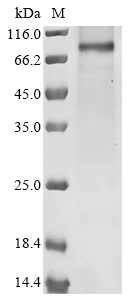
PurityGreater than 85% as determined by SDS-PAGE.
Expression Systemin vitro E.coli expression system
Expression Region1-580aa
SpeciesRattus norvegicus (Rat)
Tag InfoN-terminal 10xHis-tagged
Molecular weight69.9kDa
BufferIf the delivery form is liquid, the default storage buffer is Tris/PBS-based buffer, 5%-50% glycerol.If the delivery form is lyophilized powder, the buffer before lyophilization is Tris/PBS-based buffer, 6% Trehalose.
StorageStore at -20°C/-80°C upon receipt, aliquoting is necessary for mutiple use. Avoid repeated freeze-thaw cycles.

Function

Small conductance calcium-activated potassium channel that mediates the voltage-independent transmembrane transfer of potassium across the cell membrane through a constitutive interaction with calmodulin which binds the intracellular calcium allowing its opening. The current is characterized by a voltage-independent activation, an intracellular calcium concentration increase-dependent activation and a single-channel conductance of about 3 picosiemens. Also presents an inwardly rectifying current, thus reducing its already small outward conductance of potassium ions, which is particularly the case when the membrane potential displays positive values, above + 20 mV.

Biological Context

Subcellular Location: Membrane (Multi-pass membrane protein); Cytoplasm, myofibril, sarcomere, Z line
Tissue Specificity: Brain

Product Specifications

Recombinant Rat Small conductance calcium-activated potassium channel protein 2 (Kcnn2) Protein is a recombinant protein from Rattus norvegicus (Rat), expressed in in vitro E.coli expression system, covering amino acids 1-580aa, with N-terminal 10xHis-tagged tag, molecular weight 69.9kDa, purity Greater than 85% as determined by SDS-PAGE.. Suitable for ELISA and Western Blot applications.
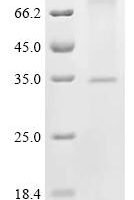
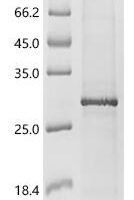
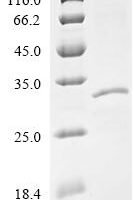
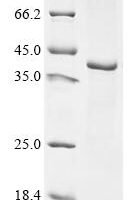
SDS-PAGE: Single band at expected molecular weight confirming purity.

ELISA: Suitable as coating antigen or detection standard.

Western Blot: Compatible with standard Western Blot protocols.

Protein Interaction: Validated for SPR (Surface Plasmon Resonance) and BLI (Bio-Layer Interferometry) studies.

Shipping: Shipped at ambient temperature. Lyophilized protein is stable during transit.

Storage: Store lyophilized protein at -20°C to -80°C. Reconstituted protein should be aliquoted and stored at -80°C. Avoid repeated freeze-thaw cycles.

Shelf Life: 12 months from date of receipt when stored as recommended.

Shipping Time: Orders placed before 2 PM EST ship same day. International orders typically deliver within 5-10 business days.

Protein Biology

Function

Small conductance calcium-activated potassium channel that mediates the voltage-independent transmembrane transfer of potassium across the cell membrane through a constitutive interaction with calmodulin which binds the intracellular calcium allowing its opening (PubMed:11325723, PubMed:20562108, PubMed:21422289, PubMed:8781233, PubMed:9774106). The current is characterized by a voltage-independent activation, an intracellular calcium concentration increase-dependent activation and a single-channel conductance of about 3 picosiemens (PubMed:8781233, PubMed:9774106). Also presents an inwardly rectifying current, thus reducing its already small outward conductance of potassium ions, which is particularly the case when the membrane potential displays positive values, above + 20 mV (PubMed:8781233, PubMed:9774106). The inward rectification could be due to a blockade of the outward current by intracellular divalent cations such as calcium and magnesium and could also be due to an intrinsic property of the channel pore, independent of intracellular divalent ions (PubMed:11325723, PubMed:21422289). There are three positively charged amino acids in the S6 transmembrane domain, close to the pore, that collectively control the conductance and rectification through an electrostatic mechanism (PubMed:21422289). Additionally, electrostatic contributions from these residues also play an important role in determining the intrinsic open probability of the channel in the absence of calcium, affecting the apparent calcium affinity for activation (PubMed:21422289). Forms an heteromeric complex with calmodulin, which is constitutively associated in a calcium-independent manner (PubMed:9774106). Channel opening is triggered when calcium binds the calmodulin resulting in a rotary movement leading to the formation of the dimeric complex to open the gate (PubMed:11323678, PubMed:9774106). Plays a role in the repolarization phase of cardiac action potential (By similarity)

Subcellular Location

Membrane (Multi-pass membrane protein); Cytoplasm, myofibril, sarcomere, Z line

Tissue Specificity

Brain

Subunit

Homodimer (By similarity). Heteromultimer with KCNN1 and KCNN3 (By similarity). The complex is composed of 4 channel subunits each of which binds to a calmodulin subunit which regulates the channel activity through calcium-binding (PubMed:11323678, PubMed:9774106). Interacts (via N-terminal domain) with MPP2 (By similarity)

Gene: Kcnn2  |  Organism: Rattus norvegicus  |  Synonyms: KCa2.2
Key Publications

Frequently Asked Questions

How do I order or inquire about this product?

Fill out the Online Inquiry form with your required quantity and specifications. You can also email sales@biocrestsci.com. Our team typically responds within 4 business hours with a quote and availability confirmation.

What is the shipping and delivery time?

Orders placed before 2 PM EST ship the same day. Domestic (US) delivery typically takes 2-3 business days. International orders deliver within 5-10 business days. All products are shipped at ambient temperature with appropriate packaging to ensure stability.

How should I store this recombinant protein?

Lyophilized proteins should be stored at -20°C to -80°C upon receipt. After reconstitution, aliquot and store at -80°C. Avoid repeated freeze-thaw cycles. Shelf life is 12 months from date of receipt when stored as recommended.

What quality controls are performed on your products?

Each product undergoes SDS-PAGE purity analysis (typically >85-95%), endotoxin testing, and bioactivity validation. Products are validated for ELISA, Western Blot, and SPR/BLI applications as specified on this product page. A Certificate of Analysis (CoA) is available upon request.

Shopping Cart
Scroll to Top