Recombinant Mouse Amino acid transporter heavy chain SLC3A2 (Slc3a2), partial Protein

Recombinant Mouse Amino acid transporter heavy chain SLC3A2 (Slc3a2), partial Protein — Acts as a chaperone that facilitates biogenesis and trafficking of functional transporters heterodimers to the plasma membrane. Purity >90%.

SKU: BCRECP-00584TM Category:

Product Specifications

Uniprot No.P10852
Gene NamesSlc3a2
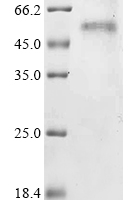
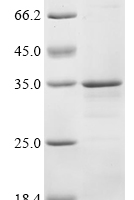
PurityGreater than 90% as determined by SDS-PAGE.
Expression Systemin vitro E.coli expression system
Expression Region1-80aa
Tag InfoN-terminal GST-tagged
Molecular weight34.6kDa
ActivityNot Test
BufferIf the delivery form is liquid, the default storage buffer is Tris/PBS-based buffer, 5%-50% glycerol.If the delivery form is lyophilized powder, the buffer before lyophilization is Tris/PBS-based buffer, 6% Trehalose.
StorageStore at -20°C/-80°C upon receipt, aliquoting is necessary for mutiple use. Avoid repeated freeze-thaw cycles.

Function

Acts as a chaperone that facilitates biogenesis and trafficking of functional transporters heterodimers to the plasma membrane. Forms heterodimer with SLC7 family transporters (SLC7A5, SLC7A6, SLC7A7, SLC7A8, SLC7A10 and SLC7A11), a group of amino-acid antiporters. Heterodimers function as amino acids exchangers, the specificity of the substrate depending on the SLC7A subunit.

Biological Context

Subcellular Location: Apical cell membrane; Cell membrane (Single-pass type II membrane protein); Cell junction; Lysosome membrane; Melanosome; Basolateral cell membrane
Tissue Specificity: Detected on the surface of embryonic epithelial cells in the epidermis, thymus, kidney, intestine, brain choroid plexus, and in retina. Detected in adult and embryonic brain, spleen, kidney, intestine and liver, and in adult testis (at protein level). Observed in all adult tissues tested with strongest expression in kidney, small intestine, spleen, thymus and liver. Moderate expression in brain, stomach, heart, testis, lung, skin, pancreas and skeletal muscle. In brain expressed on capillary endothelia in cerebral cortex

Product Specifications

Recombinant Mouse Amino acid transporter heavy chain SLC3A2 (Slc3a2), partial Protein is a recombinant protein, expressed in in vitro E.coli expression system, covering amino acids 1-80aa, with N-terminal GST-tagged tag, molecular weight 34.6kDa, purity Greater than 90% as determined by SDS-PAGE.. Suitable for ELISA and Western Blot applications.
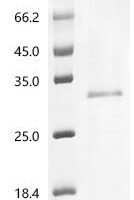
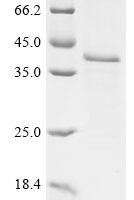
SDS-PAGE: Single band at expected molecular weight confirming purity.

ELISA: Suitable as coating antigen or detection standard.

Western Blot: Compatible with standard Western Blot protocols.

Protein Interaction: Validated for SPR (Surface Plasmon Resonance) and BLI (Bio-Layer Interferometry) studies.

Shipping: Shipped at ambient temperature. Lyophilized protein is stable during transit.

Storage: Store lyophilized protein at -20°C to -80°C. Reconstituted protein should be aliquoted and stored at -80°C. Avoid repeated freeze-thaw cycles.

Shelf Life: 12 months from date of receipt when stored as recommended.

Shipping Time: Orders placed before 2 PM EST ship same day. International orders typically deliver within 5-10 business days.

Protein Biology

Function

Acts as a chaperone that facilitates biogenesis and trafficking of functional transporters heterodimers to the plasma membrane. Forms heterodimer with SLC7 family transporters (SLC7A5, SLC7A6, SLC7A7, SLC7A8, SLC7A10 and SLC7A11), a group of amino-acid antiporters (PubMed:10574970, PubMed:10734121, PubMed:11011012, PubMed:9915839). Heterodimers function as amino acids exchangers, the specificity of the substrate depending on the SLC7A subunit. Heterodimers SLC3A2/SLC7A6 or SLC3A2/SLC7A7 mediate the uptake of dibasic amino acids. Heterodimer SLC3A2/SLC7A11 functions as an antiporter by mediating the exchange of extracellular anionic L-cystine and intracellular L-glutamate across the cellular plasma membrane (By similarity). SLC3A2/SLC7A10 translocates small neutral L- and D-amino acids across the plasma membrane (By similarity). SLC3A2/SLC75 or SLC3A2/SLC7A8 translocates neutral amino acids with broad specificity, thyroid hormones and L-DOPA. SLC3A2 is essential for plasma membrane localization, stability, and the transport activity of SLC7A5 and SLC7A8. When associated with LAPTM4B, the heterodimer SLC7A5 is recruited to lysosomes to promote leucine uptake into these organelles, and thereby mediates mTORC1 activation. Modulates integrin-related signaling and is essential for integrin-dependent cell spreading, migration and tumor progression (By similarity)

Subcellular Location

Apical cell membrane; Cell membrane (Single-pass type II membrane protein); Cell junction; Lysosome membrane; Melanosome; Basolateral cell membrane

Tissue Specificity

Detected on the surface of embryonic epithelial cells in the epidermis, thymus, kidney, intestine, brain choroid plexus, and in retina. Detected in adult and embryonic brain, spleen, kidney, intestine and liver, and in adult testis (at protein level) (PubMed:9915839). Observed in all adult tissues tested with strongest expression in kidney, small intestine, spleen, thymus and liver (PubMed:9915839). Moderate expression in brain, stomach, heart, testis, lung, skin, pancreas and skeletal muscle. In brain expressed on capillary endothelia in cerebral cortex

Subunit

Disulfide-linked heterodimer with a non-glycosylated light chain (SLC7A5, SLC7A6, SLC7A7, SLC7A8, SLC7A10 or SLC7A11) (PubMed:10574970, PubMed:10734121, PubMed:11011012, PubMed:9915839). Interacts with TLCD3A/CT120 and ICAM1. Constitutively and specifically associates with beta-1 integrins (alpha-2/beta-1, alpha-3/beta-1, alpha-5/beta-1 and alpha-6/beta-1), but minimally with alpha-4/beta-1. Interacts with LAPTM4B; recruits SLC3A2 and SLC7A5 to lysosomes to promote leucine uptake into these organelles and is required for mTORC1 activation (By similarity)

Gene: Slc3a2  |  Organism: Mus musculus  |  Synonyms: 4F2 cell-surface antigen heavy chain; Solute carrier family 3 member 2
Key Publications

Frequently Asked Questions

How do I order or inquire about this product?

Fill out the Online Inquiry form with your required quantity and specifications. You can also email sales@biocrestsci.com. Our team typically responds within 4 business hours with a quote and availability confirmation.

What is the shipping and delivery time?

Orders placed before 2 PM EST ship the same day. Domestic (US) delivery typically takes 2-3 business days. International orders deliver within 5-10 business days. All products are shipped at ambient temperature with appropriate packaging to ensure stability.

How should I store this recombinant protein?

Lyophilized proteins should be stored at -20°C to -80°C upon receipt. After reconstitution, aliquot and store at -80°C. Avoid repeated freeze-thaw cycles. Shelf life is 12 months from date of receipt when stored as recommended.

What quality controls are performed on your products?

Each product undergoes SDS-PAGE purity analysis (typically >85-95%), endotoxin testing, and bioactivity validation. Products are validated for ELISA, Western Blot, and SPR/BLI applications as specified on this product page. A Certificate of Analysis (CoA) is available upon request.

Shopping Cart
Scroll to Top