,

Recombinant Human Signal transducer CD24 (CD24), partial

Recombinant Human Signal transducer CD24 (CD24), partial — May have a pivotal role in cell differentiation of different cell types. Purity >90%.

SKU: BCRECP-000271 Categories: ,

Product Specifications

Product SkuBCRECP-000271
Product DescriptionRecombinant Human Signal transducer CD24 (CD24) Protein is expressed from Yeast with C-terminal 6xHis-tagged. It contains 27-59aa. [Accession | P25063].
Uniprot No.P25063
Gene NamesCD24
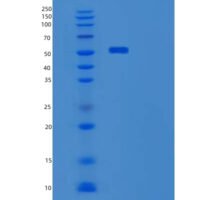
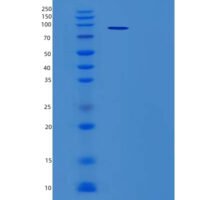
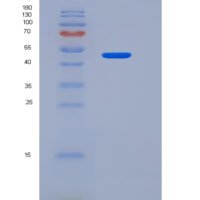
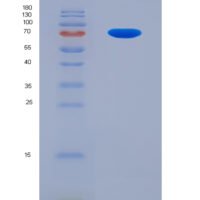
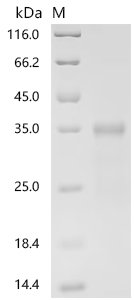
PurityGreater than 90% as determined by SDS-PAGE.
Expression SystemYeast
Expression Region27-59aa
SpeciesHomo sapiens (Human)
Tag InfoC-terminal 6xHis-tagged
Molecular weight26.3kDa
ActivityPlease contact us to obtain bioactivity data.
BufferIf the delivery form is liquid, the default storage buffer is Tris/PBS-based buffer, 5%-50% glycerol. If the delivery form is lyophilized powder, the buffer before lyophilization is Tris/PBS-based buffer, 6% Trehalose.
StorageStore at -20°C/-80°C upon receipt, aliquoting is necessary for mutiple use. Avoid repeated freeze-thaw cycles.
Research AreasImmunology

Function

May have a pivotal role in cell differentiation of different cell types. Signaling could be triggered by the binding of a lectin-like ligand to the CD24 carbohydrates, and transduced by the release of second messengers derived from the GPI-anchor. Modulates B-cell activation responses.

Biological Context

Subcellular Location: Cell membrane (Lipid-anchor, GPI-anchor)
Tissue Specificity: B-cells. Expressed in a number of B-cell lines including P32/ISH and Namalwa. Expressed in erythroleukemia cell and small cell lung carcinoma cell lines. Also expressed on the surface of T-cells
Disease Association: Multiple sclerosis (MS) : A multifactorial, inflammatory, demyelinating disease of the central nervous system. Sclerotic lesions are characterized by perivascular infiltration of monocytes and lymphocytes and appear as indurated areas in pathologic specimens (sclerosis in plaques). The pathological mechanism is regarded as an autoimmune attack of the myelin sheath, mediated by both cellular and humoral immunity. Clinical manifestations include visual loss, extra-ocular movement disorders, paresthesias, loss of sensation, weakness, dysarthria, spasticity, ataxia and bladder dysfunction. Genetic and environmental factors influence susceptibility to the disease. [Disease susceptibility may be associated with variants affecting the gene represented in this entry]

Product Specifications

Recombinant Human Signal transducer CD24 (CD24), partial is a recombinant protein from Homo sapiens (Human), expressed in Yeast, covering amino acids 27-59aa, with C-terminal 6xHis-tagged tag, molecular weight 26.3kDa, purity Greater than 90% as determined by SDS-PAGE.. Suitable for ELISA and Western Blot applications.

SDS-PAGE: Single band at expected molecular weight confirming purity.

ELISA: Suitable as coating antigen or detection standard.

Western Blot: Compatible with standard Western Blot protocols.

Protein Interaction: Validated for SPR (Surface Plasmon Resonance) and BLI (Bio-Layer Interferometry) studies.

Shipping: Shipped at ambient temperature. Lyophilized protein is stable during transit.

Storage: Store lyophilized protein at -20°C to -80°C. Reconstituted protein should be aliquoted and stored at -80°C. Avoid repeated freeze-thaw cycles.

Shelf Life: 12 months from date of receipt when stored as recommended.

Shipping Time: Orders placed before 2 PM EST ship same day. International orders typically deliver within 5-10 business days.

Protein Biology

Function

May have a pivotal role in cell differentiation of different cell types. Signaling could be triggered by the binding of a lectin-like ligand to the CD24 carbohydrates, and transduced by the release of second messengers derived from the GPI-anchor. Modulates B-cell activation responses. Promotes AG-dependent proliferation of B-cells, and prevents their terminal differentiation into antibody-forming cells (PubMed:11313396). In association with SIGLEC10 may be involved in the selective suppression of the immune response to danger-associated molecular patterns (DAMPs) such as HMGB1, HSP70 and HSP90. Plays a role in the control of autoimmunity (By similarity)

Subcellular Location

Cell membrane (Lipid-anchor, GPI-anchor)

Disease Association

Multiple sclerosis (MS) : A multifactorial, inflammatory, demyelinating disease of the central nervous system. Sclerotic lesions are characterized by perivascular infiltration of monocytes and lymphocytes and appear as indurated areas in pathologic specimens (sclerosis in plaques). The pathological mechanism is regarded as an autoimmune attack of the myelin sheath, mediated by both cellular and humoral immunity. Clinical manifestations include visual loss, extra-ocular movement disorders, paresthesias, loss of sensation, weakness, dysarthria, spasticity, ataxia and bladder dysfunction. Genetic and environmental factors influence susceptibility to the disease. [Disease susceptibility may be associated with variants affecting the gene represented in this entry]

Tissue Specificity

B-cells. Expressed in a number of B-cell lines including P32/ISH and Namalwa. Expressed in erythroleukemia cell and small cell lung carcinoma cell lines. Also expressed on the surface of T-cells

Subunit

Interacts with LYN and FGR in a cell-type specific manner. Binds FRG in a small cell cancer line, LYN in the erythroleukemia cell line K-562 and in Burkitt's lymphoma

Gene: CD24  |  Organism: Homo sapiens  |  Synonyms: Small cell lung carcinoma cluster 4 antigen
Key Publications

Frequently Asked Questions

How do I order or inquire about this product?

Fill out the Online Inquiry form with your required quantity and specifications. You can also email sales@biocrestsci.com. Our team typically responds within 4 business hours with a quote and availability confirmation.

What is the shipping and delivery time?

Orders placed before 2 PM EST ship the same day. Domestic (US) delivery typically takes 2-3 business days. International orders deliver within 5-10 business days. All products are shipped at ambient temperature with appropriate packaging to ensure stability.

How should I store this recombinant protein?

Lyophilized proteins should be stored at -20°C to -80°C upon receipt. After reconstitution, aliquot and store at -80°C. Avoid repeated freeze-thaw cycles. Shelf life is 12 months from date of receipt when stored as recommended.

What quality controls are performed on your products?

Each product undergoes SDS-PAGE purity analysis (typically >85-95%), endotoxin testing, and bioactivity validation. Products are validated for ELISA, Western Blot, and SPR/BLI applications as specified on this product page. A Certificate of Analysis (CoA) is available upon request.

Shopping Cart
Scroll to Top