Recombinant Human Forkhead box protein C1 (FOXC1)

Recombinant Human Forkhead box protein C1 (FOXC1) — DNA-binding transcriptional factor that plays a role in a broad range of cellular and developmental processes such as eye, bones, cardiovascular, kidney and skin development. Purity >85%.

SKU: BCRECP-000691 Category:

Product Specifications

Product SkuBCRECP-000691
Product DescriptionRecombinant Human Forkhead box protein C1 (FOXC1) Protein is expressed from Mammalian cell with C-terminal hFc1-tagged. It contains 1-553aa. [Accession | Q12948].
Uniprot No.Q12948
Gene NamesFOXC1
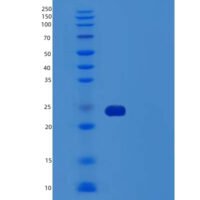
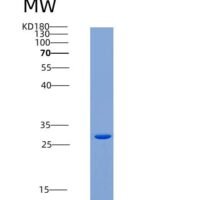
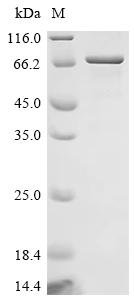
PurityGreater than 85% as determined by SDS-PAGE.
Expression SystemMammalian cell
Expression Region1-553aa
SpeciesHomo sapiens (Human)
Tag InfoC-terminal hFc1-tagged
Molecular weight85.7kDa
ActivityPlease contact us to obtain bioactivity data.
BufferIf the delivery form is liquid, the default storage buffer is Tris/PBS-based buffer, 5%-50% glycerol. If the delivery form is lyophilized powder, the buffer before lyophilization is Tris/PBS-based buffer, 6% Trehalose.
StorageStore at -20°C/-80°C upon receipt, aliquoting is necessary for mutiple use. Avoid repeated freeze-thaw cycles.
Research AreasEpigenetics and Nuclear Signaling

Function

DNA-binding transcriptional factor that plays a role in a broad range of cellular and developmental processes such as eye, bones, cardiovascular, kidney and skin development. Acts either as a transcriptional activator or repressor. Binds to the consensus binding site 5'-[G/C][A/T]AAA[T/C]AA[A/C]-3' in promoter of target genes.

Biological Context

Subcellular Location: Nucleus
Tissue Specificity: Expressed in keratinocytes of epidermis and hair follicle. Expressed strongly in microvascular invasion (MVI) formation, basal-like breast cancer (BLBC) and hepatocellular tumors. Expressed in breast cancers (at protein level). Expressed in hematopoietic cells
Disease Association: Axenfeld-Rieger syndrome 3 (RIEG3) : An autosomal dominant disorder of morphogenesis that results in abnormal development of the anterior segment of the eye, and results in blindness from glaucoma in approximately 50% of affected individuals. Features include posterior corneal embryotoxon, prominent Schwalbe line and iris adhesion to the Schwalbe line, hypertelorism, hypodontia, sensorineural deafness, redundant periumbilical skin, and cardiovascular defects such as patent ductus arteriosus and atrial septal defect. When associated with tooth anomalies, the disorder is known as Rieger syndrome. [The disease is caused by variants affecting the gene represented in this entry] | Anterior segment dysgenesis 3 (ASGD3) : A form of anterior segment dysgenesis, a group of defects affecting anterior structures of the eye including cornea, iris, lens, trabecular meshwork, and Schlemm canal. Anterior segment dysgeneses result from abnormal migration or differentiation of the neural crest derived mesenchymal cells that give rise to components of the anterior chamber during eye development. Different anterior segment anomalies may exist alone or in combination, including iris hypoplasia, enlarged or reduced corneal diameter, corneal vascularization and opacity, posterior embryotoxon, corectopia, polycoria, abnormal iridocorneal angle, ectopia lentis, and anterior synechiae between the iris and posterior corneal surface. Clinical conditions falling within the phenotypic spectrum of anterior segment dysgeneses include aniridia, Axenfeld anomaly, Reiger anomaly/syndrome, Peters anomaly, and iridogoniodysgenesis. ASGD3 inheritance is autosomal dominant. [The disease is caused by variants affecting the gene represented in this entry]

Product Specifications

Recombinant Human Forkhead box protein C1 (FOXC1) is a recombinant protein from Homo sapiens (Human), expressed in Mammalian cell, covering amino acids 1-553aa, with C-terminal hFc1-tagged tag, molecular weight 85.7kDa, purity Greater than 85% as determined by SDS-PAGE.. Suitable for ELISA and Western Blot applications.
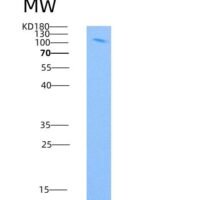
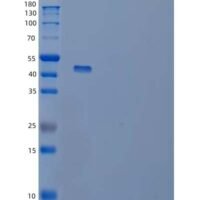
SDS-PAGE: Single band at expected molecular weight confirming purity.

ELISA: Suitable as coating antigen or detection standard.

Western Blot: Compatible with standard Western Blot protocols.

Protein Interaction: Validated for SPR (Surface Plasmon Resonance) and BLI (Bio-Layer Interferometry) studies.

Shipping: Shipped at ambient temperature. Lyophilized protein is stable during transit.

Storage: Store lyophilized protein at -20°C to -80°C. Reconstituted protein should be aliquoted and stored at -80°C. Avoid repeated freeze-thaw cycles.

Shelf Life: 12 months from date of receipt when stored as recommended.

Shipping Time: Orders placed before 2 PM EST ship same day. International orders typically deliver within 5-10 business days.

Protein Biology

Function

DNA-binding transcriptional factor that plays a role in a broad range of cellular and developmental processes such as eye, bones, cardiovascular, kidney and skin development (PubMed:11782474, PubMed:14506133, PubMed:14578375, PubMed:15277473, PubMed:15299087, PubMed:15684392, PubMed:16449236, PubMed:16492674, PubMed:17210863, PubMed:19279310, PubMed:19793056, PubMed:25786029, PubMed:27804176, PubMed:27907090). Acts either as a transcriptional activator or repressor (PubMed:11782474). Binds to the consensus binding site 5'-[G/C][A/T]AAA[T/C]AA[A/C]-3' in promoter of target genes (PubMed:11782474, PubMed:12533514, PubMed:14506133, PubMed:19793056, PubMed:27804176, PubMed:7957066). Upon DNA-binding, promotes DNA bending (PubMed:14506133, PubMed:7957066). Acts as a transcriptional coactivator (PubMed:26565916). Stimulates Indian hedgehog (Ihh)-induced target gene expression mediated by the transcription factor GLI2, and hence regulates endochondral ossification (By similarity). Also acts as a transcriptional coregulator by increasing DNA-binding capacity of GLI2 in breast cancer cells (PubMed:26565916). Regulates FOXO1 through binding to a conserved element, 5'-GTAAACAAA-3' in its promoter region, implicating FOXC1 as an important regulator of cell viability and resistance to oxidative stress in the eye (PubMed:17993506). Cooperates with transcription factor FOXC2 in regulating expression of genes that maintain podocyte integrity (By similarity). Promotes cell growth inhibition by stopping the cell cycle in the G1 phase through TGFB1-mediated signals (PubMed:12408963). Involved in epithelial-mesenchymal transition (EMT) induction by increasing cell proliferation, migration and invasion (PubMed:20406990, PubMed:22991501). Involved in chemokine CXCL12-induced endothelial cell migration through the control of CXCR4 expression (By similarity). Plays a role in the gene regulatory network essential for epidermal keratinocyte terminal differentiation (PubMed:27907090). Essential developmental transcriptional factor required for mesoderm-derived tissues, such as the somites, skin, bone and cartilage. Positively regulates CXCL12 and stem cell factor expression in bone marrow mesenchymal progenitor cells, and hence plays a role in the development and maintenance of mesenchymal niches for haematopoietic stem and progenitor cells (HSPC). Plays a role in corneal transparency by preventing both blood vessel and lymphatic vessel growth during embryonic development in a VEGF-dependent manner. Involved in chemokine CXCL12-induced endothelial cell migration through the control of CXCR4 expression (By similarity). May function as a tumor suppressor (PubMed:12408963)

Subcellular Location

Nucleus

Disease Association

Axenfeld-Rieger syndrome 3 (RIEG3) : An autosomal dominant disorder of morphogenesis that results in abnormal development of the anterior segment of the eye, and results in blindness from glaucoma in approximately 50% of affected individuals. Features include posterior corneal embryotoxon, prominent Schwalbe line and iris adhesion to the Schwalbe line, hypertelorism, hypodontia, sensorineural deafness, redundant periumbilical skin, and cardiovascular defects such as patent ductus arteriosus and atrial septal defect. When associated with tooth anomalies, the disorder is known as Rieger syndrome. [The disease is caused by variants affecting the gene represented in this entry] | Anterior segment dysgenesis 3 (ASGD3) : A form of anterior segment dysgenesis, a group of defects affecting anterior structures of the eye including cornea, iris, lens, trabecular meshwork, and Schlemm canal. Anterior segment dysgeneses result from abnormal migration or differentiation of the neural crest derived mesenchymal cells that give rise to components of the anterior chamber during eye development. Different anterior segment anomalies may exist alone or in combination, including iris hypoplasia, enlarged or reduced corneal diameter, corneal vascularization and opacity, posterior embryotoxon, corectopia, polycoria, abnormal iridocorneal angle, ectopia lentis, and anterior synechiae between the iris and posterior corneal surface. Clinical conditions falling within the phenotypic spectrum of anterior segment dysgeneses include aniridia, Axenfeld anomaly, Reiger anomaly/syndrome, Peters anomaly, and iridogoniodysgenesis. ASGD3 inheritance is autosomal dominant. [The disease is caused by variants affecting the gene represented in this entry]

Tissue Specificity

Expressed in keratinocytes of epidermis and hair follicle (PubMed:27907090). Expressed strongly in microvascular invasion (MVI) formation, basal-like breast cancer (BLBC) and hepatocellular tumors (PubMed:20406990, PubMed:22991501). Expressed in breast cancers (at protein level) (PubMed:26565916). Expressed in hematopoietic cells (PubMed:8499623)

Subunit

Monomer. Interacts with C1QBP (PubMed:18676636). Interacts (via N-terminus) with GLI2 (via C-terminal internal region); this interaction is direct and increases GLI2 DNA-binding and transcriptional activity through a smoothened (SMO)-independent Hedgehog (Hh) signaling pathway (PubMed:26565916). Interacts (via C-terminus domain) with PITX2 isoform 3 (via homeobox domain) (PubMed:16449236). Interacts with FLNA and PBX1 (PubMed:15684392)

Gene: FOXC1  |  Organism: Homo sapiens  |  Synonyms: Forkhead-related protein FKHL7; Forkhead-related transcription factor 3
Key Publications

Frequently Asked Questions

How do I order or inquire about this product?

Fill out the Online Inquiry form with your required quantity and specifications. You can also email sales@biocrestsci.com. Our team typically responds within 4 business hours with a quote and availability confirmation.

What is the shipping and delivery time?

Orders placed before 2 PM EST ship the same day. Domestic (US) delivery typically takes 2-3 business days. International orders deliver within 5-10 business days. All products are shipped at ambient temperature with appropriate packaging to ensure stability.

How should I store this recombinant protein?

Lyophilized proteins should be stored at -20°C to -80°C upon receipt. After reconstitution, aliquot and store at -80°C. Avoid repeated freeze-thaw cycles. Shelf life is 12 months from date of receipt when stored as recommended.

What quality controls are performed on your products?

Each product undergoes SDS-PAGE purity analysis (typically >85-95%), endotoxin testing, and bioactivity validation. Products are validated for ELISA, Western Blot, and SPR/BLI applications as specified on this product page. A Certificate of Analysis (CoA) is available upon request.

Shopping Cart
Scroll to Top