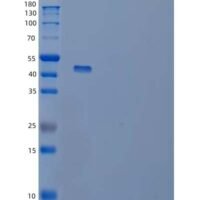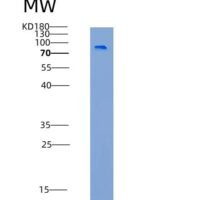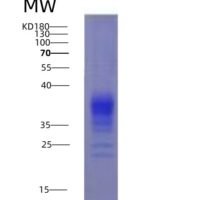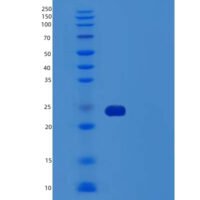
Function
Constant region of immunoglobulin (Ig) heavy chains. Igs are membrane-bound or secreted glycoproteins produced by B lymphocytes. In the recognition phase of humoral immunity, the membrane-bound Igs serve as receptors, which upon binding to a specific antigen trigger the clonal expansion and differentiation of B lymphocytes into Ig-secreting plasma cells.
Biological Context
Subcellular Location: Cell membrane (Single-pass membrane protein)
Disease Association: Multiple myeloma (MM) : A malignant tumor of plasma cells usually arising in the bone marrow and characterized by diffuse involvement of the skeletal system, hyperglobulinemia, Bence-Jones proteinuria and anemia. Complications of multiple myeloma are bone pain, hypercalcemia, renal failure and spinal cord compression. The aberrant antibodies that are produced lead to impaired humoral immunity and patients have a high prevalence of infection. Amyloidosis may develop in some patients. Multiple myeloma is part of a spectrum of diseases ranging from monoclonal gammopathy of unknown significance (MGUS) to plasma cell leukemia. [The disease is caused by variants affecting the gene represented in this entry. A chromosomal aberration involving IGHG1 is found in multiple myeloma. Translocation t(11;14)(q13;q32) with the IgH locus. Translocation t(11;14)(q13;q32) with CCND1; translocation t(4;14)(p16.3;q32.3) with FGFR3; translocation t(6;14)(p25;q32) with IRF4]
Product Specifications
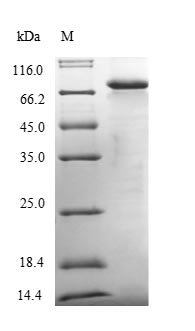
Recombinant Human Ig gamma-1 chain C region (IGHG1) is a recombinant protein from Homo sapiens (Human), expressed in E.coli, covering amino acids 1-479aa, with N-terminal 6xHis-SUMO-tagged tag, molecular weight 68.5kDa, purity Greater than 85% as determined by SDS-PAGE.. Suitable for ELISA and Western Blot applications.