,

Recombinant Human Cytochrome c oxidase subunit 1 (MT-CO1), partial

Recombinant Human Cytochrome c oxidase subunit 1 (MT-CO1), partial — Component of the cytochrome c oxidase, the last enzyme in the mitochondrial electron transport chain which drives oxidative phosphorylation. Purity >85%.

SKU: BCRECP-001190 Categories: ,

Product Specifications

Product SkuBCRECP-001190
Product DescriptionRecombinant Human Cytochrome c oxidase subunit 1 (MT-CO1) Protein is expressed from E.coli with N-terminal 6xHis-GST-tagged. It contains 474-513aa. [Accession | P00395].
Uniprot No.P00395
Gene NamesMT-CO1
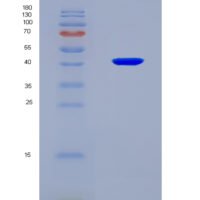
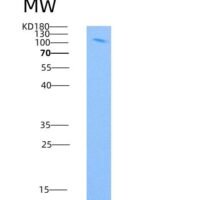
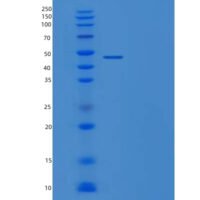
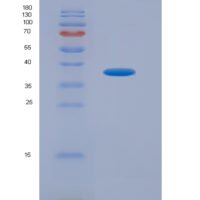
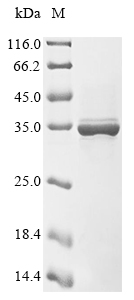
PurityGreater than 85% as determined by SDS-PAGE.
Expression SystemE.coli
Expression Region474-513aa
SpeciesHomo sapiens (Human)
Tag InfoN-terminal 6xHis-GST-tagged
Molecular weight36.3kDa
ActivityPlease contact us to obtain bioactivity data.
BufferIf the delivery form is liquid, the default storage buffer is Tris/PBS-based buffer, 5%-50% glycerol. If the delivery form is lyophilized powder, the buffer before lyophilization is Tris/PBS-based buffer, 6% Trehalose.
StorageStore at -20°C/-80°C upon receipt, aliquoting is necessary for mutiple use. Avoid repeated freeze-thaw cycles.
Research AreasOthers

Function

Component of the cytochrome c oxidase, the last enzyme in the mitochondrial electron transport chain which drives oxidative phosphorylation. The respiratory chain contains 3 multisubunit complexes succinate dehydrogenase (complex II, CII), ubiquinol-cytochrome c oxidoreductase (cytochrome b-c1 complex, complex III, CIII) and cytochrome c oxidase (complex IV, CIV), that cooperate to transfer electrons derived from NADH and succinate to molecular oxygen, creating an electrochemical gradient over the inner membrane that drives transmembrane transport and the ATP synthase. Cytochrome c oxidase is the component of the respiratory chain that catalyzes the reduction of oxygen to water.

Biological Context

Subcellular Location: Mitochondrion inner membrane (Multi-pass membrane protein)
Disease Association: Leber hereditary optic neuropathy (LHON) : A maternally inherited form of Leber hereditary optic neuropathy, a mitochondrial disease resulting in bilateral painless loss of central vision due to selective degeneration of the retinal ganglion cells and their axons. The disorder shows incomplete penetrance and male predominance. Cardiac conduction defects and neurological defects have also been described in some LHON patients. LHON results from primary mitochondrial DNA mutations affecting the respiratory chain complexes. [The disease is caused by variants affecting the gene represented in this entry] | [MT-CO1 may play a role in the pathogenesis of acquired idiopathic sideroblastic anemia, a disease characterized by inadequate formation of heme and excessive accumulation of iron in mitochondria. Mitochondrial iron overload may be attributable to mutations of mitochondrial DNA because these can cause respiratory chain dysfunction, thereby impairing reduction of ferric iron to ferrous iron. The reduced form of iron is essential to the last step of mitochondrial heme biosynthesis] | Mitochondrial complex IV deficiency (MT-C4D) : A disorder of the mitochondrial respiratory chain with heterogeneous clinical manifestations, ranging from isolated myopathy to severe multisystem disease affecting several tissues and organs. Features include hypertrophic cardiomyopathy, hepatomegaly and liver dysfunction, hypotonia, muscle weakness, exercise intolerance, developmental delay, delayed motor development and intellectual disability. Some affected individuals manifest a fatal hypertrophic cardiomyopathy resulting in neonatal death. A subset of patients manifest Leigh syndrome. [The disease is caused by variants affecting the gene represented in this entry] | Recurrent myoglobinuria mitochondrial (RM-MT) : Recurrent myoglobinuria is characterized by recurrent attacks of rhabdomyolysis (necrosis or disintegration of skeletal muscle) associated with muscle pain and weakness, and followed by excretion of myoglobin in the urine. [The gene represented in this entry may be involved in disease pathogenesis] | Deafness, sensorineural, mitochondrial (DFNM) : A form of non-syndromic deafness with maternal inheritance. Affected individuals manifest progressive, postlingual, sensorineural hearing loss involving high frequencies. [The disease is caused by variants affecting the gene represented in this entry] | Colorectal cancer (CRC) : A complex disease characterized by malignant lesions arising from the inner wall of the large intestine (the colon) and the rectum. Genetic alterations are often associated with progression from premalignant lesion (adenoma) to invasive adenocarcinoma. Risk factors for cancer of the colon and rectum include colon polyps, long-standing ulcerative colitis, and genetic family history. [The gene represented in this entry may be involved in disease pathogenesis]
Pathway: Energy metabolism; oxidative phosphorylation

Product Specifications

Recombinant Human Cytochrome c oxidase subunit 1 (MT-CO1), partial is a recombinant protein from Homo sapiens (Human), expressed in E.coli, covering amino acids 474-513aa, with N-terminal 6xHis-GST-tagged tag, molecular weight 36.3kDa, purity Greater than 85% as determined by SDS-PAGE.. Suitable for ELISA and Western Blot applications.

SDS-PAGE: Single band at expected molecular weight confirming purity.

ELISA: Suitable as coating antigen or detection standard.

Western Blot: Compatible with standard Western Blot protocols.

Protein Interaction: Validated for SPR (Surface Plasmon Resonance) and BLI (Bio-Layer Interferometry) studies.

Shipping: Shipped at ambient temperature. Lyophilized protein is stable during transit.

Storage: Store lyophilized protein at -20°C to -80°C. Reconstituted protein should be aliquoted and stored at -80°C. Avoid repeated freeze-thaw cycles.

Shelf Life: 12 months from date of receipt when stored as recommended.

Shipping Time: Orders placed before 2 PM EST ship same day. International orders typically deliver within 5-10 business days.

Protein Biology

Function

Component of the cytochrome c oxidase, the last enzyme in the mitochondrial electron transport chain which drives oxidative phosphorylation. The respiratory chain contains 3 multisubunit complexes succinate dehydrogenase (complex II, CII), ubiquinol-cytochrome c oxidoreductase (cytochrome b-c1 complex, complex III, CIII) and cytochrome c oxidase (complex IV, CIV), that cooperate to transfer electrons derived from NADH and succinate to molecular oxygen, creating an electrochemical gradient over the inner membrane that drives transmembrane transport and the ATP synthase. Cytochrome c oxidase is the component of the respiratory chain that catalyzes the reduction of oxygen to water. Electrons originating from reduced cytochrome c in the intermembrane space (IMS) are transferred via the dinuclear copper A center (CU(A)) of subunit 2 and heme A of subunit 1 to the active site in subunit 1, a binuclear center (BNC) formed by heme A3 and copper B (CU(B)). The BNC reduces molecular oxygen to 2 water molecules using 4 electrons from cytochrome c in the IMS and 4 protons from the mitochondrial matrix

Subcellular Location

Mitochondrion inner membrane (Multi-pass membrane protein)

Disease Association

Leber hereditary optic neuropathy (LHON) : A maternally inherited form of Leber hereditary optic neuropathy, a mitochondrial disease resulting in bilateral painless loss of central vision due to selective degeneration of the retinal ganglion cells and their axons. The disorder shows incomplete penetrance and male predominance. Cardiac conduction defects and neurological defects have also been described in some LHON patients. LHON results from primary mitochondrial DNA mutations affecting the respiratory chain complexes. [The disease is caused by variants affecting the gene represented in this entry] | [MT-CO1 may play a role in the pathogenesis of acquired idiopathic sideroblastic anemia, a disease characterized by inadequate formation of heme and excessive accumulation of iron in mitochondria. Mitochondrial iron overload may be attributable to mutations of mitochondrial DNA because these can cause respiratory chain dysfunction, thereby impairing reduction of ferric iron to ferrous iron. The reduced form of iron is essential to the last step of mitochondrial heme biosynthesis] | Mitochondrial complex IV deficiency (MT-C4D) : A disorder of the mitochondrial respiratory chain with heterogeneous clinical manifestations, ranging from isolated myopathy to severe multisystem disease affecting several tissues and organs. Features include hypertrophic cardiomyopathy, hepatomegaly and liver dysfunction, hypotonia, muscle weakness, exercise intolerance, developmental delay, delayed motor development and intellectual disability. Some affected individuals manifest a fatal hypertrophic cardiomyopathy resulting in neonatal death. A subset of patients manifest Leigh syndrome. [The disease is caused by variants affecting the gene represented in this entry] | Recurrent myoglobinuria mitochondrial (RM-MT) : Recurrent myoglobinuria is characterized by recurrent attacks of rhabdomyolysis (necrosis or disintegration of skeletal muscle) associated with muscle pain and weakness, and followed by excretion of myoglobin in the urine. [The gene represented in this entry may be involved in disease pathogenesis] | Deafness, sensorineural, mitochondrial (DFNM) : A form of non-syndromic deafness with maternal inheritance. Affected individuals manifest progressive, postlingual, sensorineural hearing loss involving high frequencies. [The disease is caused by variants affecting the gene represented in this entry] | Colorectal cancer (CRC) : A complex disease characterized by malignant lesions arising from the inner wall of the large intestine (the colon) and the rectum. Genetic alterations are often associated with progression from premalignant lesion (adenoma) to invasive adenocarcinoma. Risk factors for cancer of the colon and rectum include colon polyps, long-standing ulcerative colitis, and genetic family history. [The gene represented in this entry may be involved in disease pathogenesis]

Subunit

Component of the cytochrome c oxidase (complex IV, CIV), a multisubunit enzyme composed of 14 subunits. The complex is composed of a catalytic core of 3 subunits MT-CO1, MT-CO2 and MT-CO3, encoded in the mitochondrial DNA, and 11 supernumerary subunits COX4I1 (or COX4I2), COX5A, COX5B, COX6A1 (or COX6A2), COX6B1 (or COX6B2), COX6C, COX7A2 (or COX7A1), COX7B, COX7C, COX8A and COXFA4, which are encoded in the nuclear genome (PubMed:30030519). The complex exists as a monomer or a dimer and forms supercomplexes (SCs) in the inner mitochondrial membrane with NADH-ubiquinone oxidoreductase (complex I, CI) and ubiquinol-cytochrome c oxidoreductase (cytochrome b-c1 complex, complex III, CIII), resulting in different assemblies (supercomplex SCI(1)III(2)IV(1) and megacomplex MCI(2)III(2)IV(2)) (PubMed:28844695). As a newly synthesized protein, rapidly incorporates into a multi-subunit assembly intermediate in the inner membrane, called MITRAC (mitochondrial translation regulation assembly intermediate of cytochrome c oxidase) complex, whose core components are COA3/MITRAC12 and COX14. Within the MITRAC complex, interacts with COA3 and with SMIM20/MITRAC7; the interaction with SMIM20 stabilizes the newly synthesized MT-CO1 and prevents its premature turnover (PubMed:26321642). Interacts with TMEM177 in a COX20-dependent manner (PubMed:29154948)

Pathway

Energy metabolism; oxidative phosphorylation

Gene: MT-CO1  |  Organism: Homo sapiens  |  Synonyms: Cytochrome c oxidase polypeptide I
Key Publications

Frequently Asked Questions

How do I order or inquire about this product?

Fill out the Online Inquiry form with your required quantity and specifications. You can also email sales@biocrestsci.com. Our team typically responds within 4 business hours with a quote and availability confirmation.

What is the shipping and delivery time?

Orders placed before 2 PM EST ship the same day. Domestic (US) delivery typically takes 2-3 business days. International orders deliver within 5-10 business days. All products are shipped at ambient temperature with appropriate packaging to ensure stability.

How should I store this recombinant protein?

Lyophilized proteins should be stored at -20°C to -80°C upon receipt. After reconstitution, aliquot and store at -80°C. Avoid repeated freeze-thaw cycles. Shelf life is 12 months from date of receipt when stored as recommended.

What quality controls are performed on your products?

Each product undergoes SDS-PAGE purity analysis (typically >85-95%), endotoxin testing, and bioactivity validation. Products are validated for ELISA, Western Blot, and SPR/BLI applications as specified on this product page. A Certificate of Analysis (CoA) is available upon request.

Shopping Cart
Scroll to Top